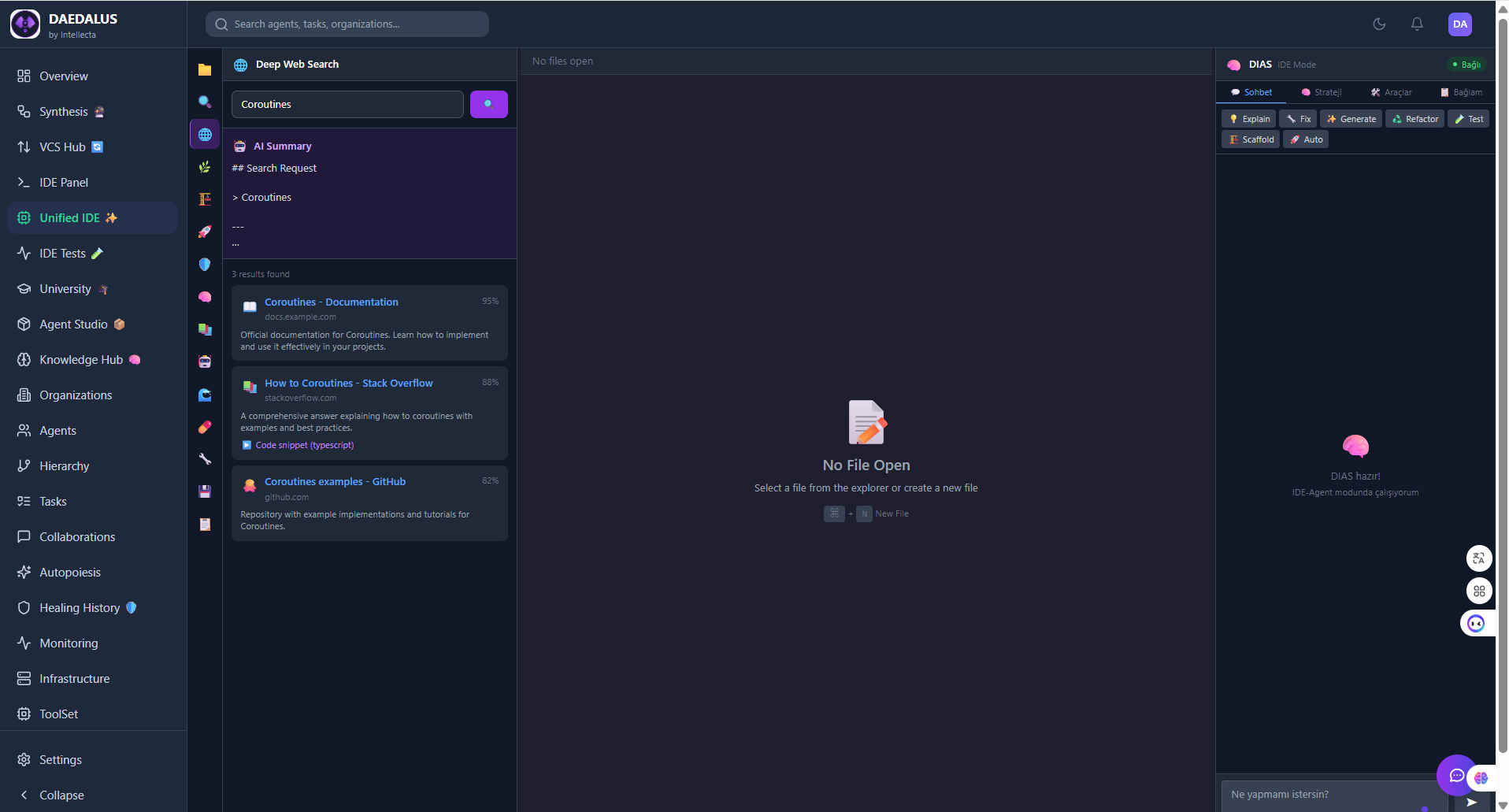
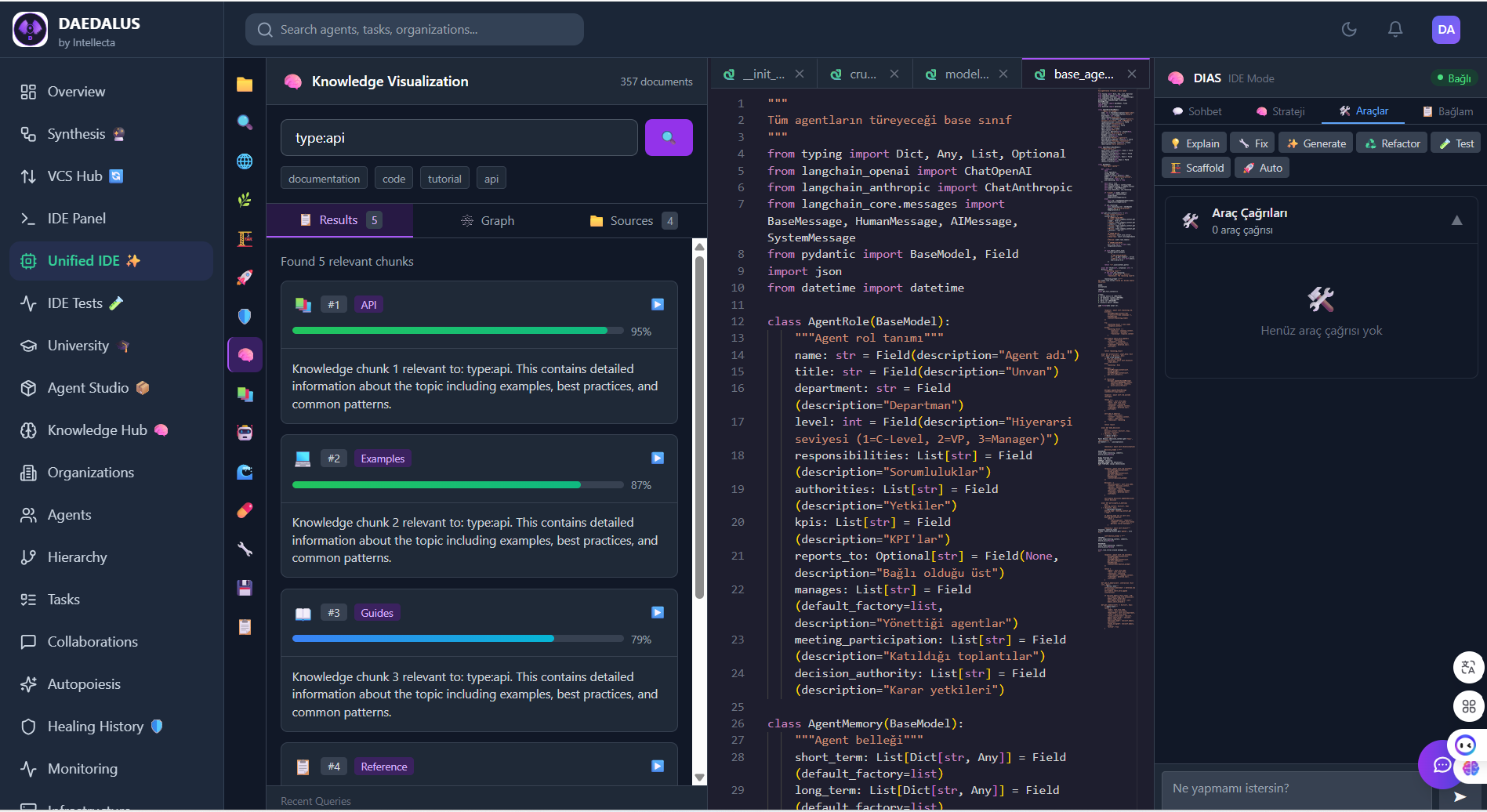
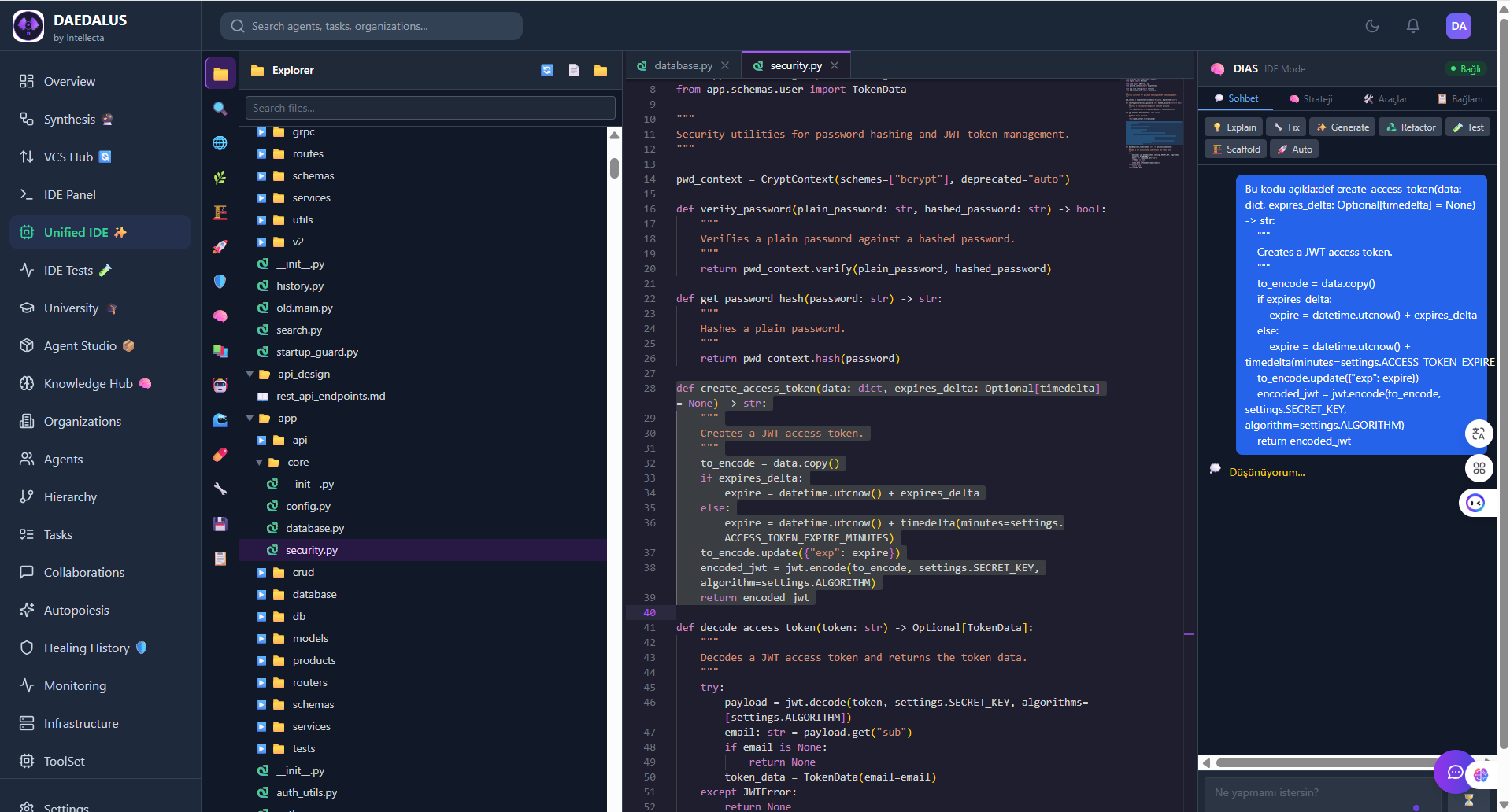
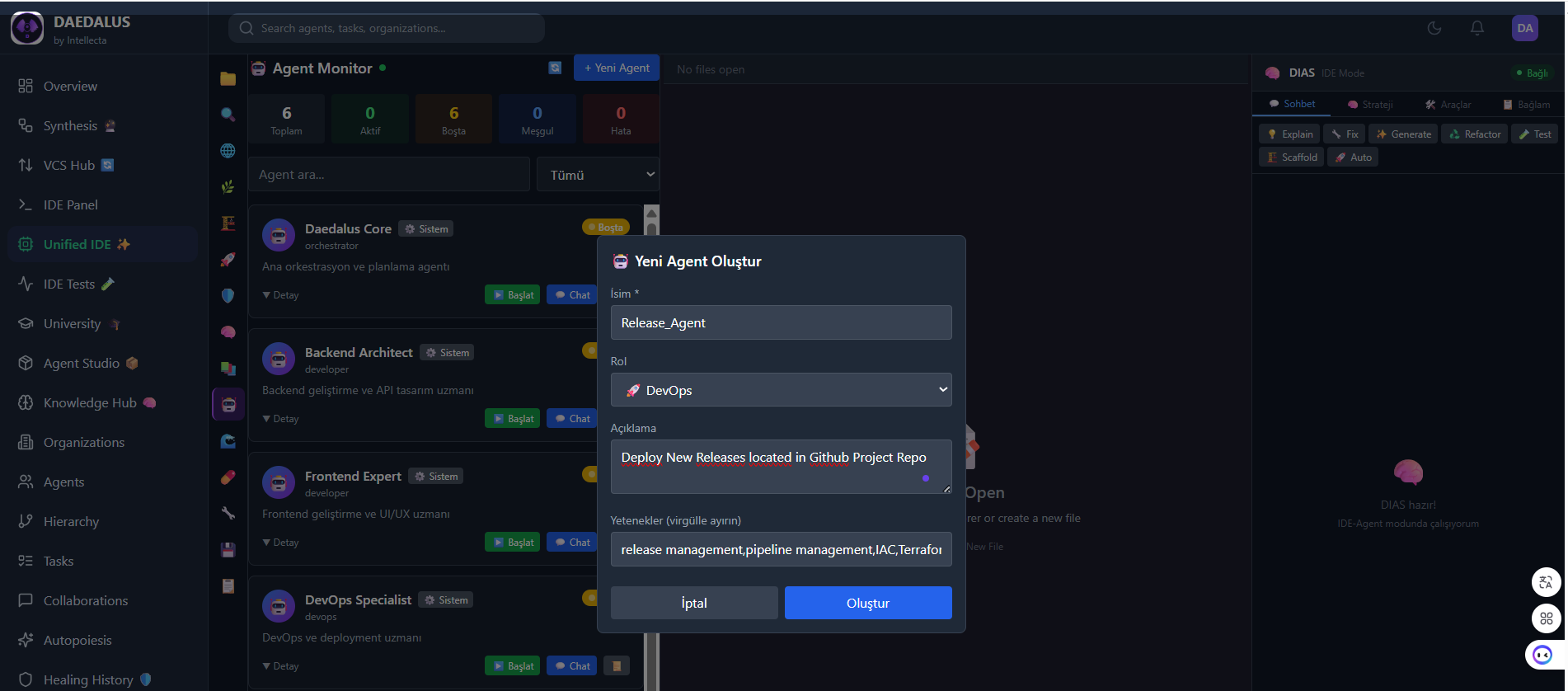
Daedalus Autonomous Agent Platform

Daedalus LogoDAEDALUS

"The Master Architect of Autonomous Organizations"

Create, orchestrate, and manage self-healing, self-improving AI agents with cognitive reasoning capabilities. DAEDALUS builds intelligent systems that think, adapt, and evolve autonomously.

Built on Patent-Pending Autopoietic Architecture (TR 2026/005340)
Autopoietic
Self-Healing
Autonomous
Orchestration

Three Powerful Modes

DAEDALUS operates in three distinct modes, each designed for specific workflows and use cases.

Task-Agent Mode

Multi-agent orchestration for complex tasks

Task Agent Mode
  • Automatic task decomposition
  • Smart agent assignment
  • Flow-based execution
  • Real-time collaboration
Learn More

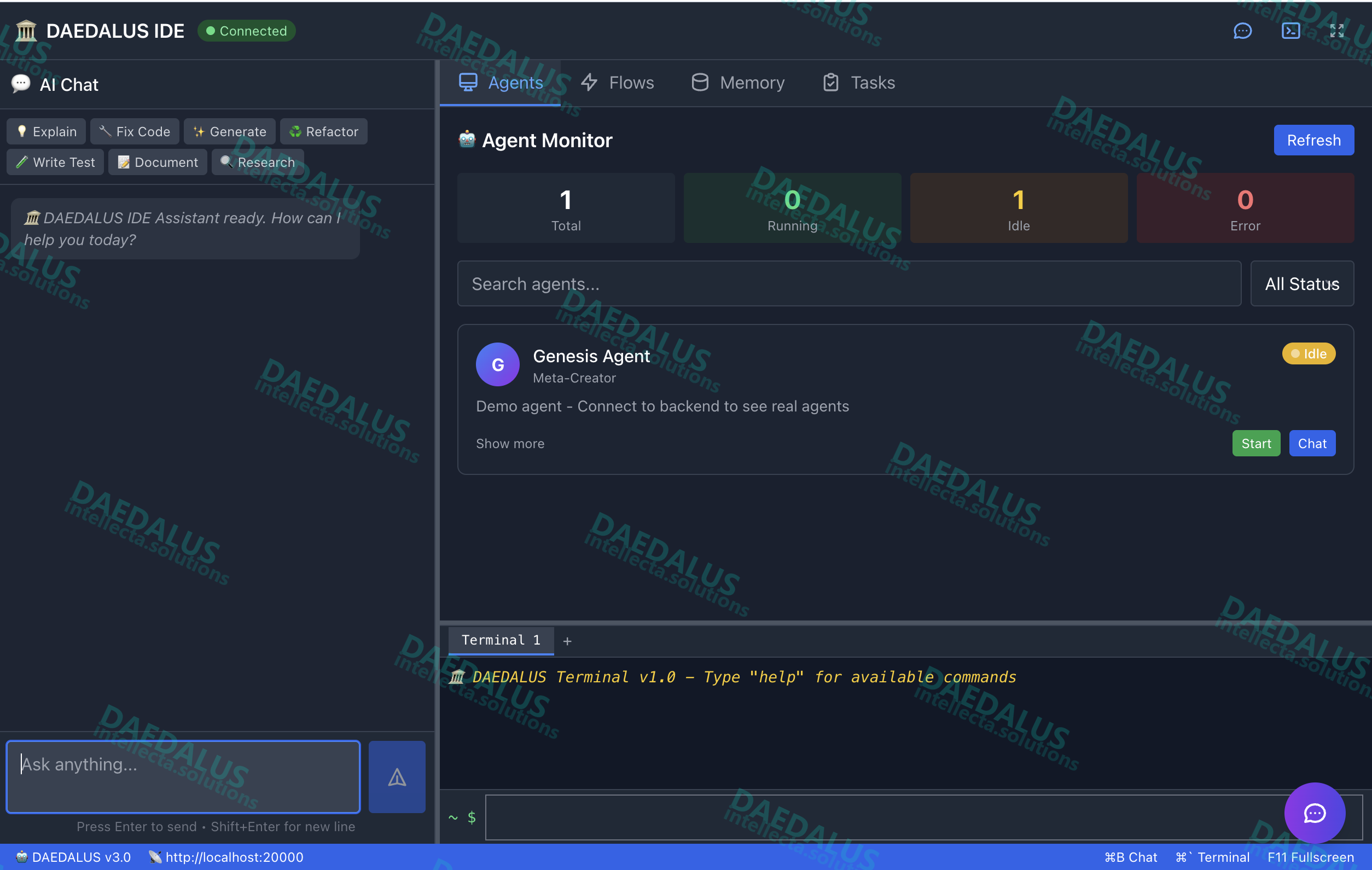
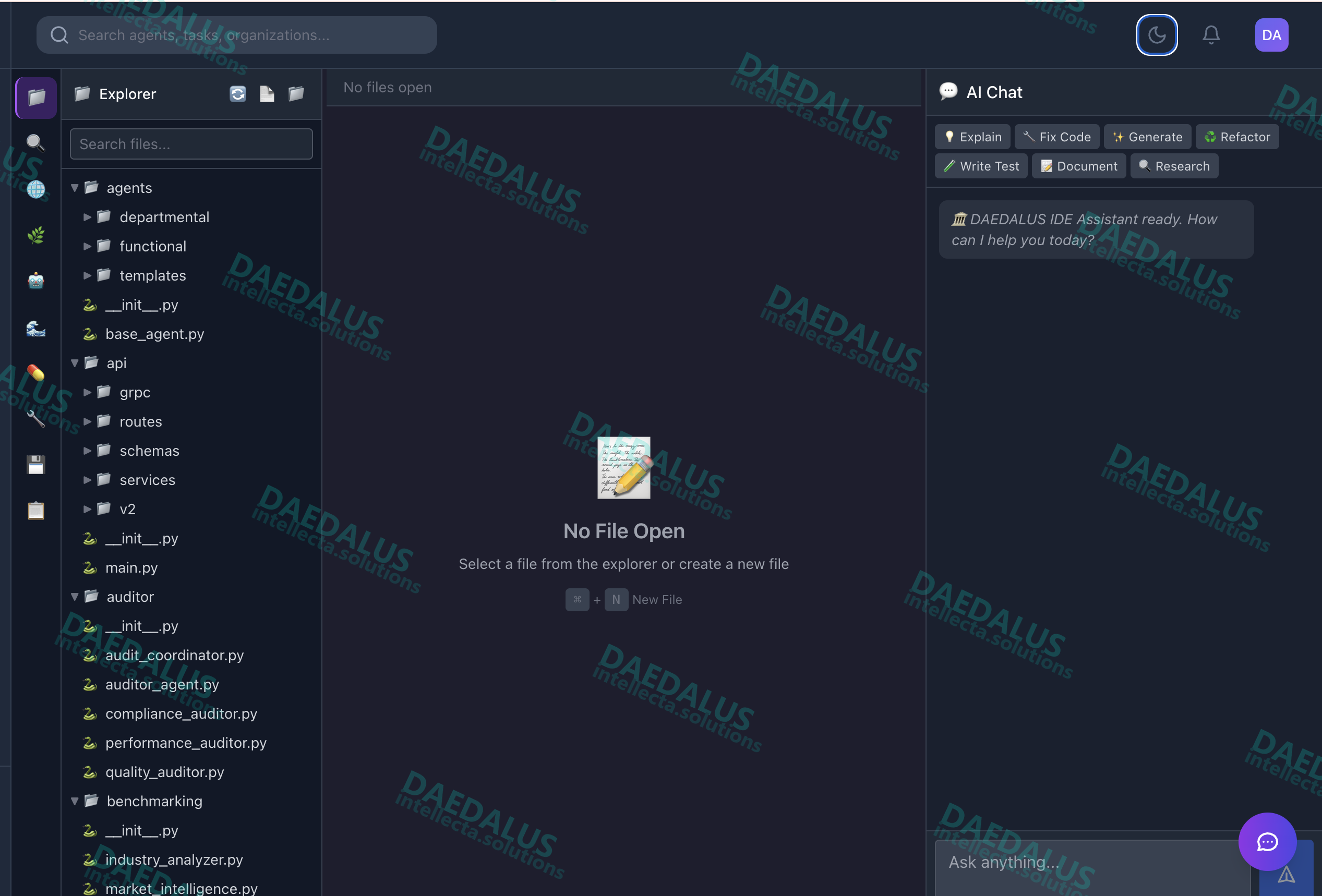
IDE-Agentic Mode

Full-stack development with AI scaffolding

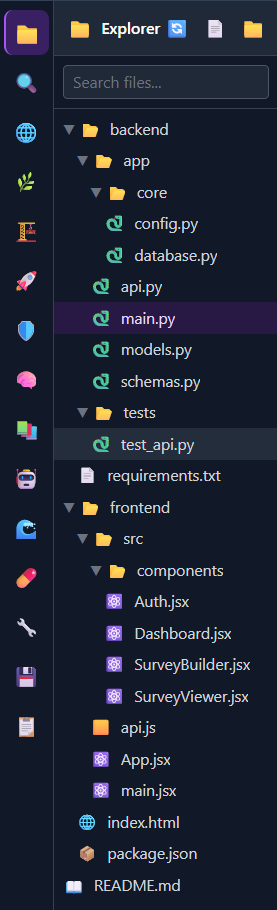
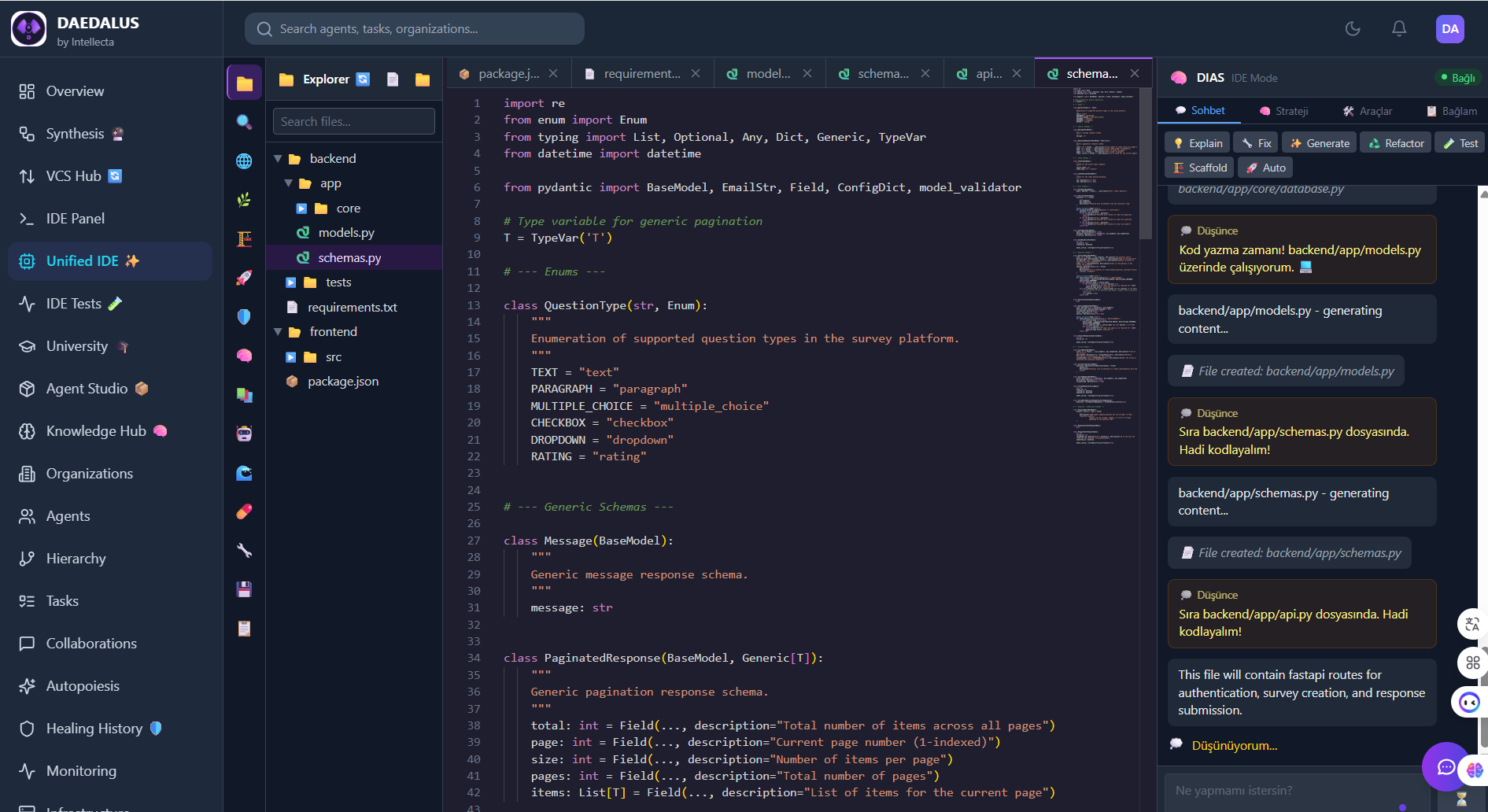
IDE Agentic Mode
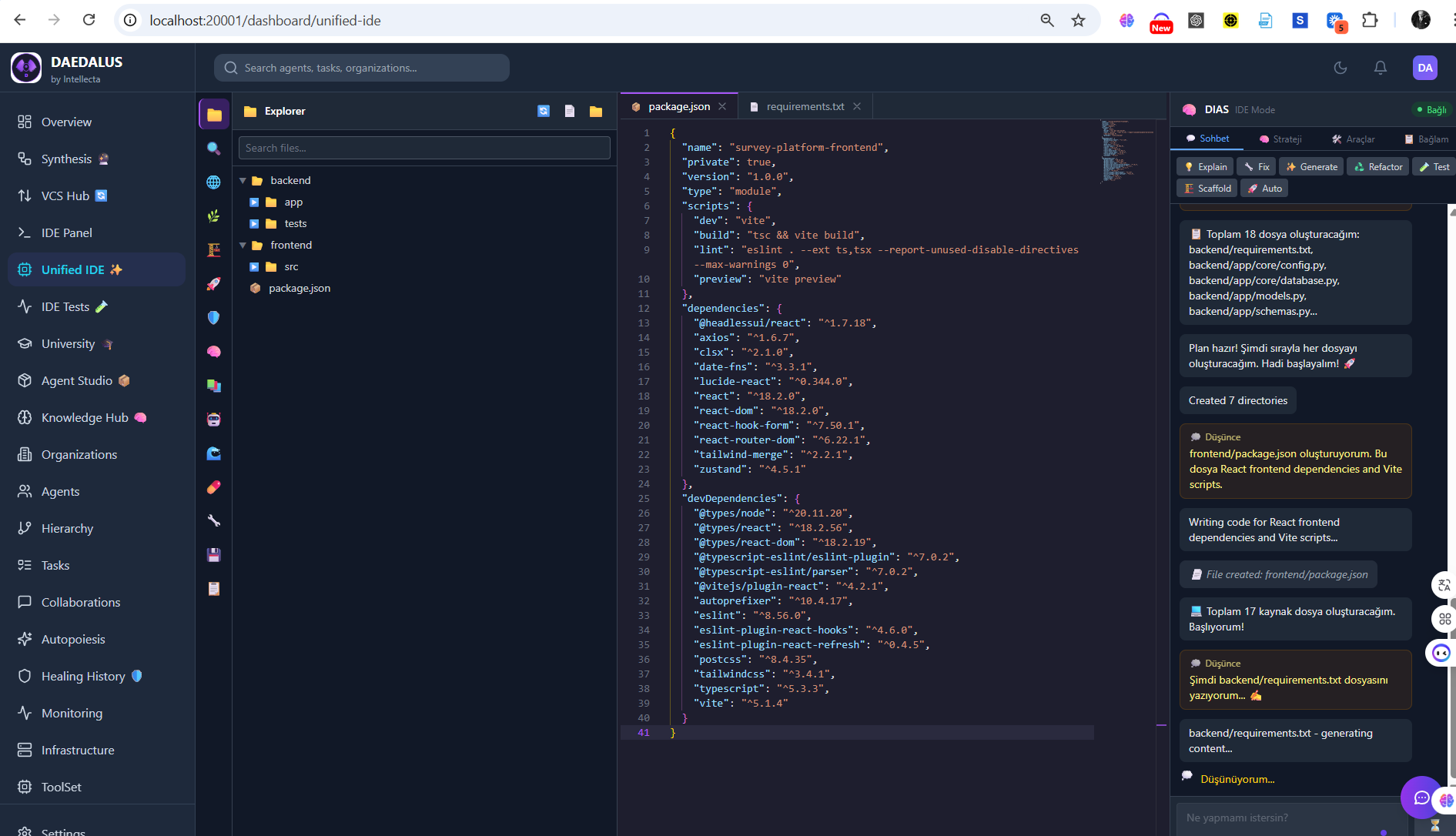
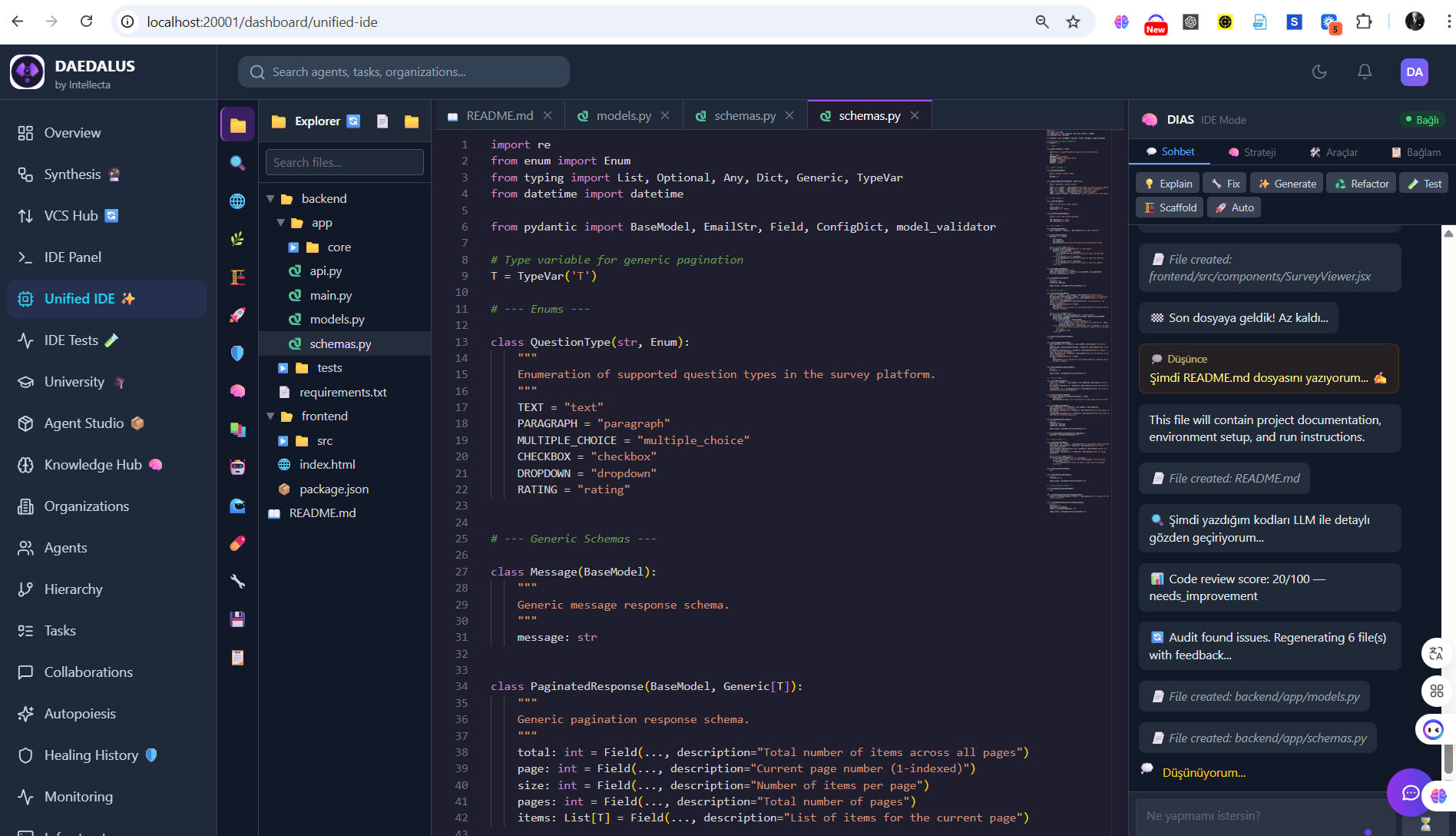
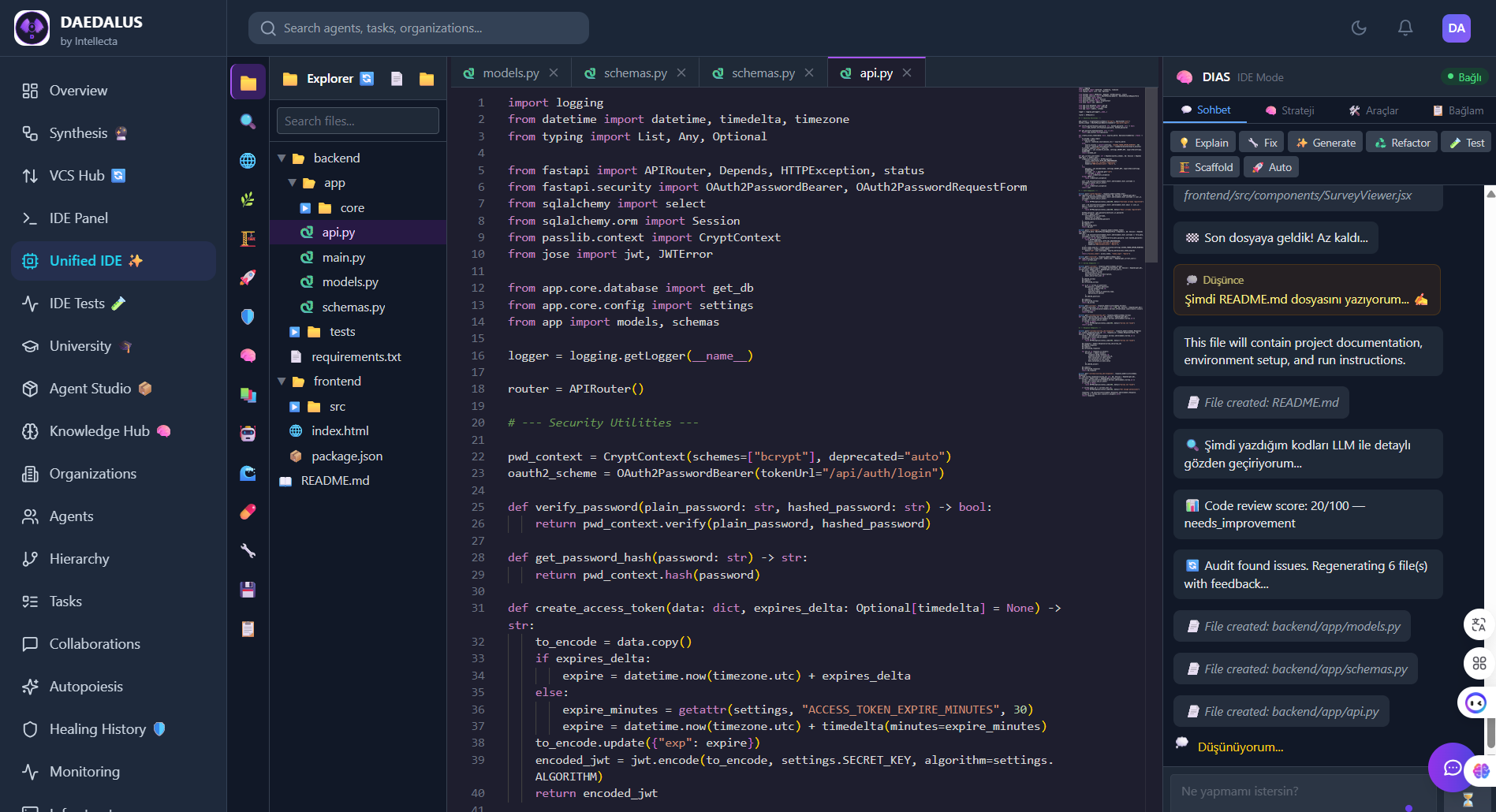
  • Monaco-based code editor
  • Ghost text completions
  • Inline edit widgets
  • Git integration
Learn More

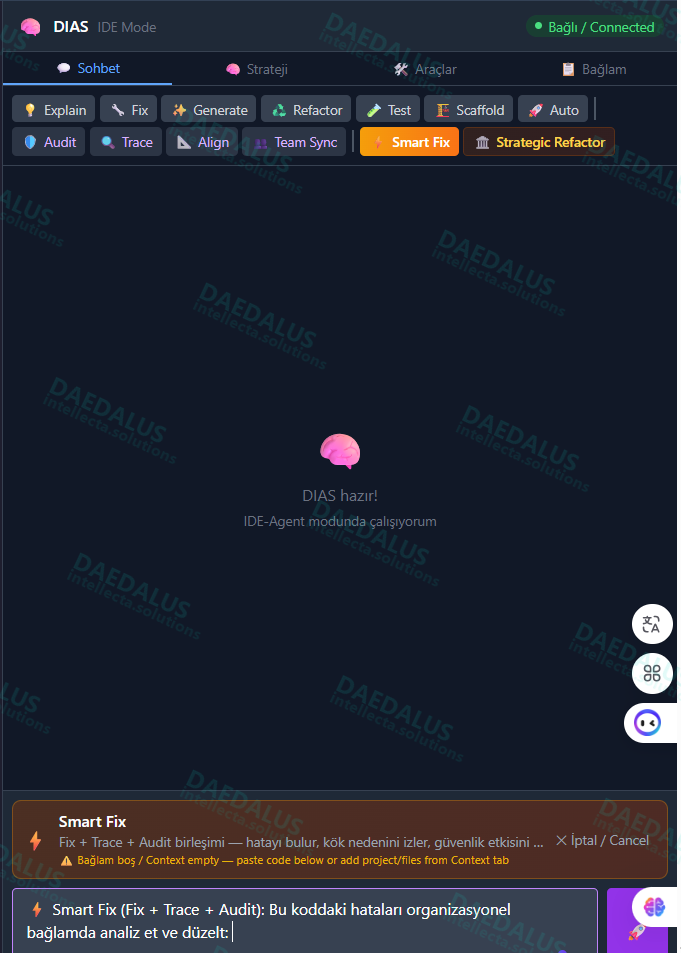
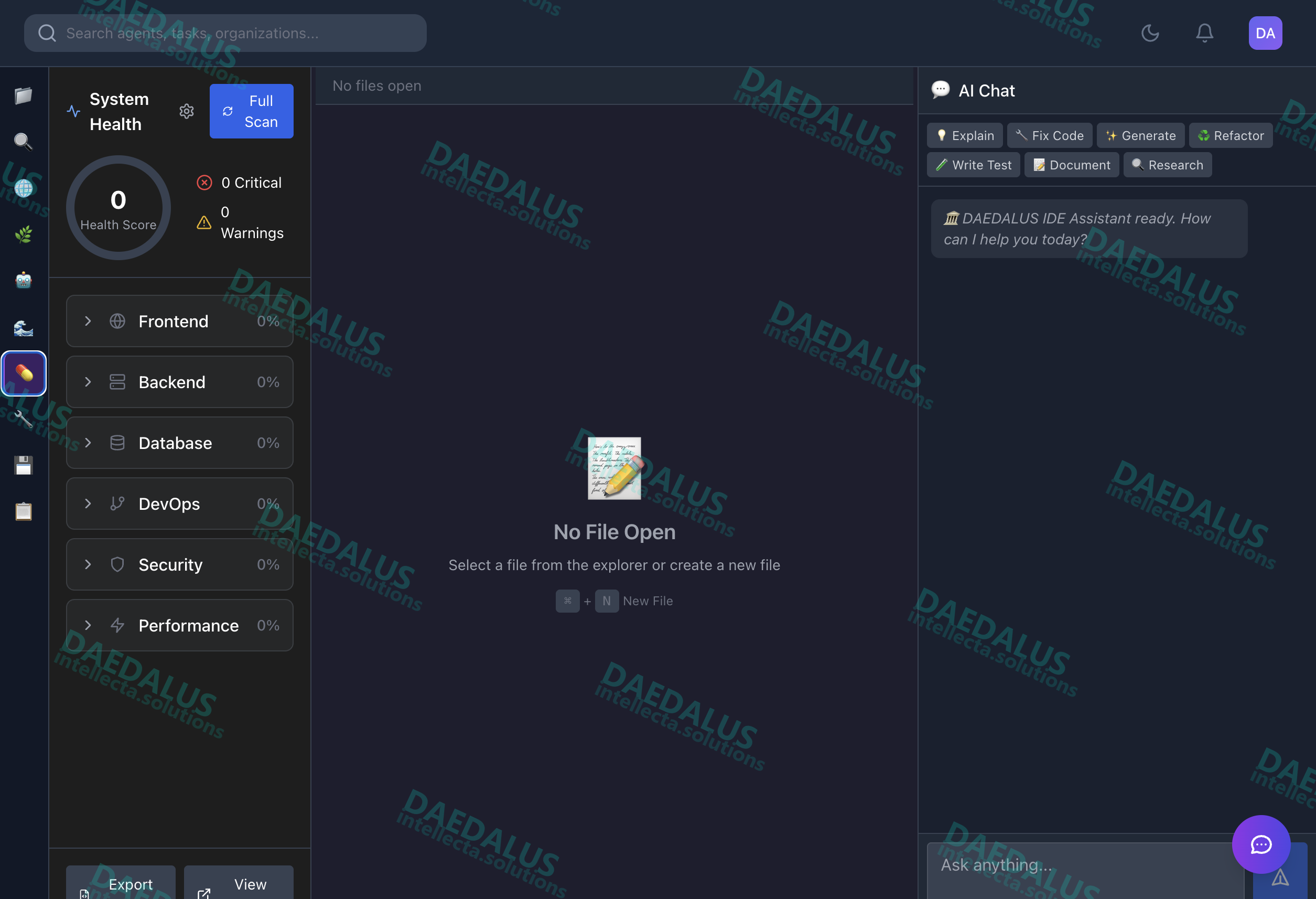
DIAS Mode

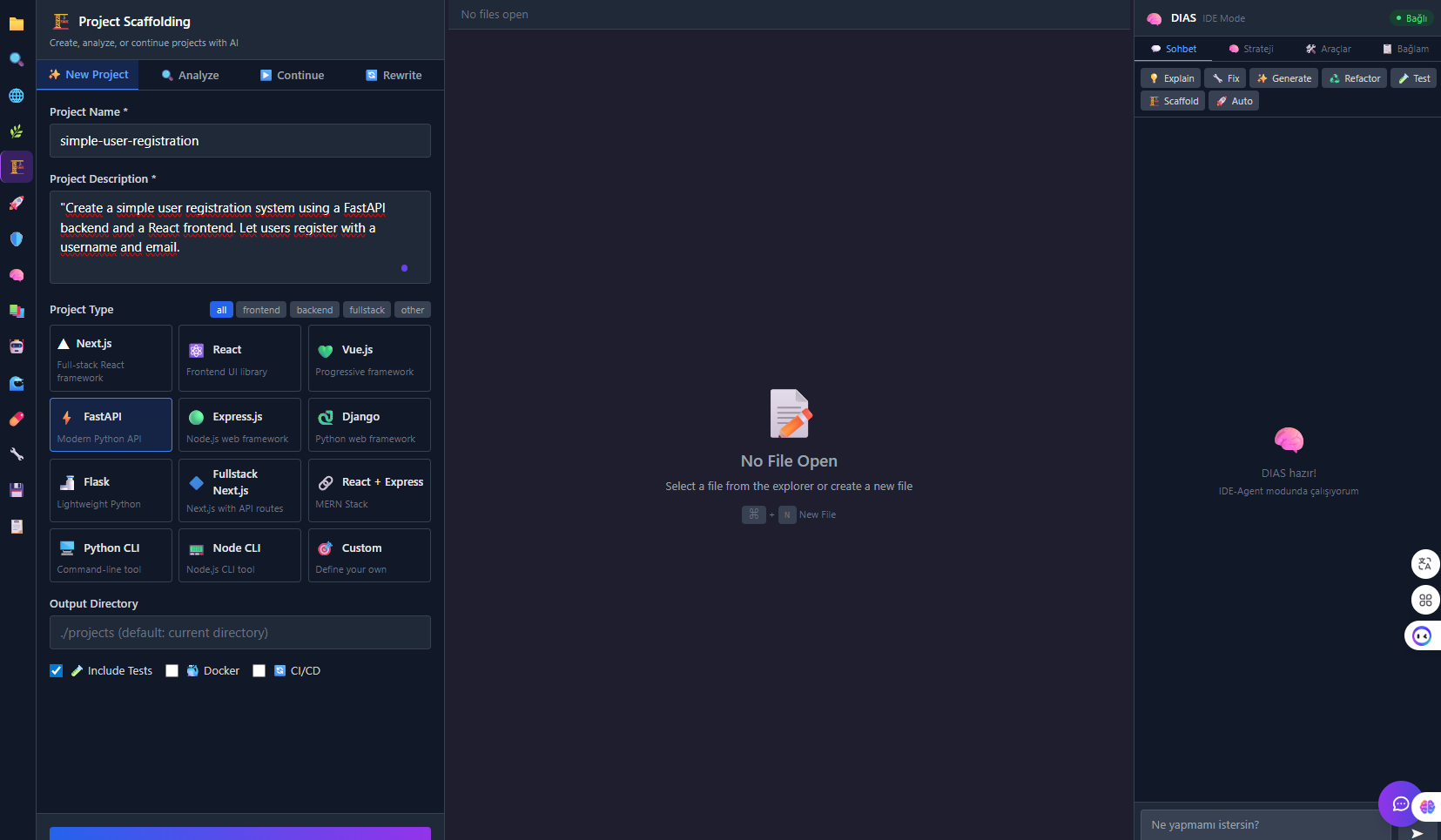
DIAS — Dynamic Intelligent Analysis System

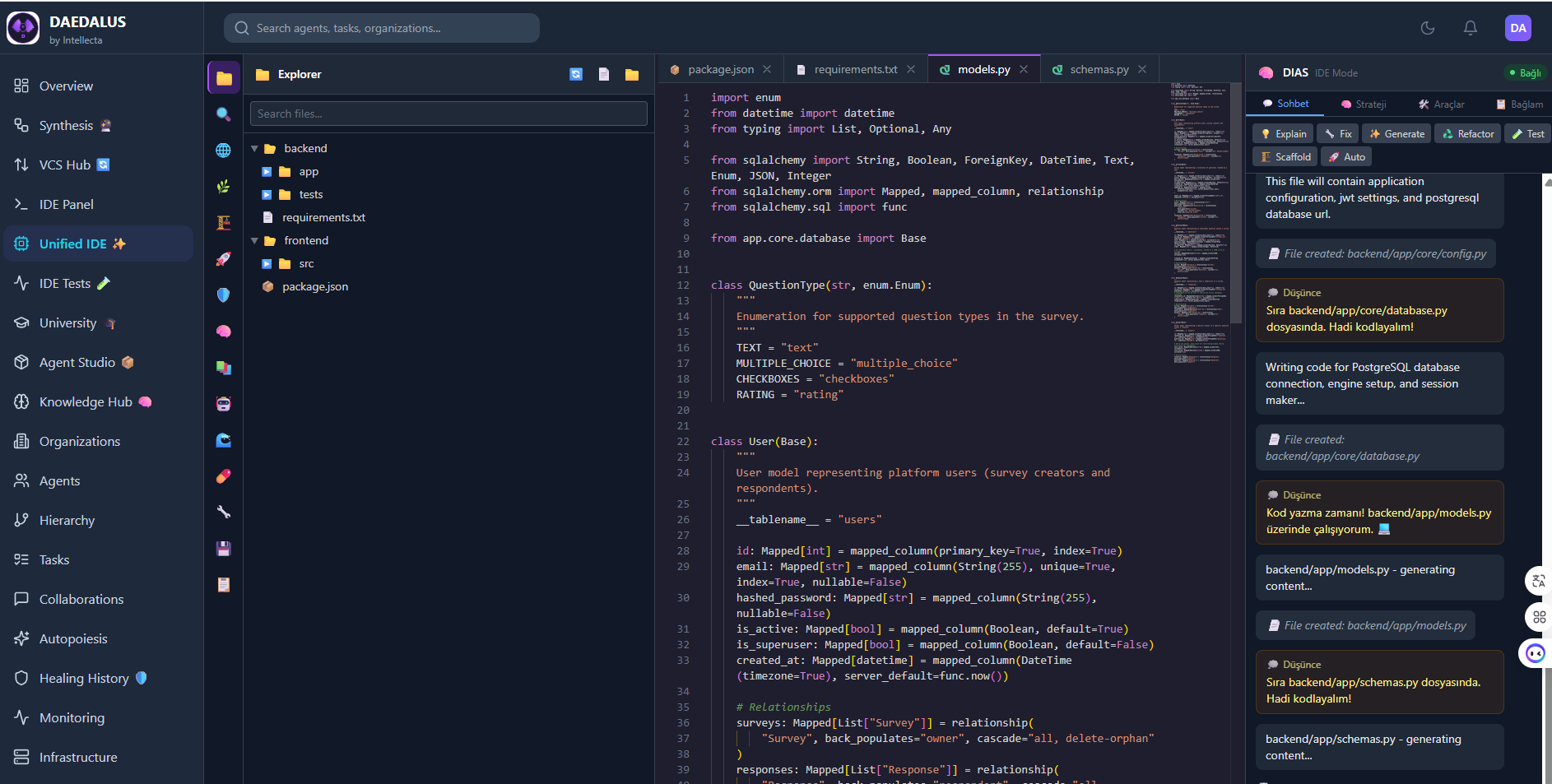
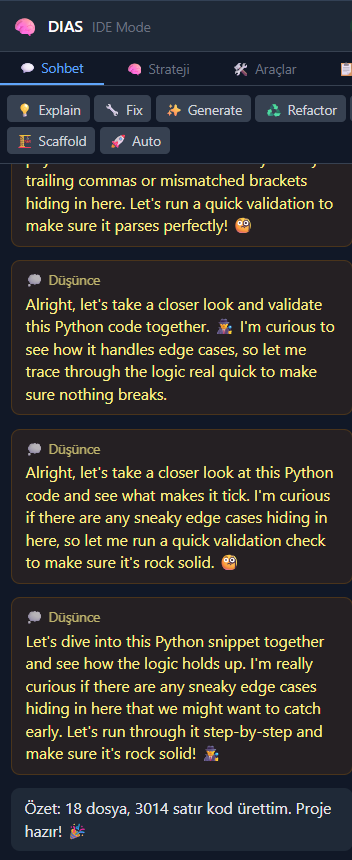
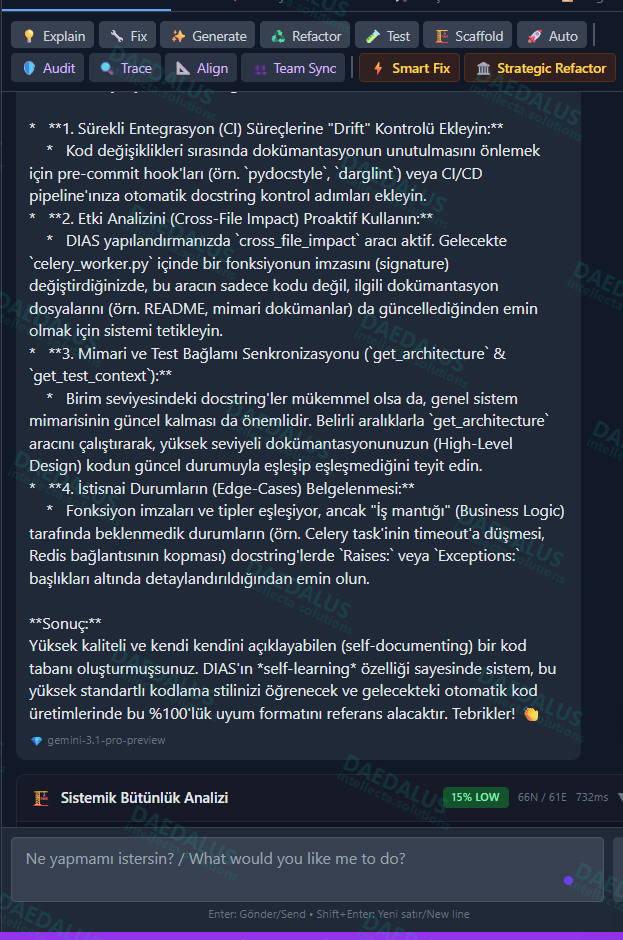
DIAS Mode Dashboard
  • Contextual understanding
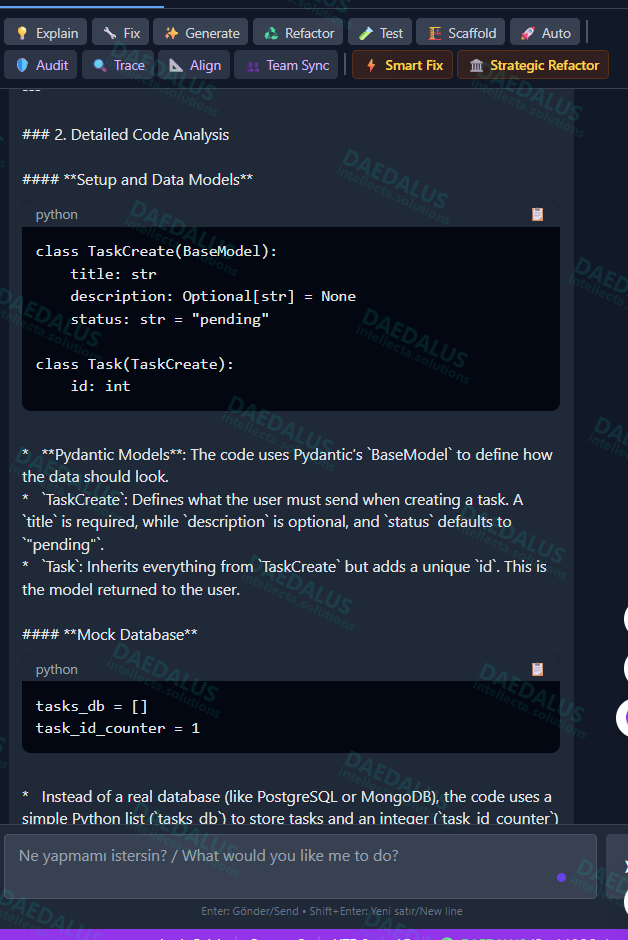
  • Code explanation
  • Quick actions (Fix, Refactor)
  • Documentation generation
Learn More
Beyond Automation

An agent that creates not only agents,
but also your entire organization.

Daedalus goes beyond task automation. It analyzes, blueprints, and constructs living agentic organizations — complete with self-evolving agents, knowledge synthesis, and strategic transformation roadmaps.

Explore: Build Intelligence-First Organizations
Synthesis Module

From Vision to Execution:
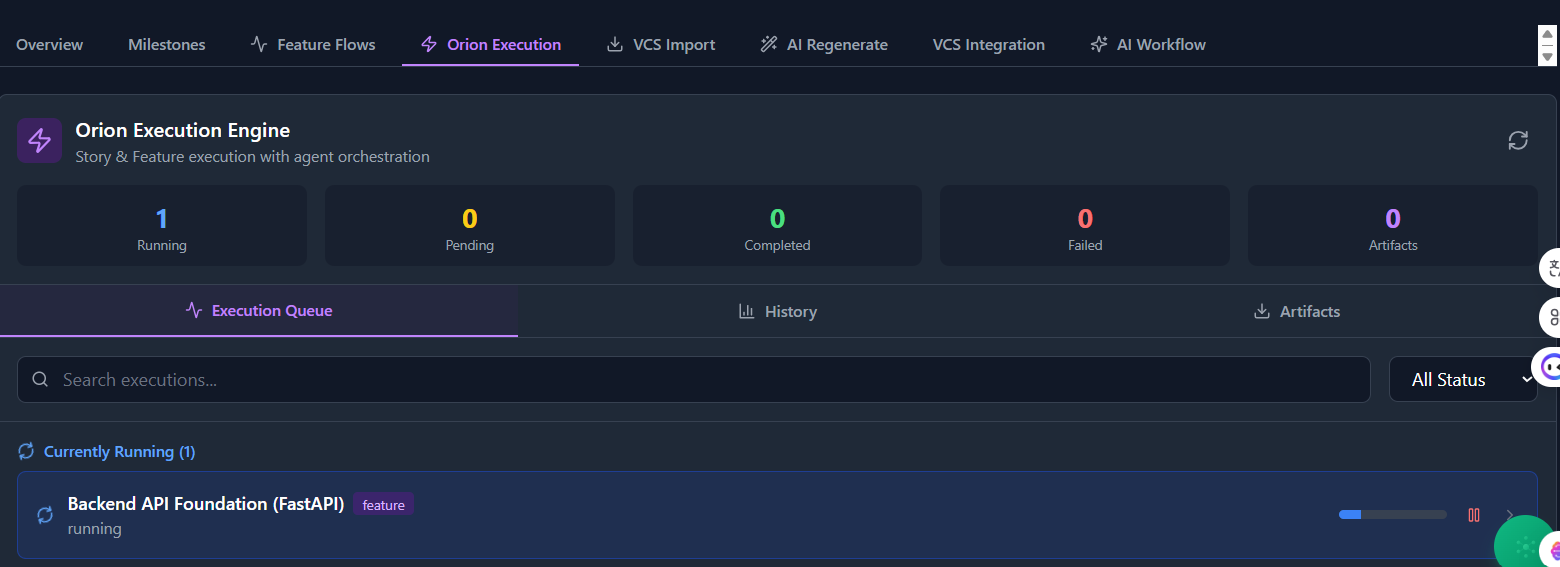
Auto-Decompose, Orchestrate & Ship with Orion.

Synthesis transforms high-level business goals into structured Programs, Epics, Milestones, Stories & Tasks — then Orion Execution autonomously assigns agents, executes flows, and delivers production-ready artifacts with full VCS integration.

DAEDALUS • Intellecta
Explore: Synthesis & Orion Execution

Cognitive Architecture

DAEDALUS combines multiple AI paradigms into a unified, self-evolving system.

Autopoietic

Self-producing agents that maintain and evolve autonomously

Reasoning Engine

Multi-strategy reasoning with deductive, inductive, and causal logic

Cognitive Profiles

Customizable thinking modes and problem-solving approaches

Self-Learning

Experience-based pattern recognition and adaptation

Self-Healing

Automatic error detection and recovery mechanisms

Multi-Agent

Coordinated agent swarms for complex problem solving

Core Capabilities

Enterprise-grade features for autonomous agent orchestration

Agent Creator

Create specialized AI agents with custom personalities, skills, and cognitive profiles using our intuitive wizard interface.

Agent Creator
Visual Builder Templates

Daedalus: Intelligence that evolves itself.

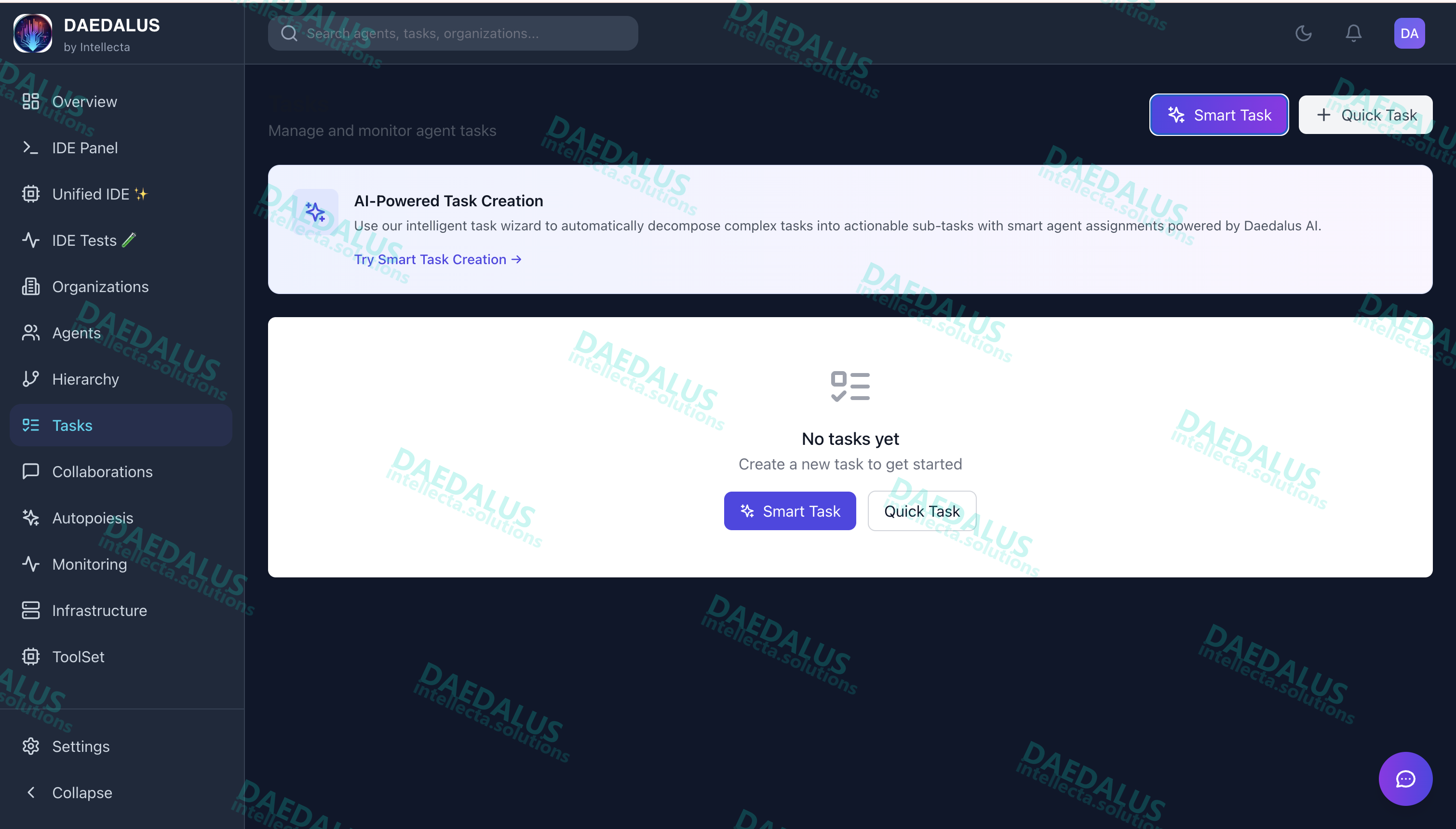
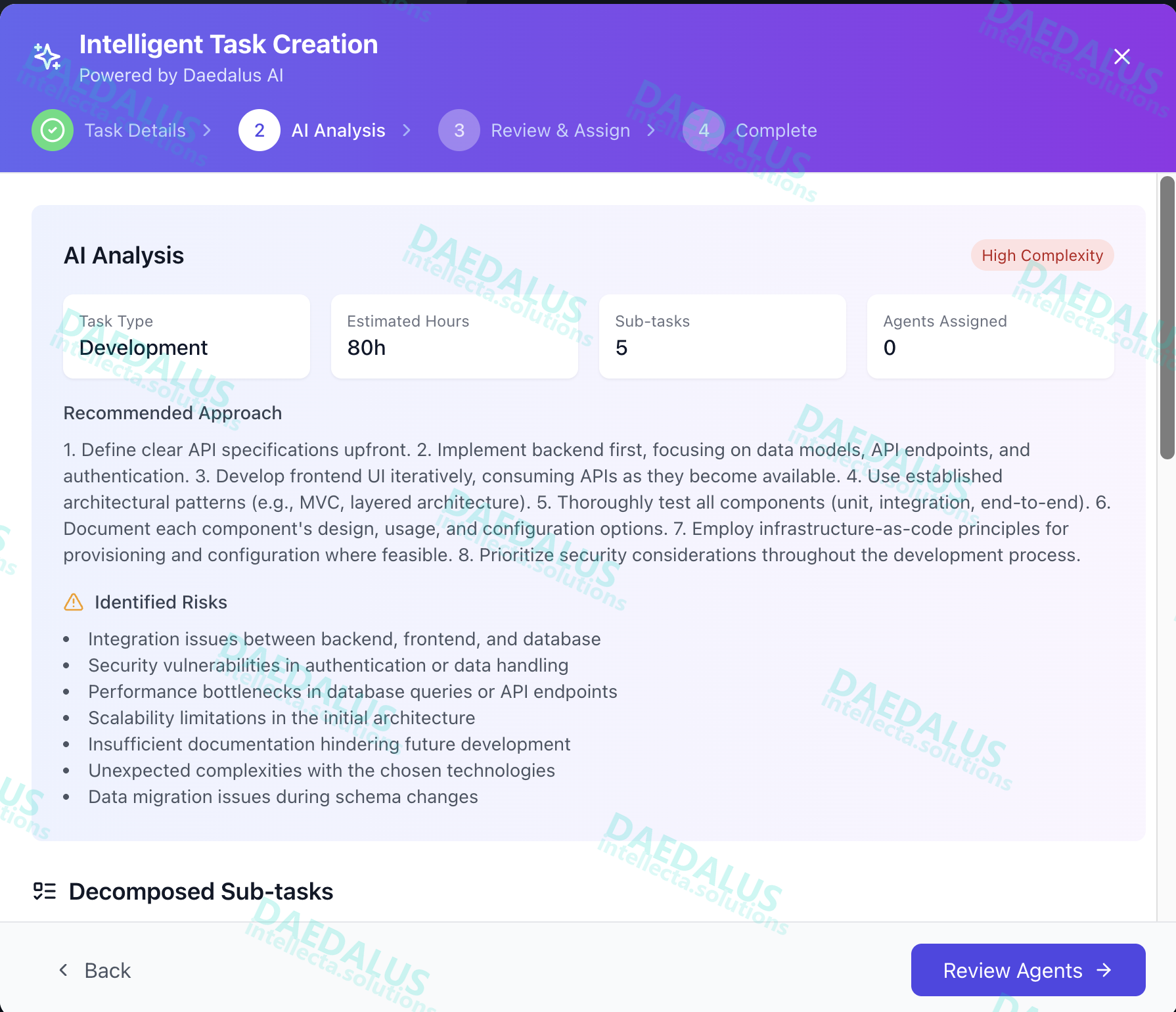
Smart Task Creation Engine

AI-powered task decomposition engine that autonomously breaks complex goals into actionable sub-tasks, assigns agents, and orchestrates multi-step execution with conditional branching and dynamic routing.

Smart Task Creation Engine
AI Task Planner DAG Support Agent Orchestration

Smart Task Creation Engine — AI-powered task decomposition in action.

Self-Healing

Automatic error detection, recovery, and system optimization without human intervention.

Self-Healing
Auto-Recovery Monitoring

Knowledge Base

Integrated vector database for semantic search and long-term memory across agent interactions.

Knowledge Base
RAG Embeddings

Test Scenarios

See DAEDALUS in action with real-world scenarios

REST API Generation Success

Input

"Create a REST API for user management with CRUD operations, JWT authentication, and input validation"

Output

✓ UserController.js (245 lines)
✓ AuthMiddleware.js (89 lines)
✓ ValidationSchema.js (67 lines)
✓ Unit tests (12 test cases)
<3sGeneration Time
HighCode Quality
FullTest Coverage
Memory Leak Detection Fixed

Problem

Application memory usage grows continuously over time, causing eventual crash

Solution

✓ Identified: Event listener not removed
✓ Fixed: Added cleanup in useEffect
✓ Verified: Memory stable at 45MB
Legacy Code Migration Completed

Before

jQuery callbacks, global state, no types, 2500 lines

After

React + TypeScript, Redux, 15 components, 100% typed

📦 Agent Studio

Export your agents to any platform, anywhere. Create once, deploy everywhere.

Export Formats

Python Class

Standalone Python module

Core

Docker

Containerized deployment

Core

REST API

FastAPI server ready

Core

Serverless

AWS Lambda / Vercel

Core

MCP Server

Model Context Protocol

Enterprise

n8n Workflow

Automation integration

Enterprise

Kubernetes

K8s deployment YAML

Enterprise

DevOps CI/CD

GitHub Actions ready

Enterprise

Chrome Extension

Browser assistant

Platform

VS Code

Editor extension

Platform

WhatsApp Bot

Messaging integration

Platform

OpenAI GPTs

GPT Store publish

Platform

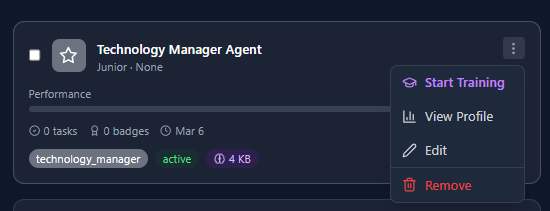
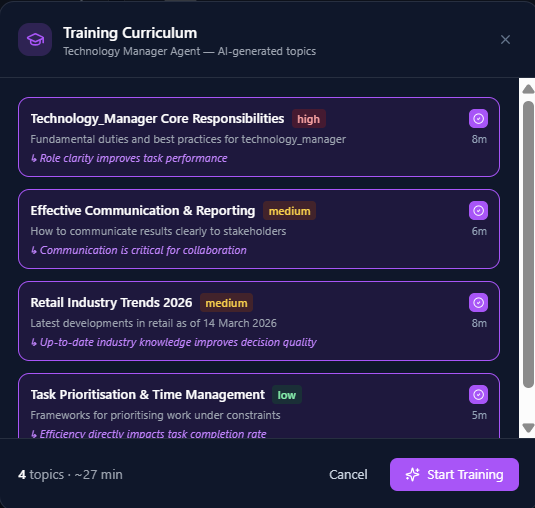
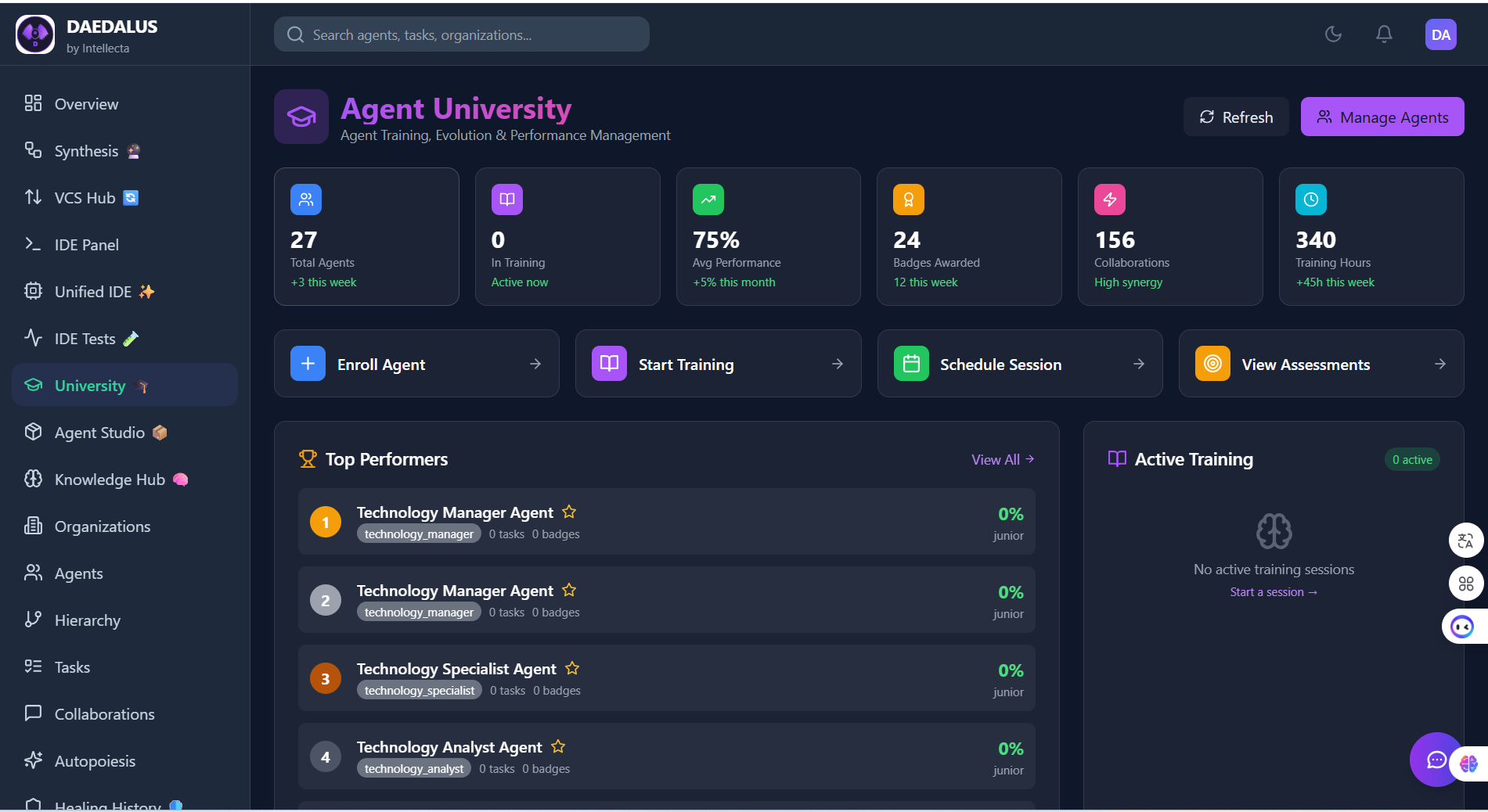
🎓 Agent University

Train your agents with structured learning programs. Our University system provides:

  • Curriculum-based training modules
  • Specialization certificates
  • Performance benchmarking
  • Continuous improvement tracking

🧠 DAR - Self-Awareness

Digital Agent Reflection - Agents that understand themselves:

  • Cognitive self-assessment
  • Capability awareness
  • Limitation understanding
  • Autonomous improvement
Learn about DAR
Autopoietic Organization Creation

Build Intelligence-First Organizations with Daedalus

Daedalus doesn't just automate tasks — it creates, analyzes, and transforms entire organizations. From AI-powered structural blueprints and transformation roadmaps to synthesis agents that embody your organization's knowledge, Daedalus builds living agentic enterprises that self-improve over time.

Organization Blueprints
Organization Transformation
Document Analysis
Synthesis Agents
Strategic Road Map
AI Analysis Reports
Real Auditor Scoring
Multi-Level Support
5
Creation Pathways
AI
Document-Driven Analysis
100
Auditor Score Target
Evolving Org Intelligence

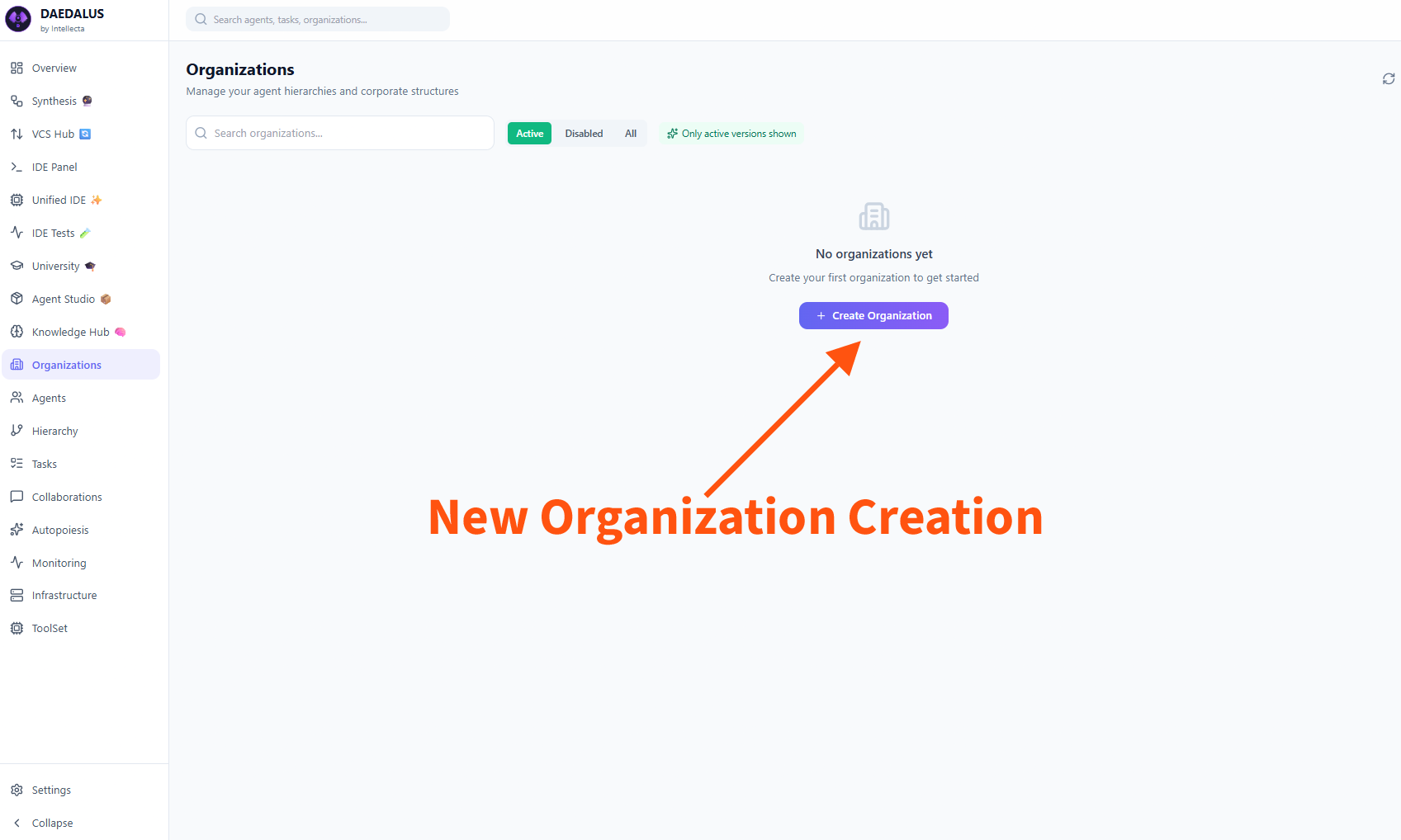
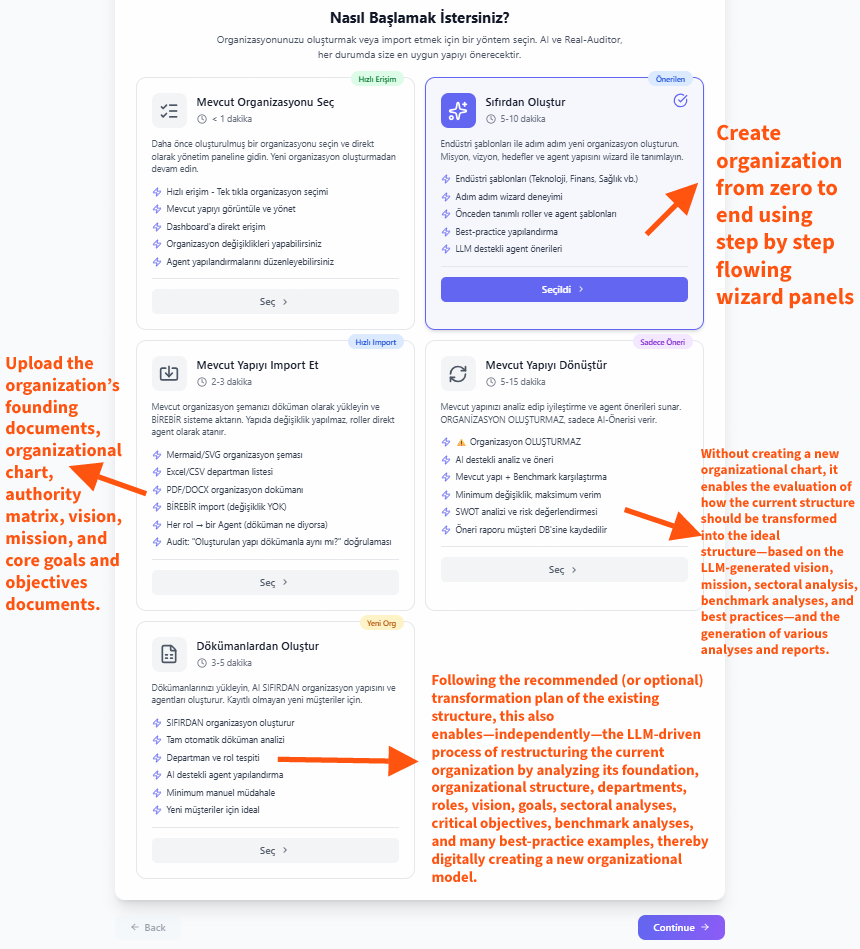
1. Create Your Agentic Organization

Start from scratch or select from five proven creation pathways. Daedalus guides you through defining your organizational structure, departments, agent roles, and intelligence layers — generating a fully agentic blueprint that can be deployed immediately.

  • 5 organization creation pathways — Industry, Department, Function, Role-Based, Custom
  • AI-generated org chart with agent assignments
  • Ready-to-deploy configuration with one click
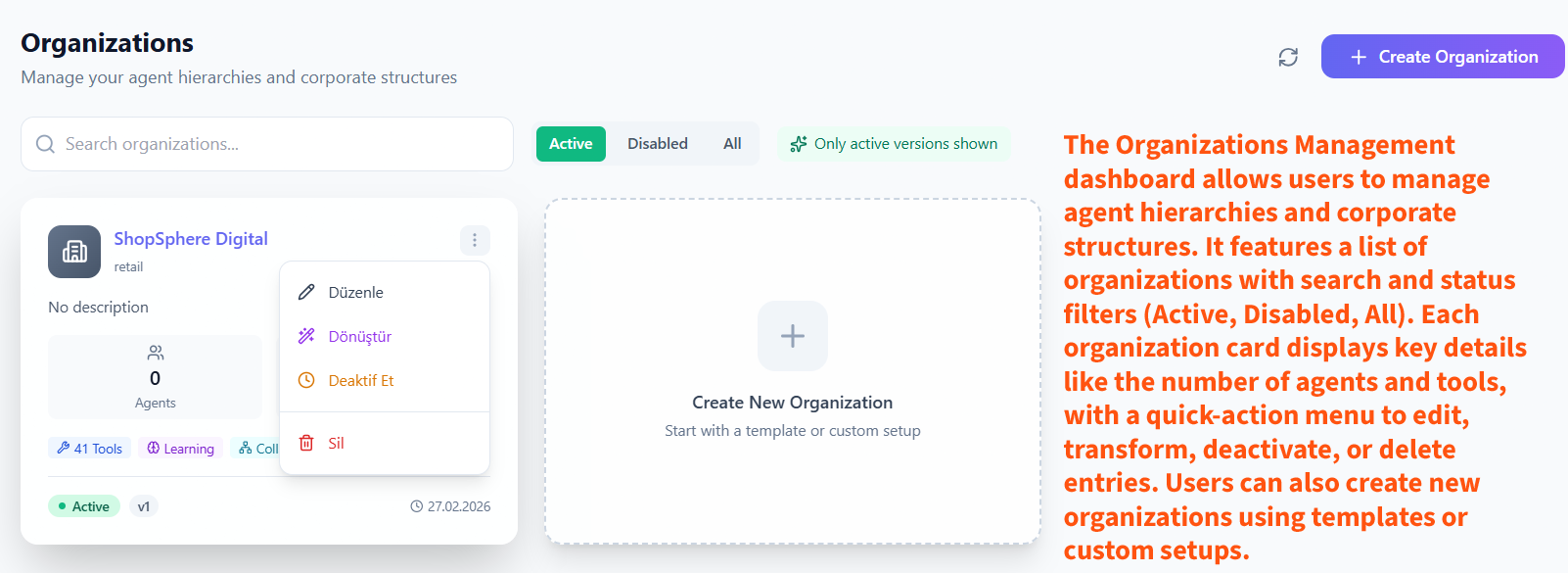
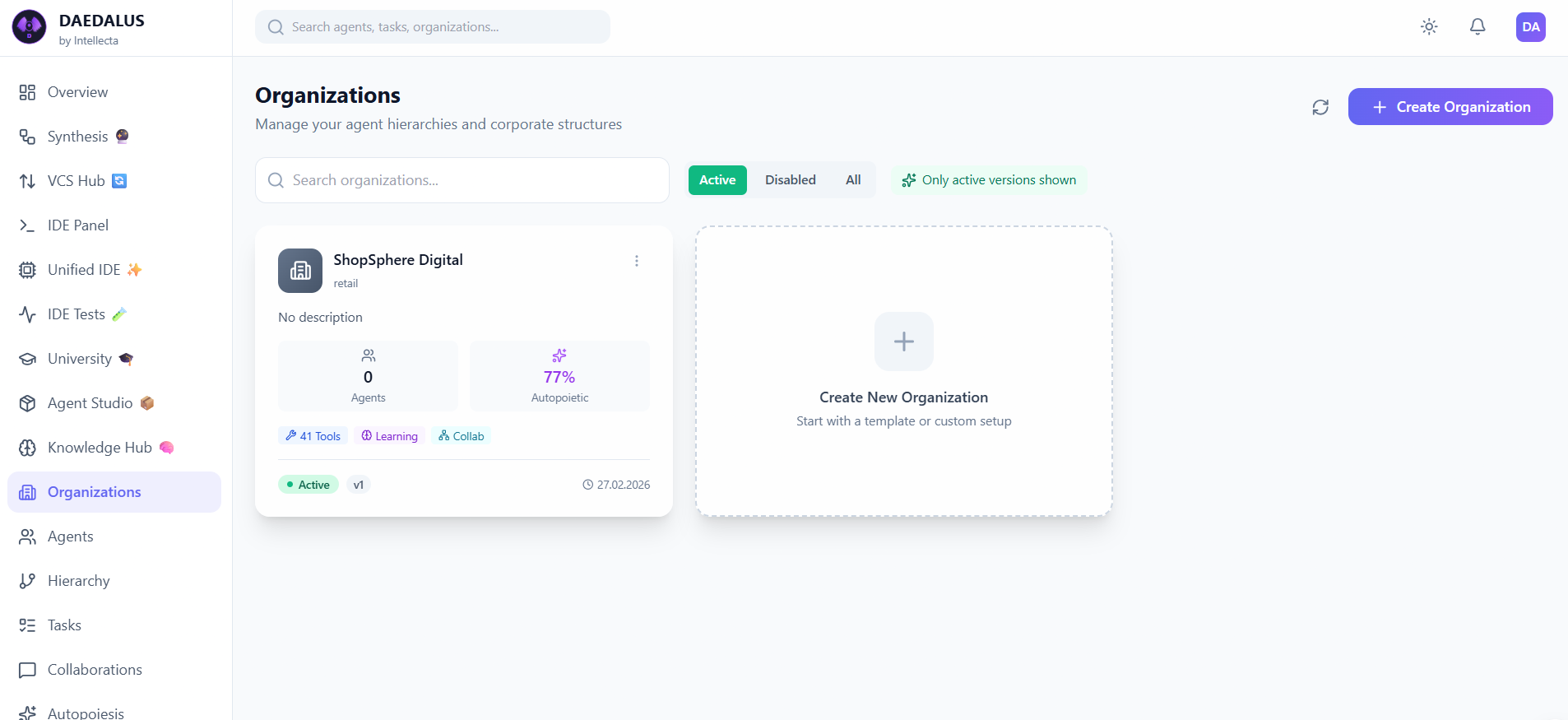
  • Organization Management Dashboard for live oversight
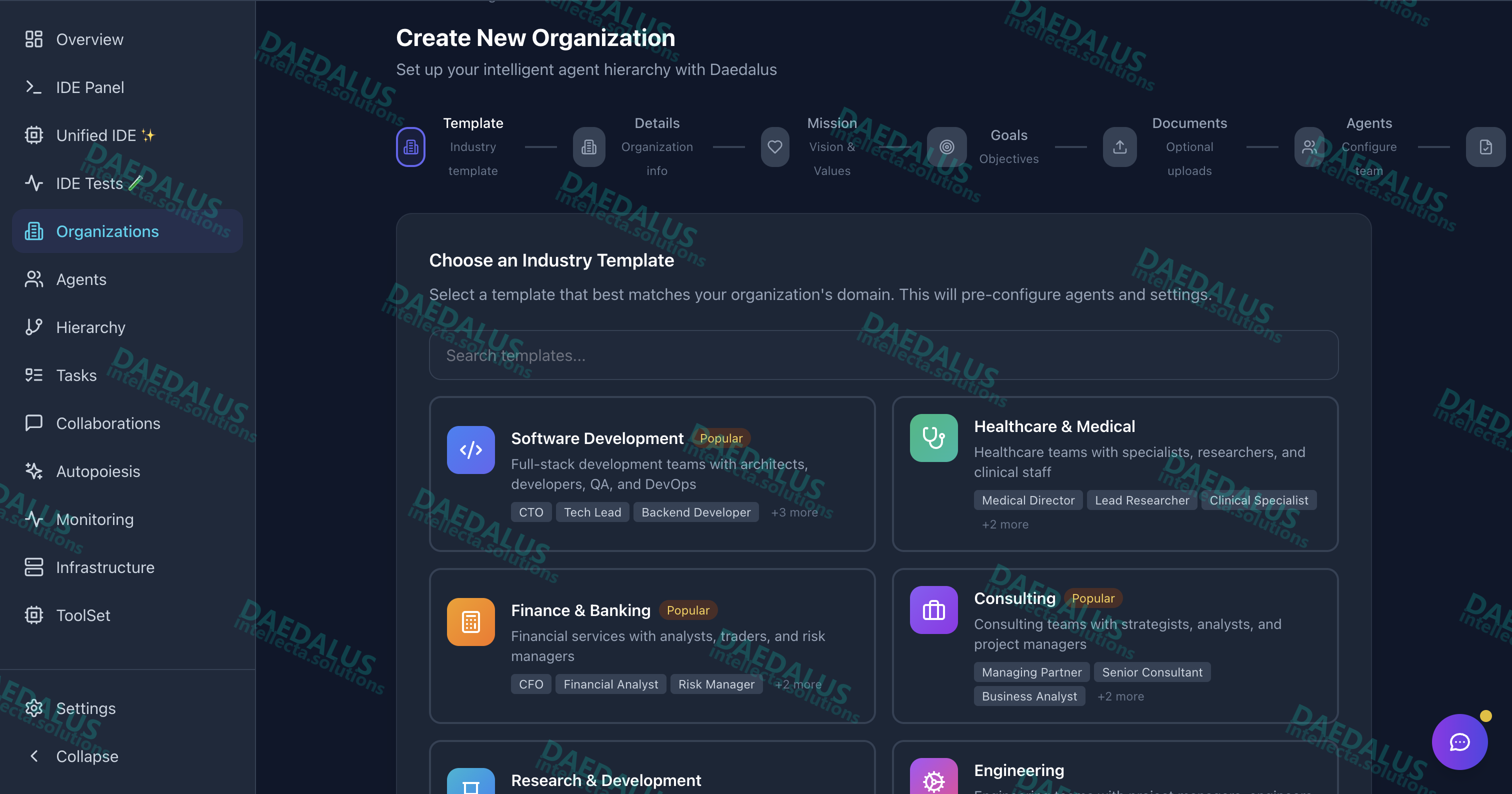
Organization Creation

Organization Creation Wizard

Step-by-step AI-guided creation flow for new agentic organizations

5 Creation Options

5 Creation Pathways

Choose from five tailored pathways to match your organizational model

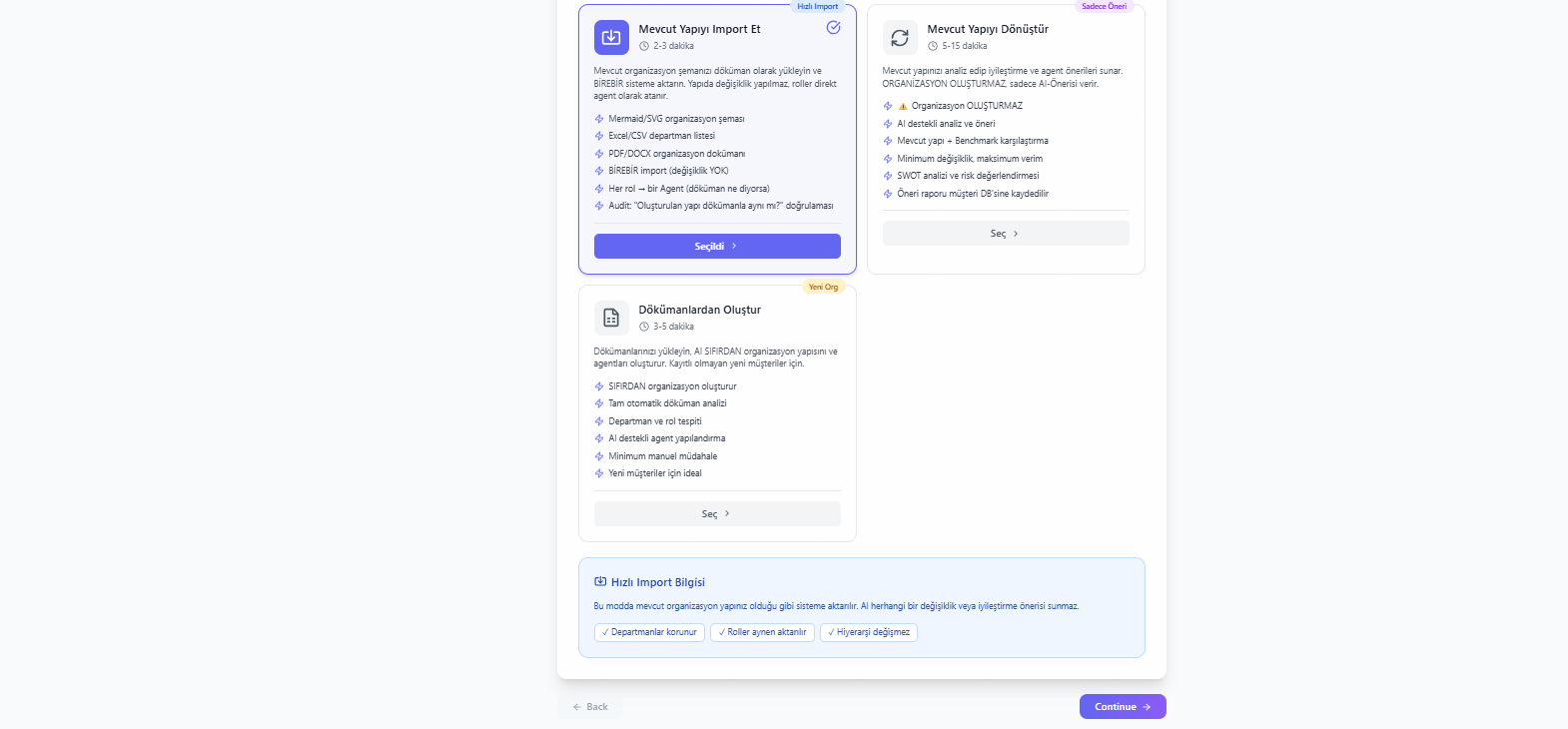
Creation Option Detail

Pathway Configuration

Detailed configuration for your chosen creation pathway

Management Dashboard

Organization Management Dashboard

Live oversight of all agents, departments, and organizational activities

Organization Created

Organization Successfully Created

Confirmation and initial deployment of the new agentic organization

2. Transform Existing Organizations

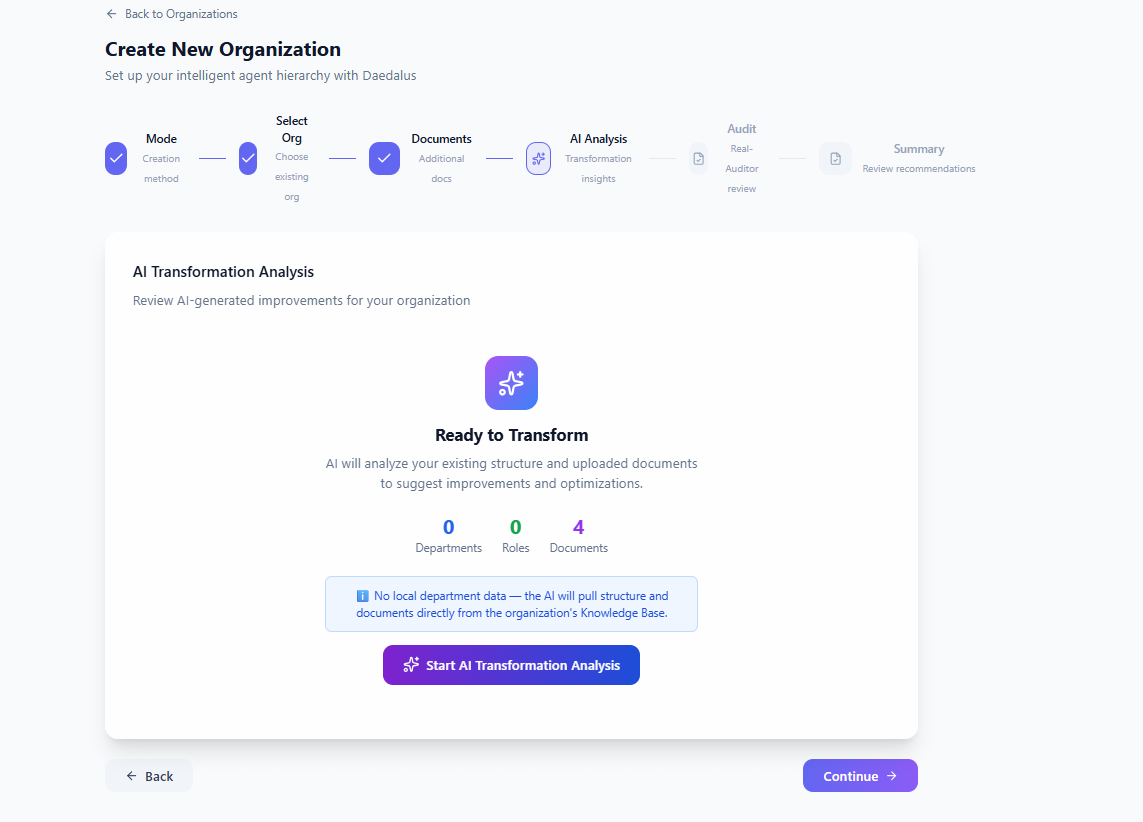
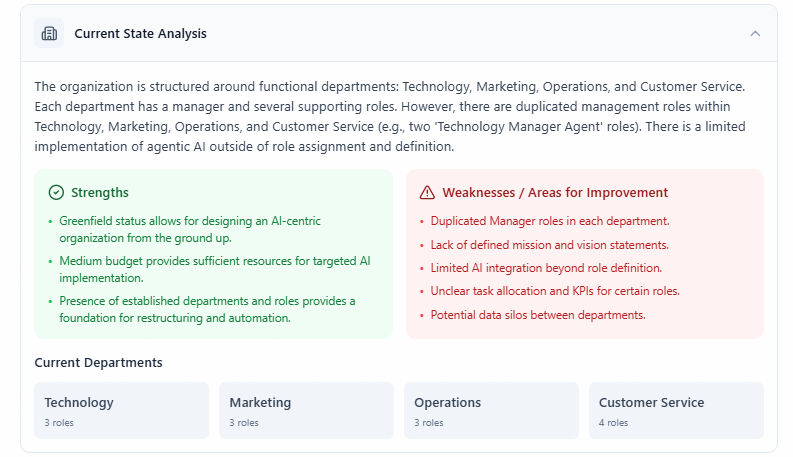
Upload your existing documents, processes, and org data — Daedalus conducts an AI-powered transformation analysis, reviewing your current state against best-in-class agentic models. The result: a gap analysis, transformation report, and strategic road map generated in minutes.

  • Select existing organization for deep analysis
  • AI transformation analysis engine reviews all uploaded documents
  • Real-time reviewing indicator with progress tracking
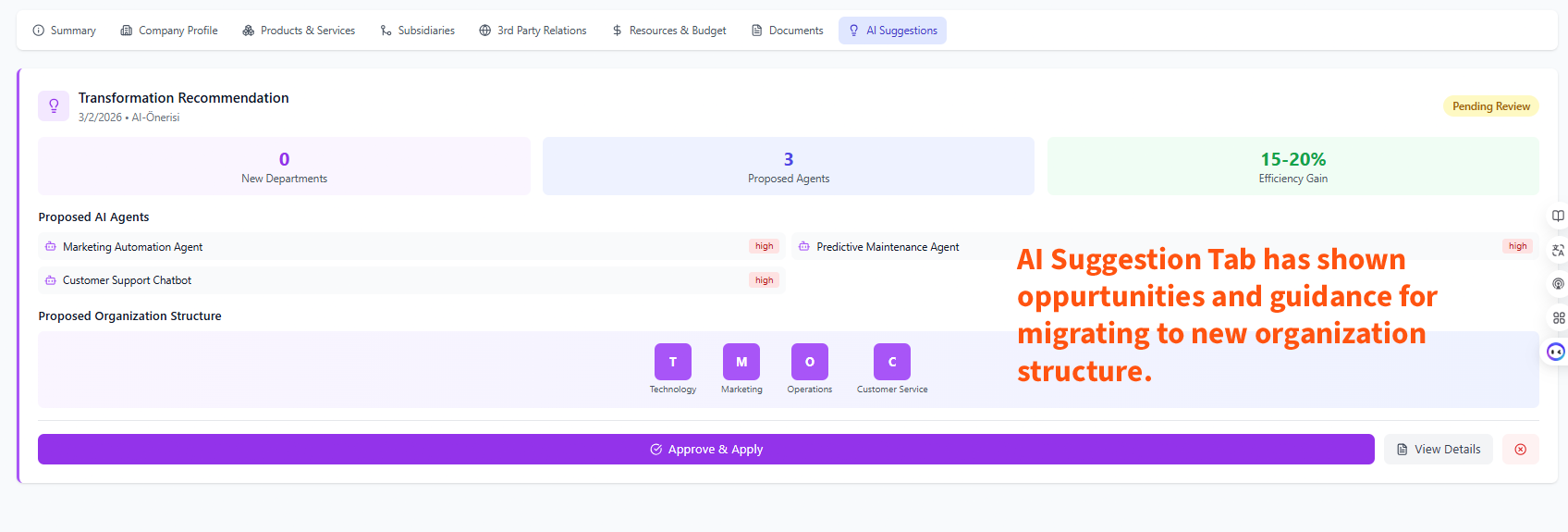
  • AI Suggestion tab with actionable recommendations
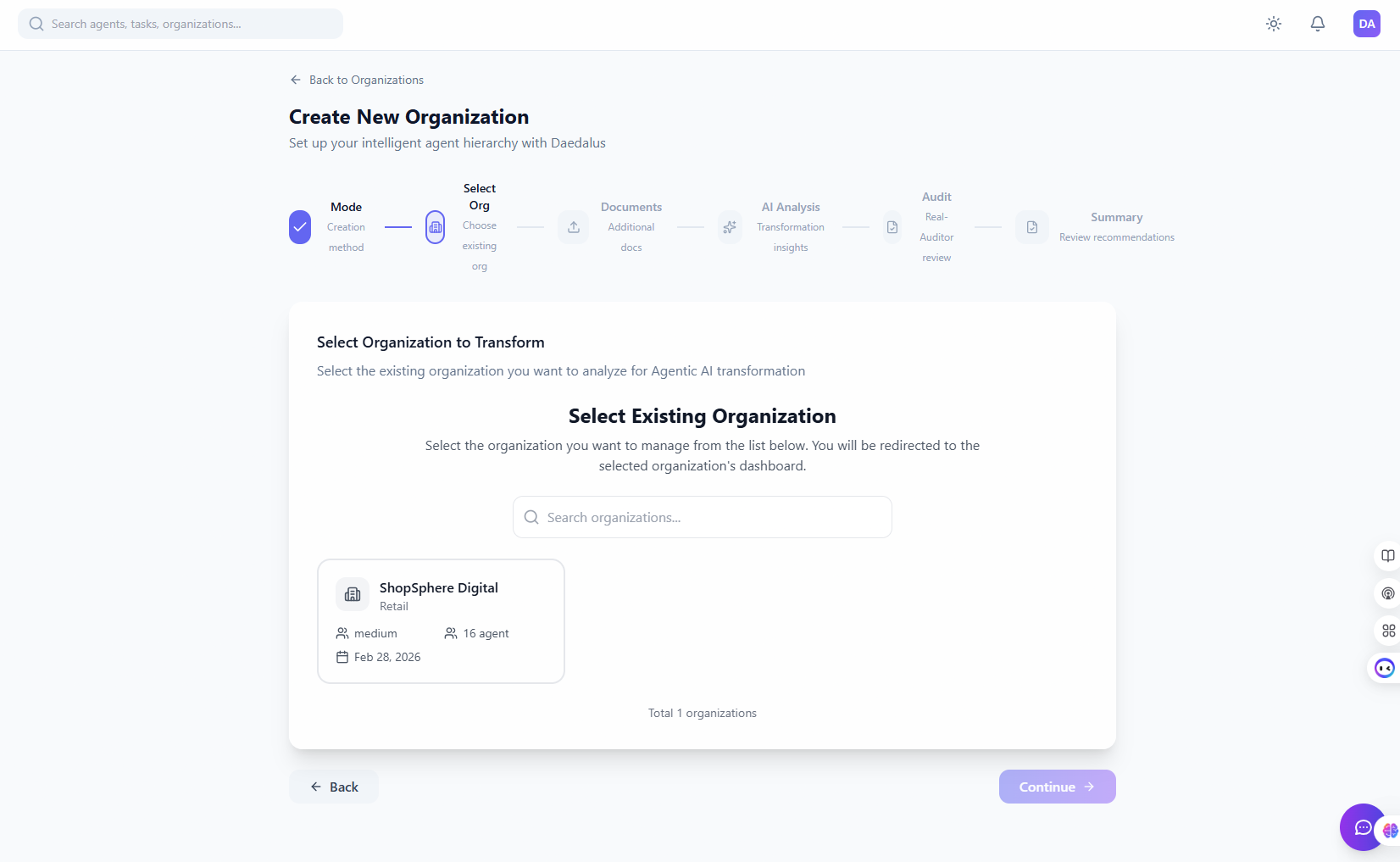
Select Existing Organization

Select Organization for Transformation

Choose an existing organization to receive an AI-powered transformation analysis

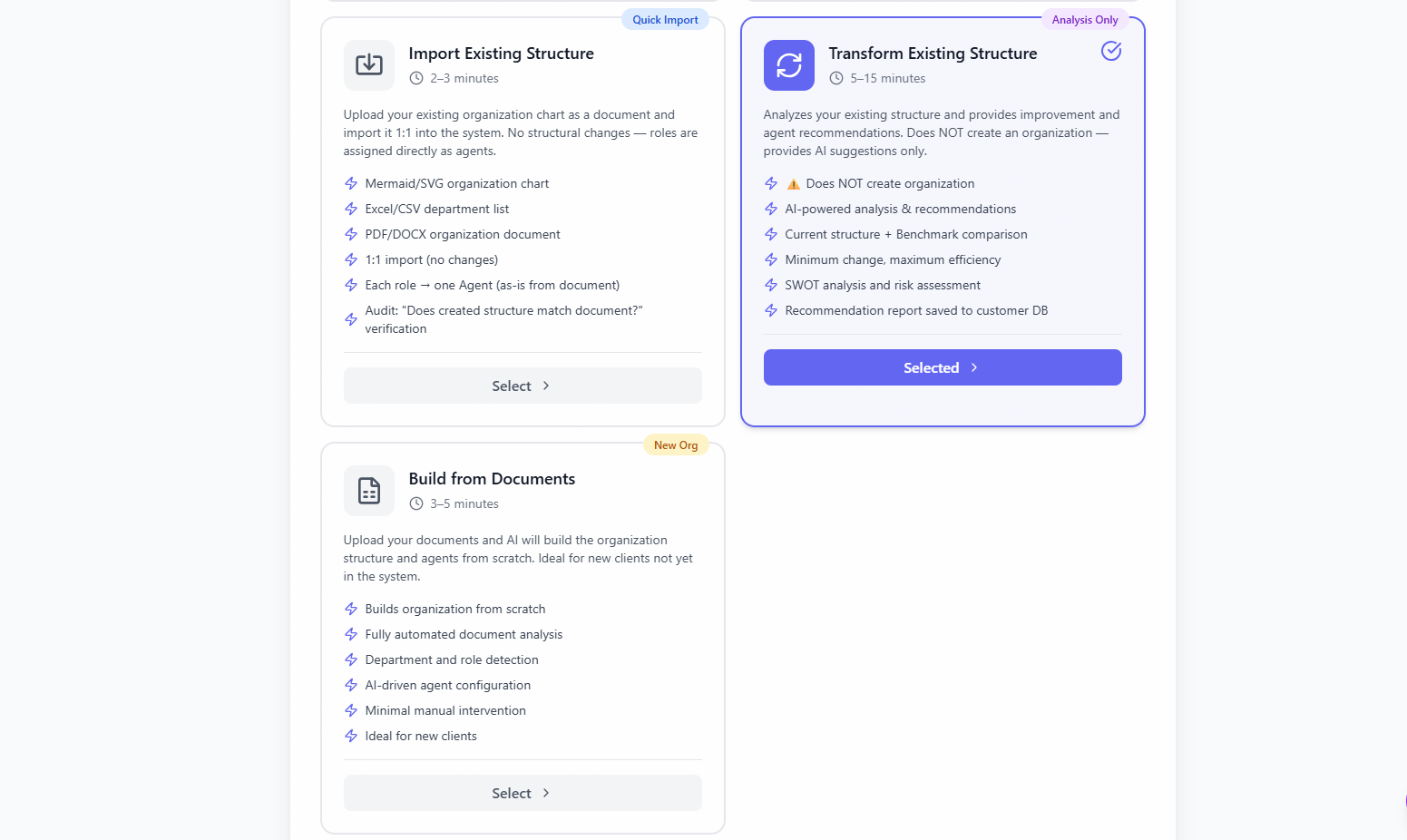
Transform Existing Org

Transformation Workflow

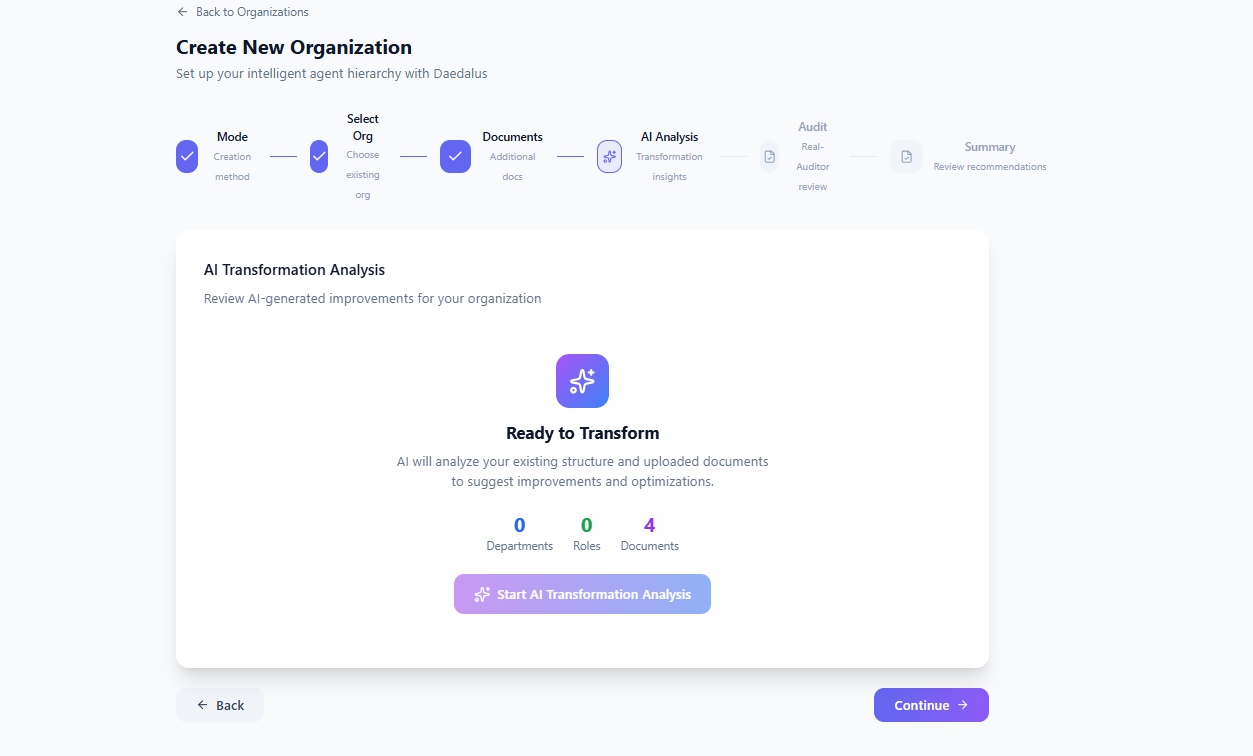
Full transformation workflow from current state to agentic model

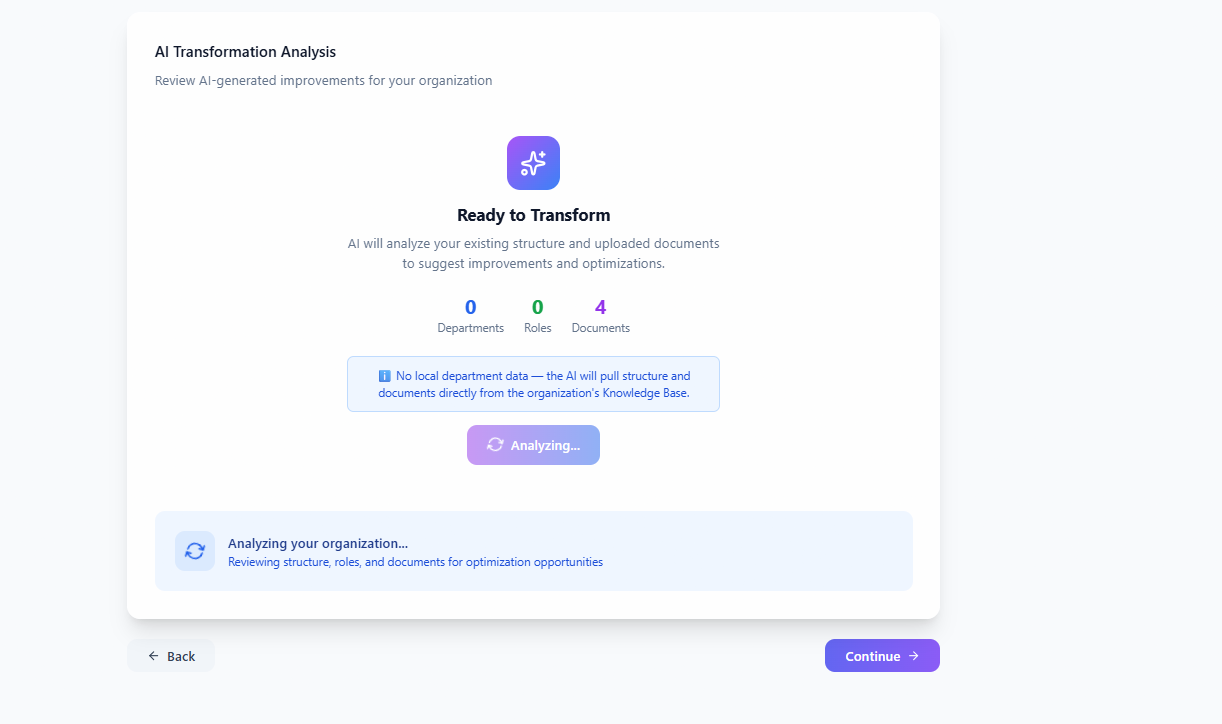
Analysis Started

Analysis Initiated

Transformation analysis kicks off with document ingestion and AI review

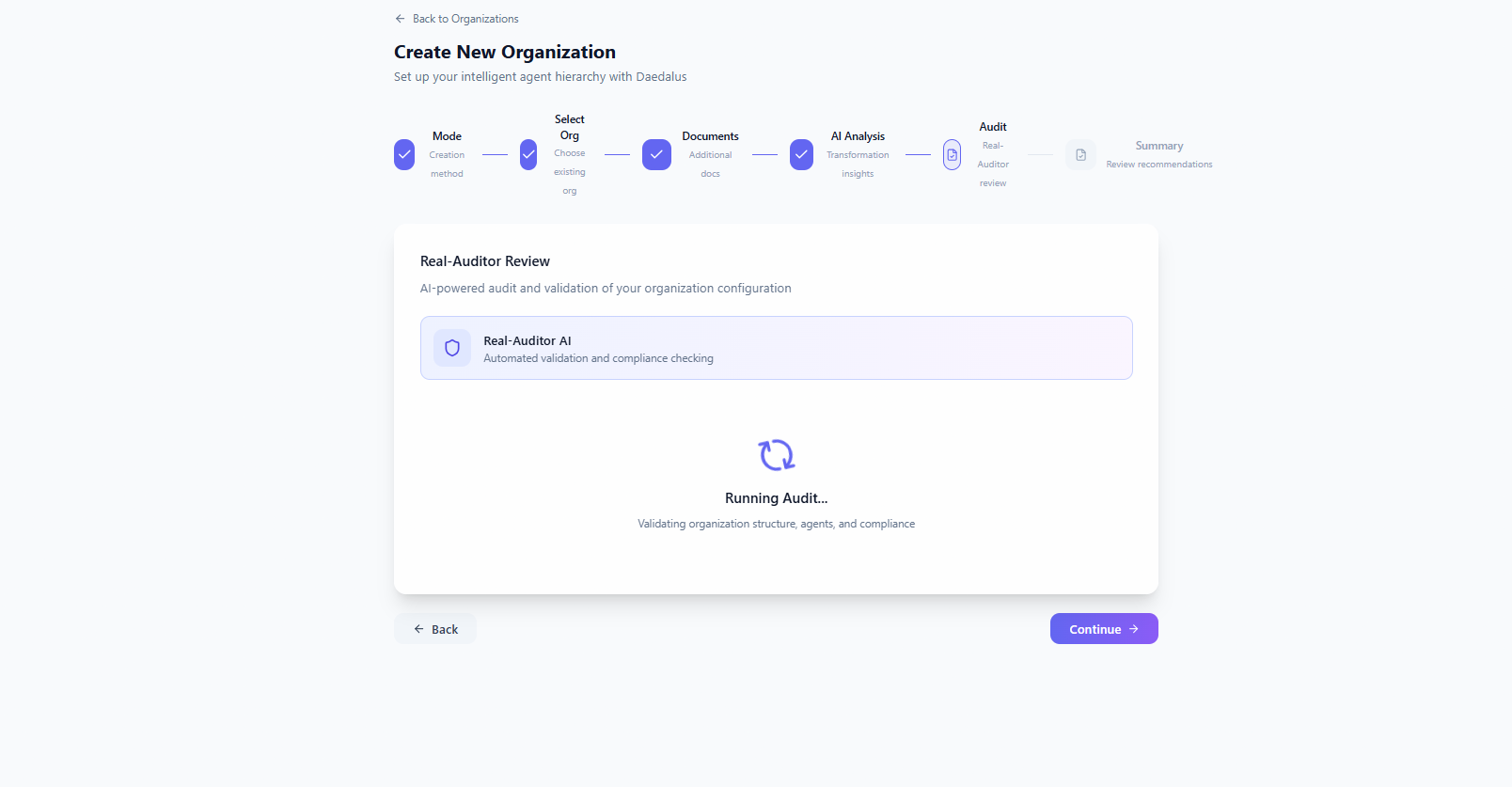
Analysis Reviewing

Deep Review in Progress

AI systematically reviews each dimension of your organization

AI Analysis

AI Analysis Results

Comprehensive AI-generated insights and transformation opportunities

3. Transformation Reports & Strategic Road Map

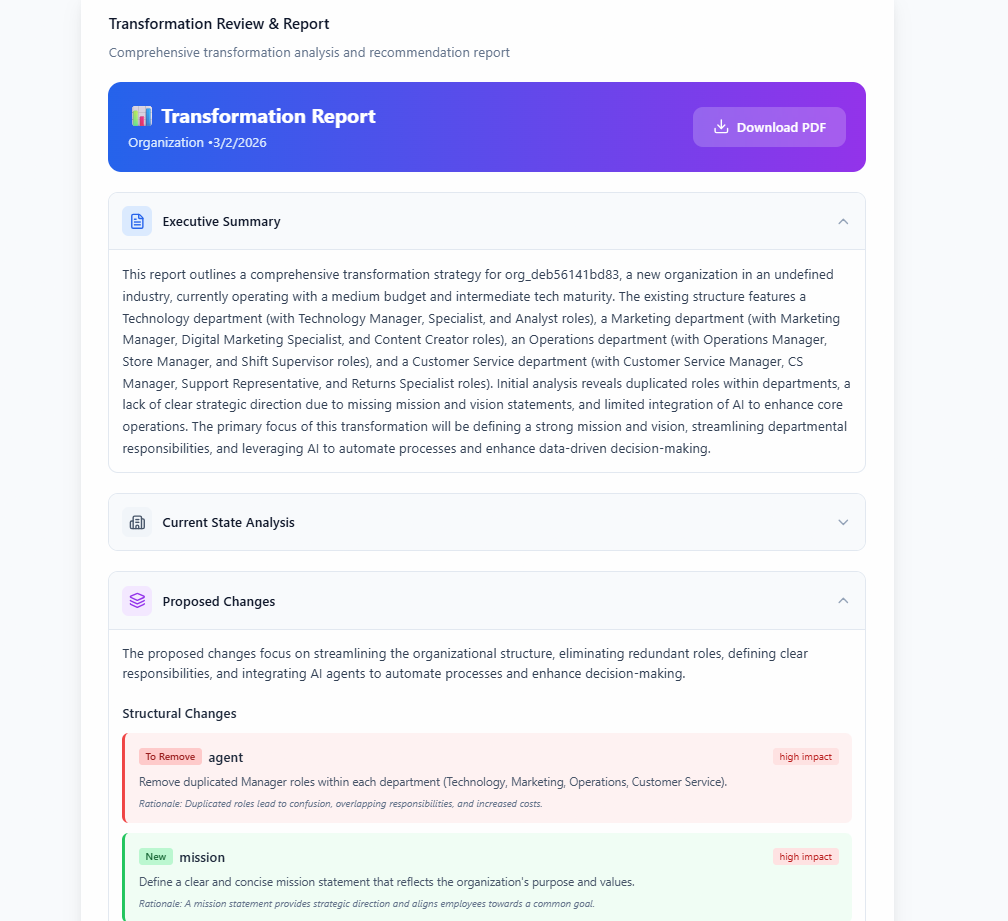
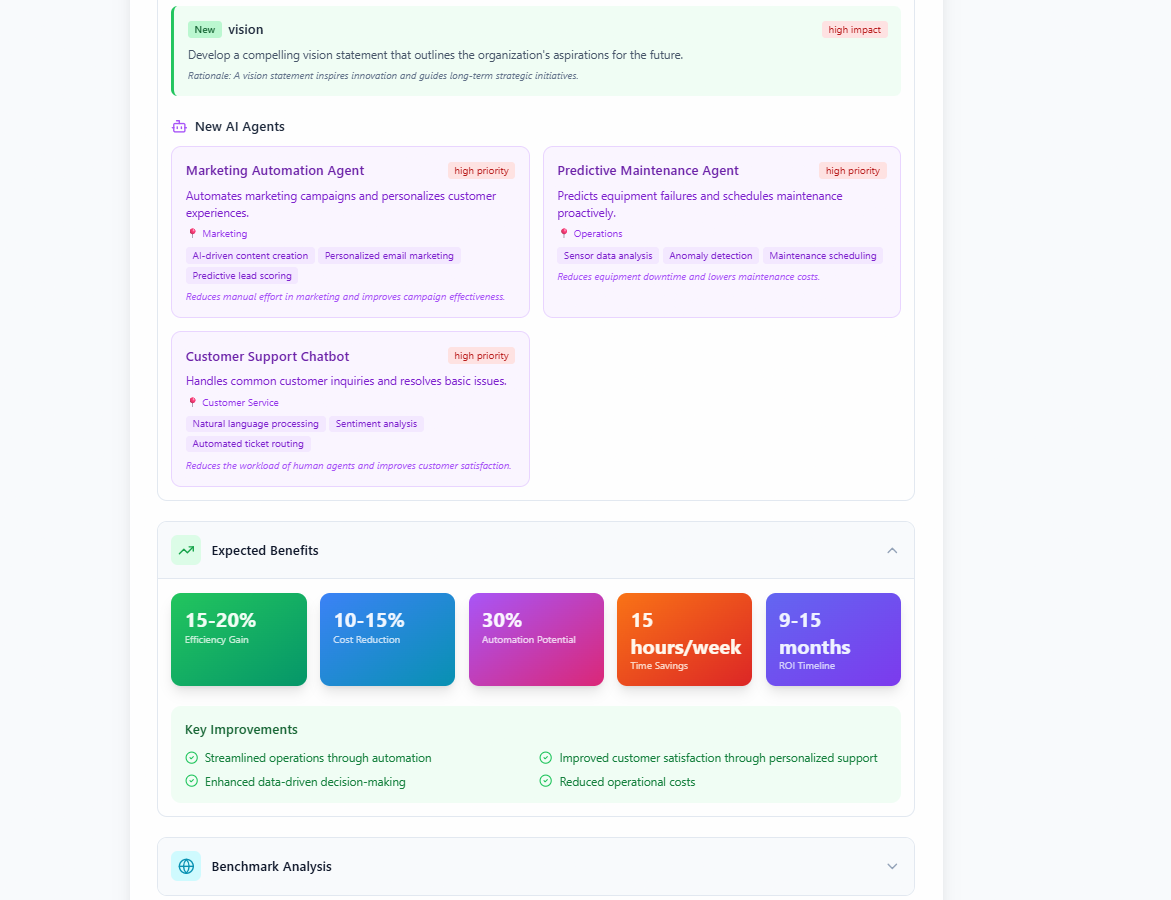
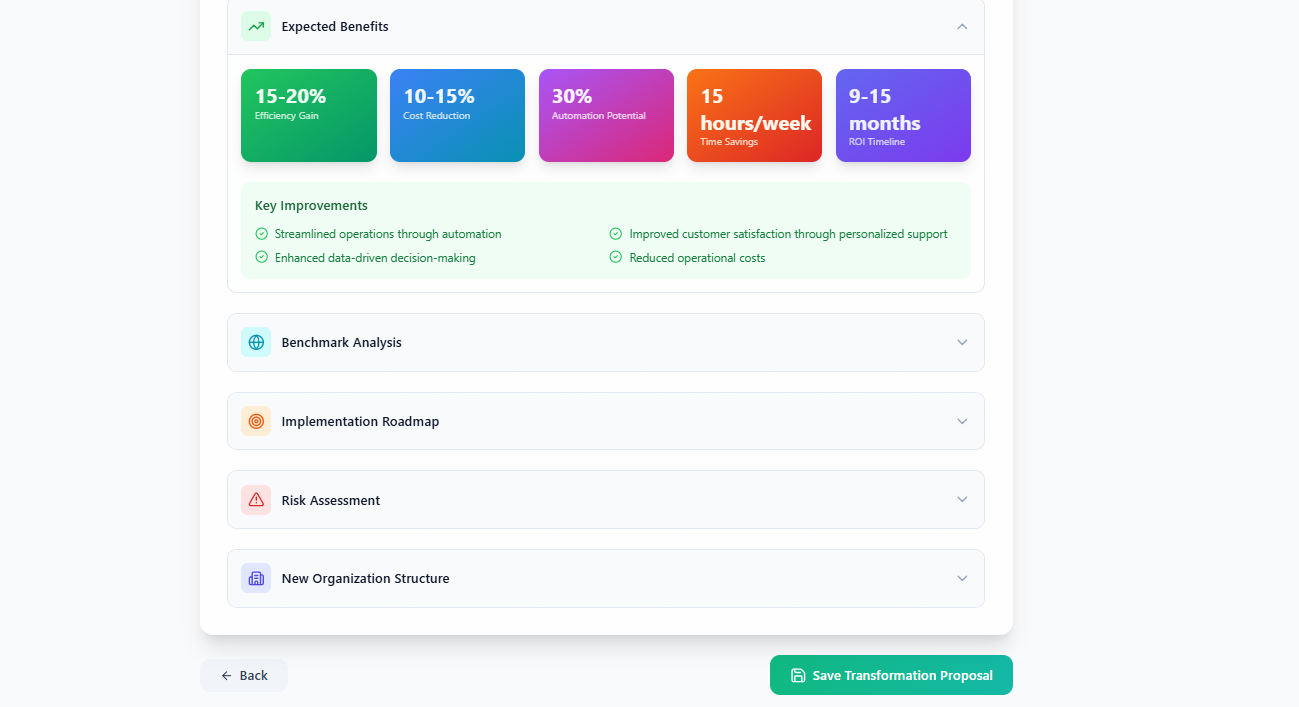
Daedalus generates structured, actionable transformation reports covering every aspect of your organizational change journey. Paired with a strategic road map that plots your path from current state to fully agentic operation — complete with milestones, priorities, and agent deployments.

  • Multi-section transformation report saved as PDF
  • AI Suggestion tab with prioritized implementation steps
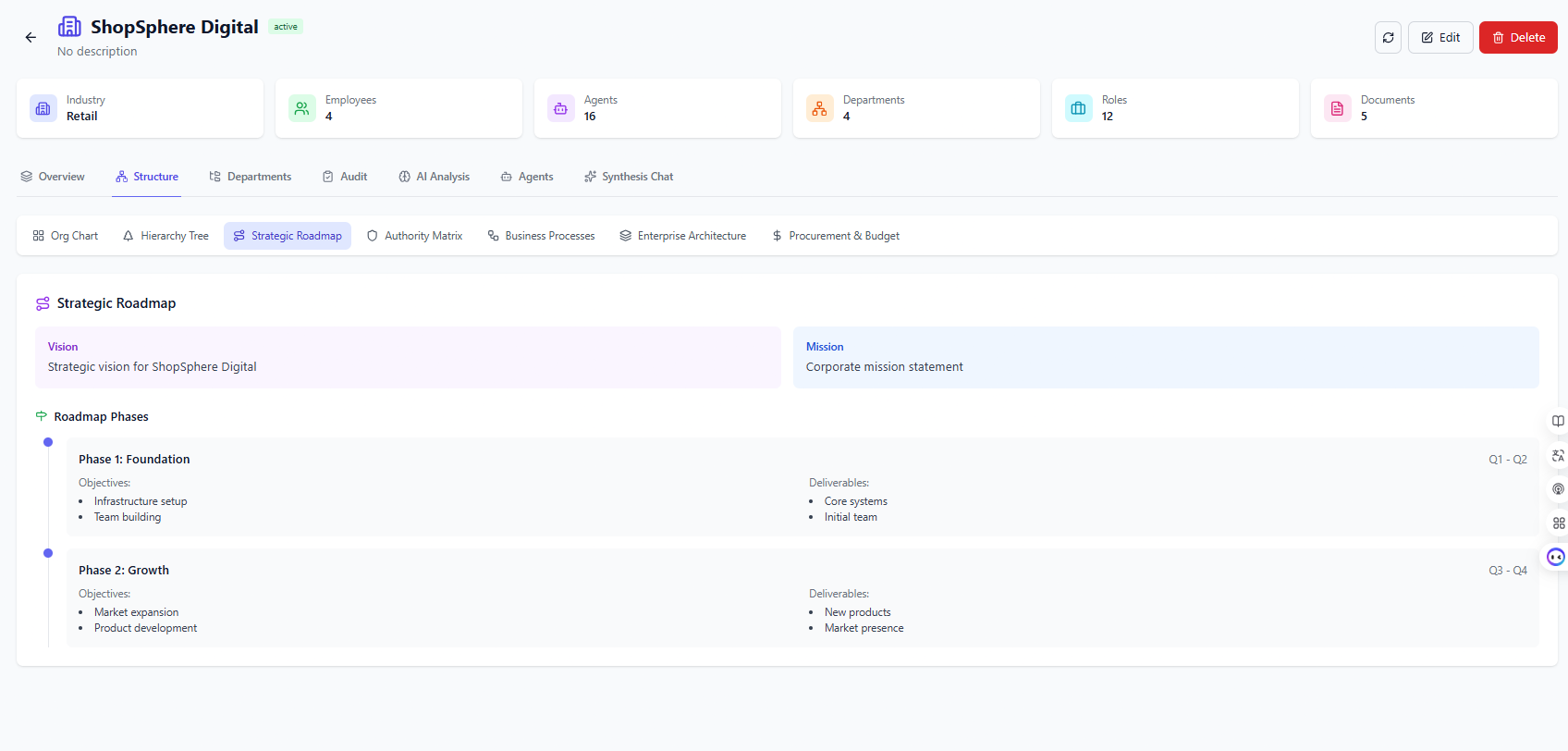
  • Strategic road map with timeline and milestones
  • Ready-to-Transform action plan with agent assignments
Transformation Report 1

Report: Executive Summary

Transformation Report 2

Report: Gap Analysis

Transformation Report 3

Report: Agent Architecture

Transformation Report 4

Report: Implementation Plan

AI Suggestion Tab

AI Suggestions Tab

Actionable AI recommendations ranked by impact and feasibility

Strategic Road Map

Strategic Road Map

AI-generated transformation road map with phased milestones

Ready To Transform

Ready To Transform

Final confirmation — your organization is ready for agentic transformation

4. Synthesis Agents & Knowledge Extraction

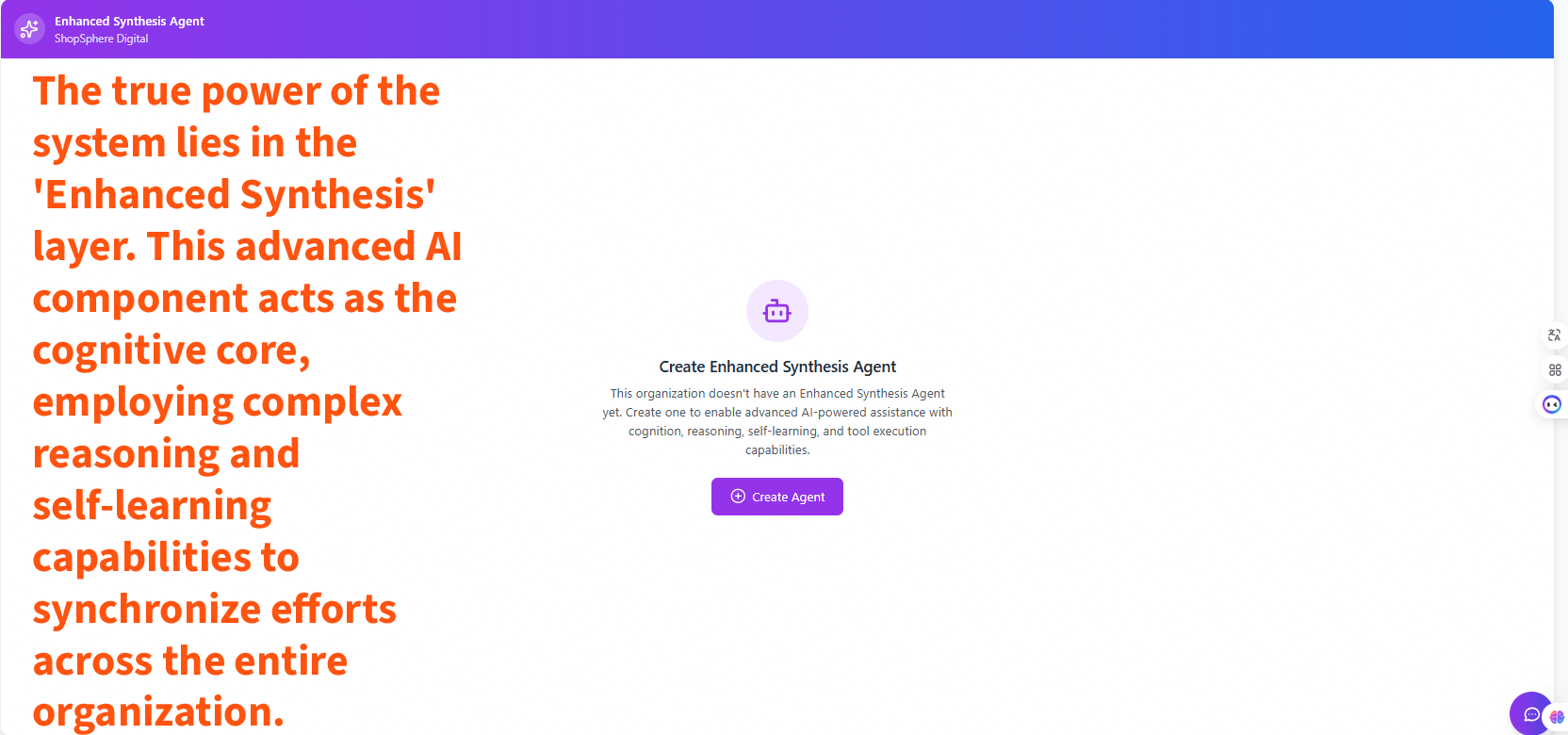
Synthesis Agents are specialized Daedalus agents that absorb your organizational documents, SOPs, policies, and knowledge bases — then become a conversational interface to your org's institutional intelligence. Ask them anything about your structure, processes, or history.

  • Upload any org document — PDFs, policies, SOPs, reports
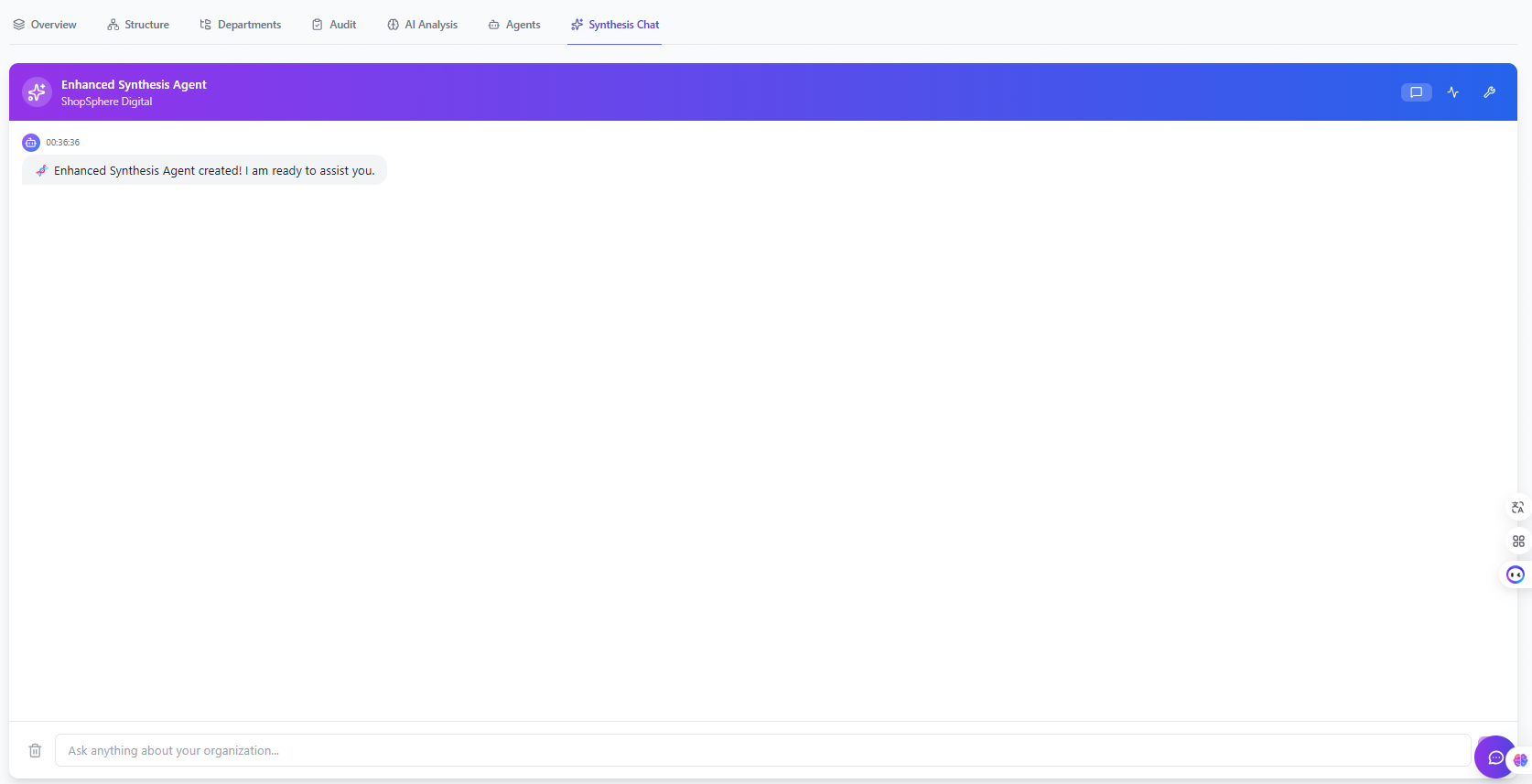
  • Synthesis agents chat interface for knowledge exploration
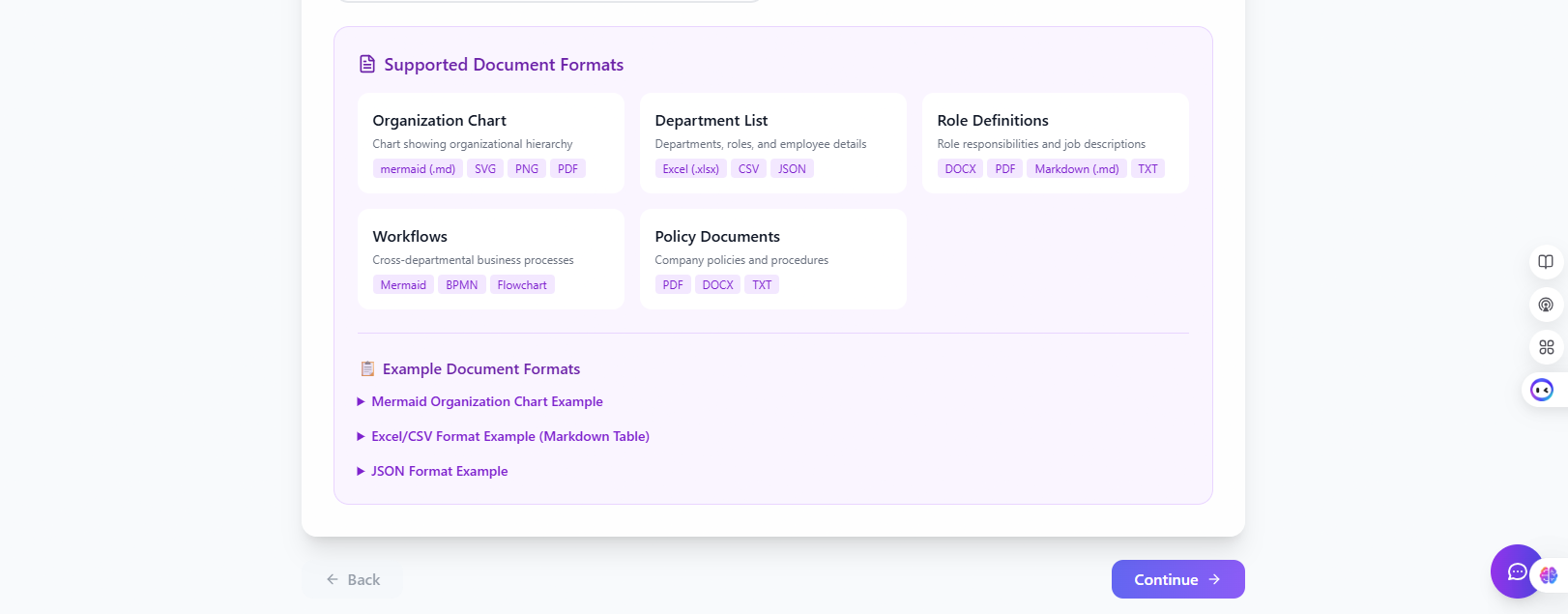
  • Supported document types with ingestion status display
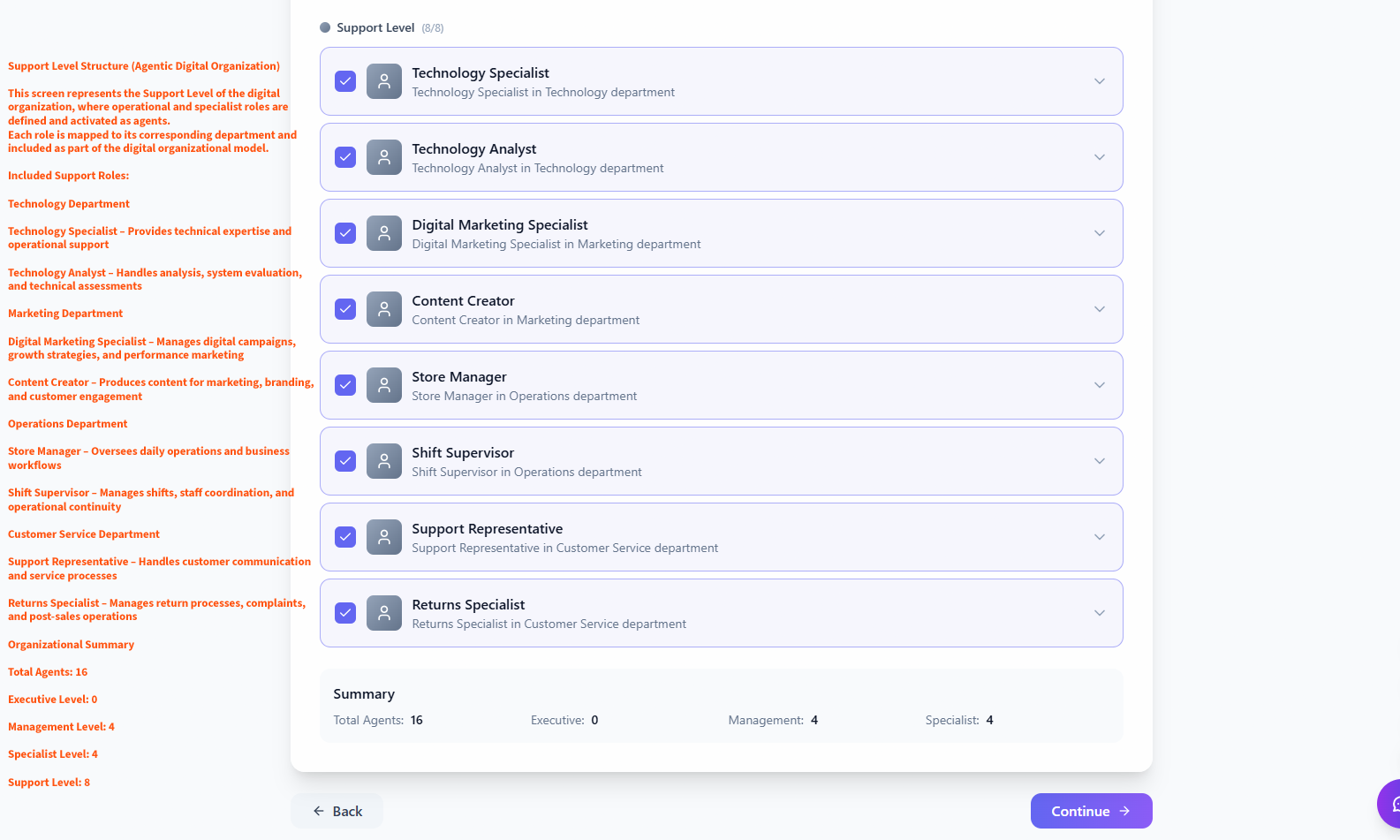
  • Support level classification for agentic readiness scoring
  • Real Auditor scoring of organizational intelligence quality
Synthesis Agent

Synthesis Agent Overview

Synthesis agents that become living interfaces to your organizational knowledge

Synthesis Agent Chat

Synthesis Agent Chat Interface

Converse with your org's collective intelligence — ask anything, get expert answers

Supported Documents

Supported Document Types

Full list of supported organizational document formats for AI ingestion

Support Level

Agentic Support Level

Readiness classification levels from basic automation to full agentic maturity

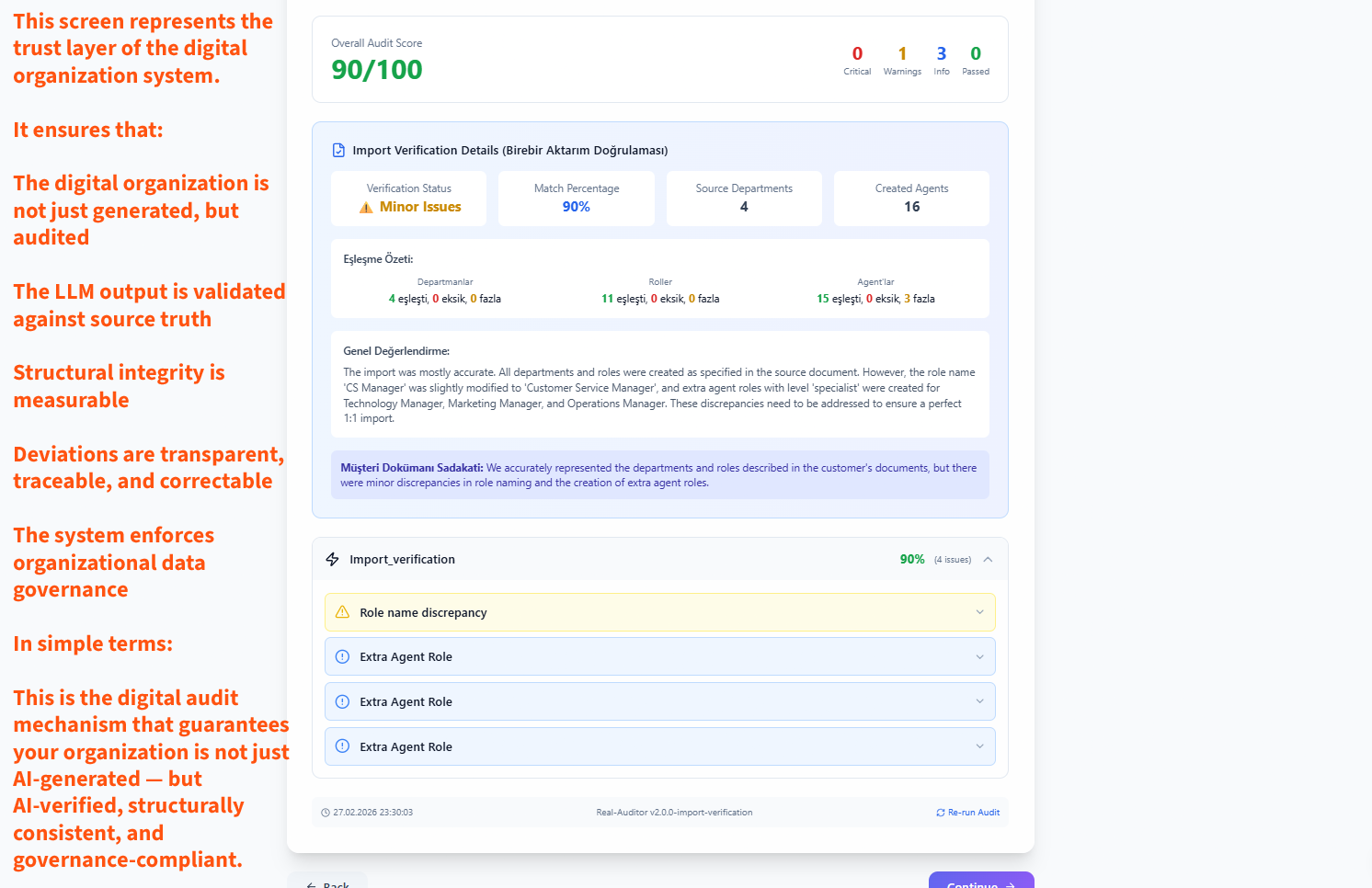
Real Auditor Score

Real Auditor Score

Objective quality score of your organization's agentic intelligence level

Synthesis Module

Synthesis: From Strategy to Shipped Code

Synthesis is Daedalus's project lifecycle engine. It auto-decomposes Programs into Epics, Milestones, Stories and Tasks, then Orion Execution orchestrates autonomous agents to execute every story in parallel — producing real code artifacts, tests, and documentation with full GitHub/GitLab VCS integration.

Epic & Milestone Decomposition
Story & Task Autocreation
Orion Execution Engine
VCS Integration
Autonomous Agent Flows
AI Regeneration
Enhanced Synthesis Chat
Artifact Generation
Auto
Epic/Story Decomposition
Orion
Autonomous Execution
VCS
GitHub & GitLab Sync
AI
Regeneration Engine

1. Synthesis Dashboard & Overview

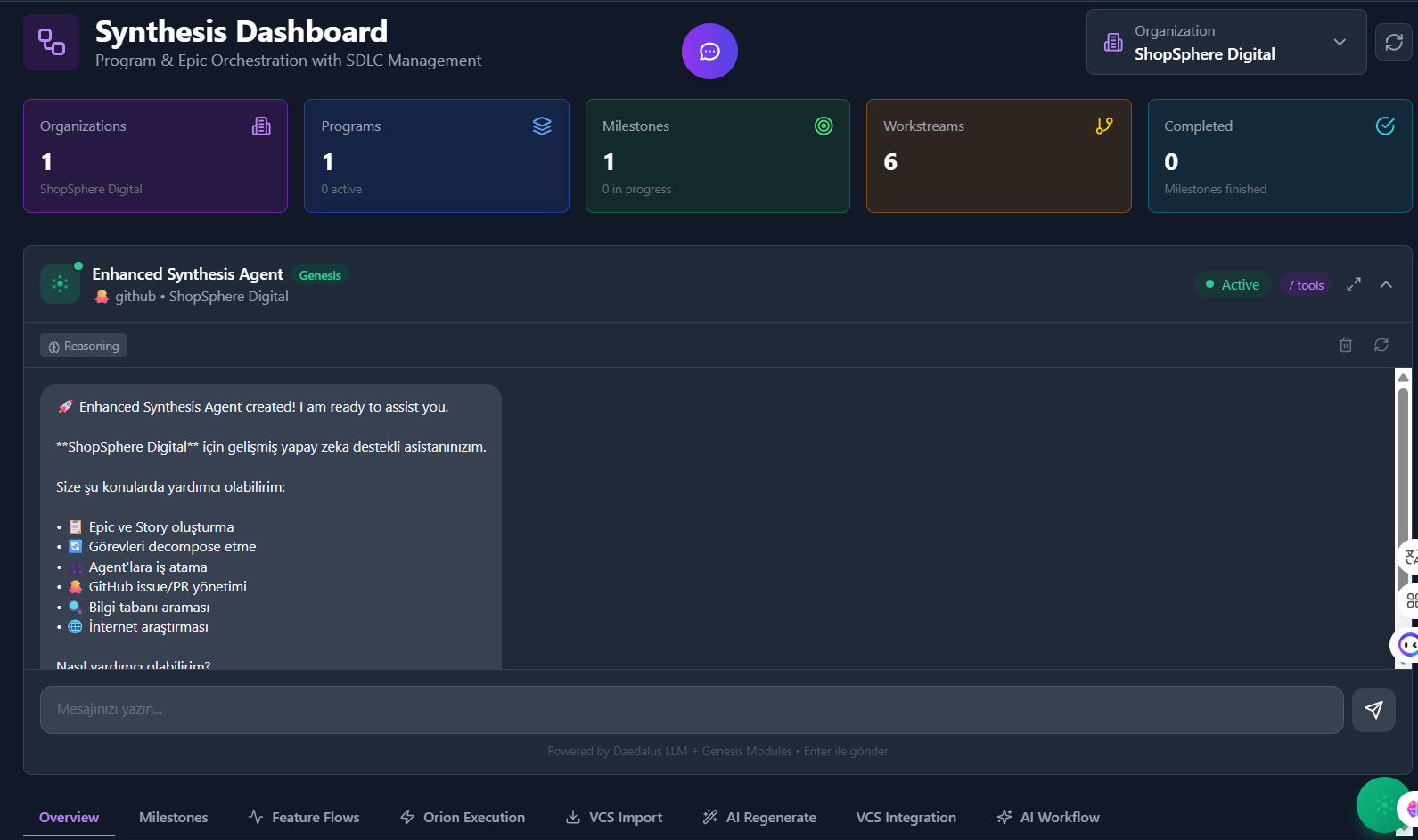
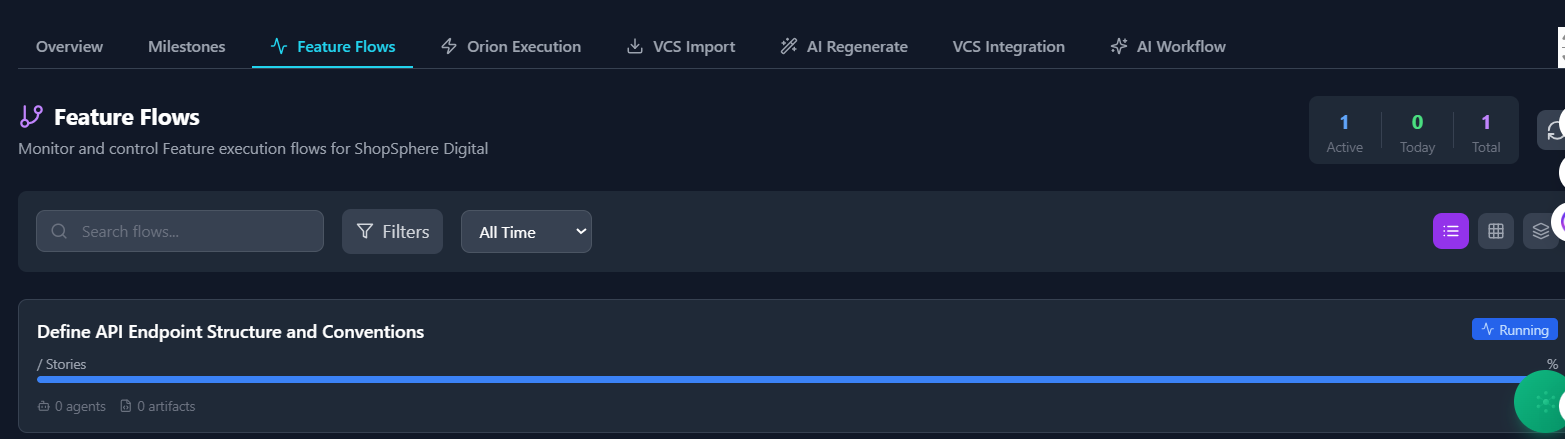
The Synthesis Dashboard provides a unified view of your programs, epics, milestones, and feature flows. Monitor active sprints, track story completion, observe agent assignments, and manage your entire project lifecycle from one place.

  • Real-time project overview with milestone progress tracking
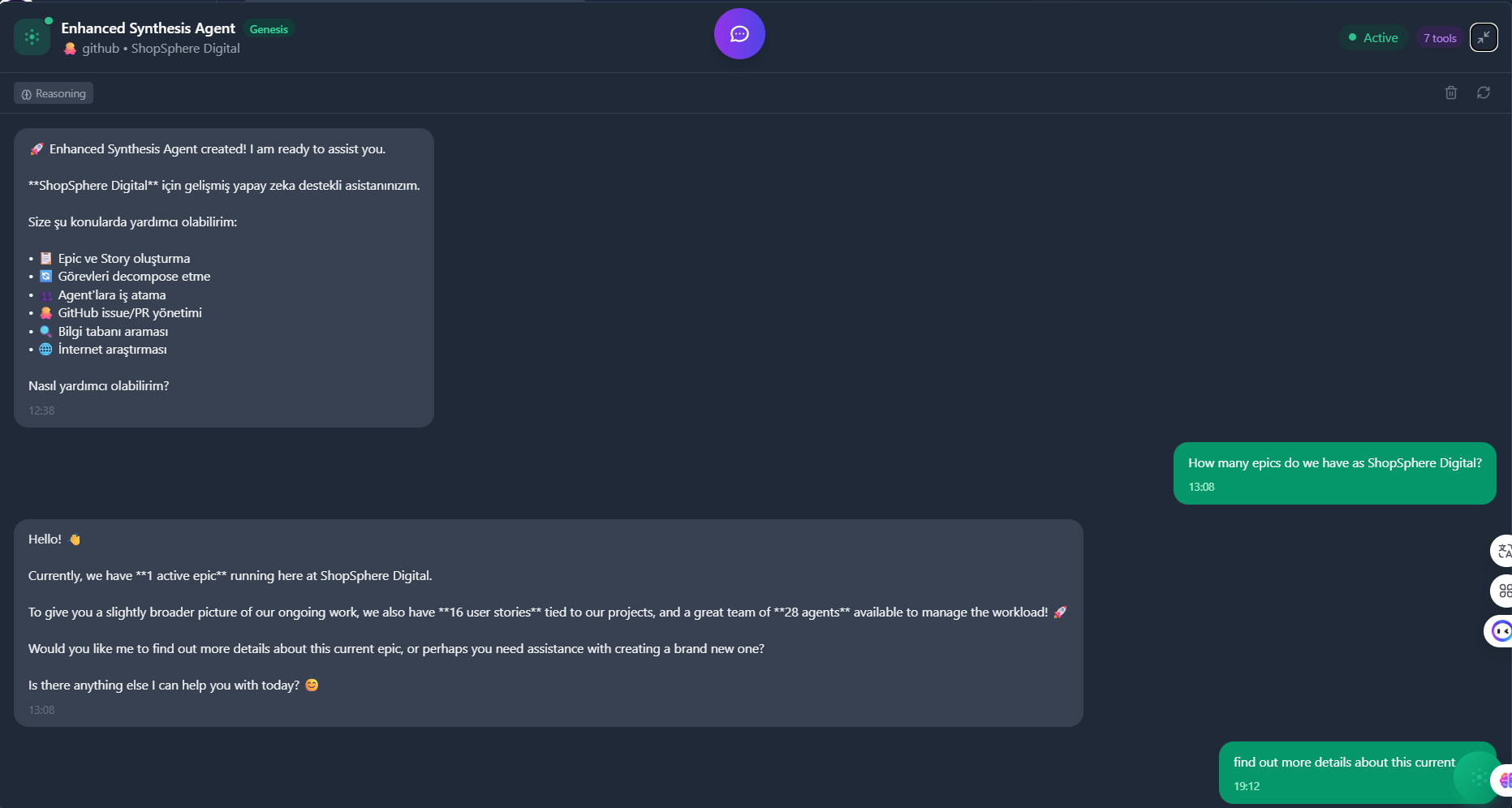
  • Integrated Synthesis Chat agent for natural-language project queries
  • Epic-to-Story decomposition with automatic priority assignment
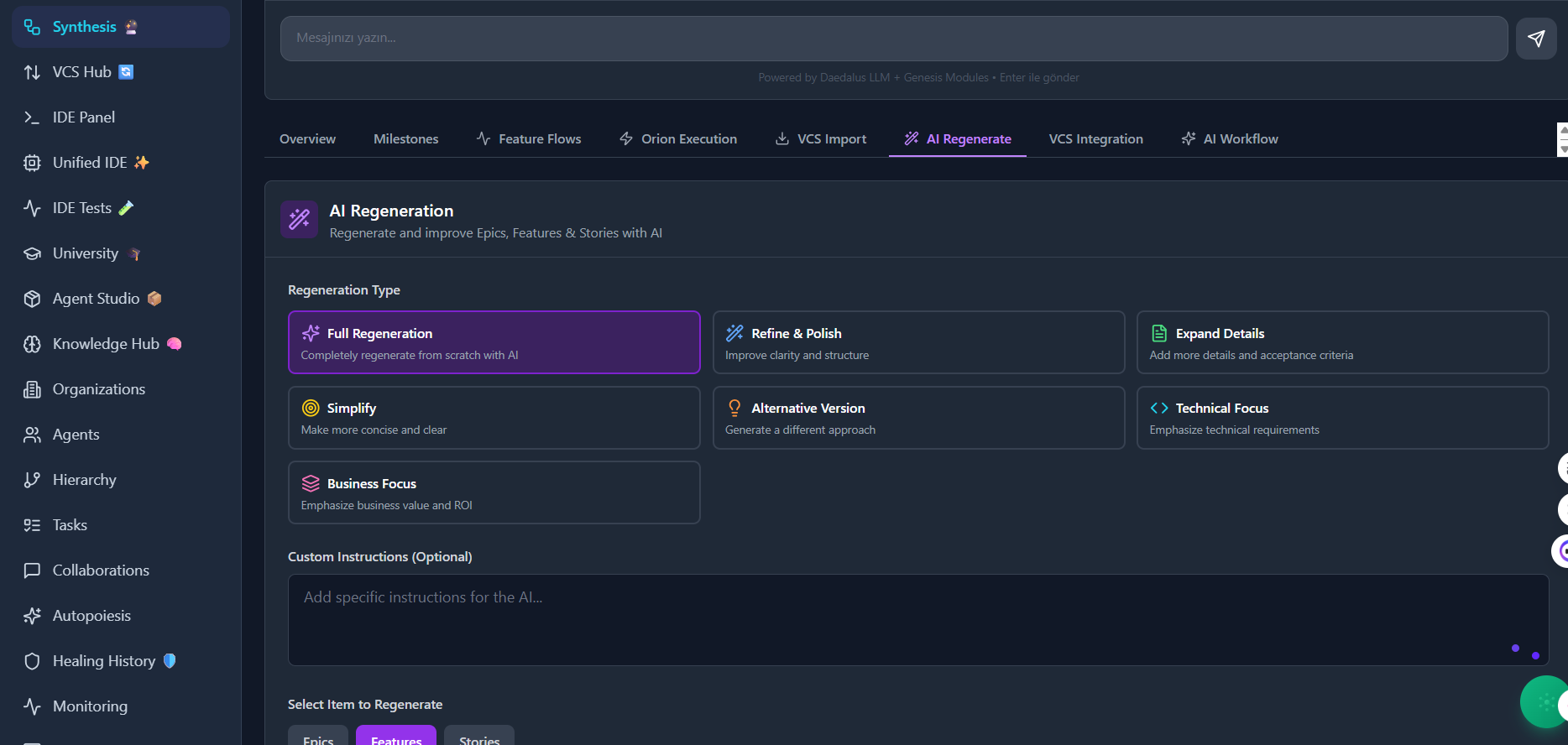
  • AI Regeneration for refining epics, features, and stories
Synthesis Dashboard Overview DAEDALUS • Intellecta

Synthesis Dashboard

Unified view of programs, epics, milestones and active flows

Synthesis Dashboard Detail DAEDALUS • Intellecta

Dashboard Detail View

Detailed project metrics and milestone completion status

Synthesis Chat DAEDALUS • Intellecta

Synthesis Chat Agent

Natural-language interactions for project management and story queries

AI Regeneration DAEDALUS • Intellecta

AI Regeneration

Regenerate and improve Epics, Features & Stories with AI

2. Epic & Milestone Decomposition

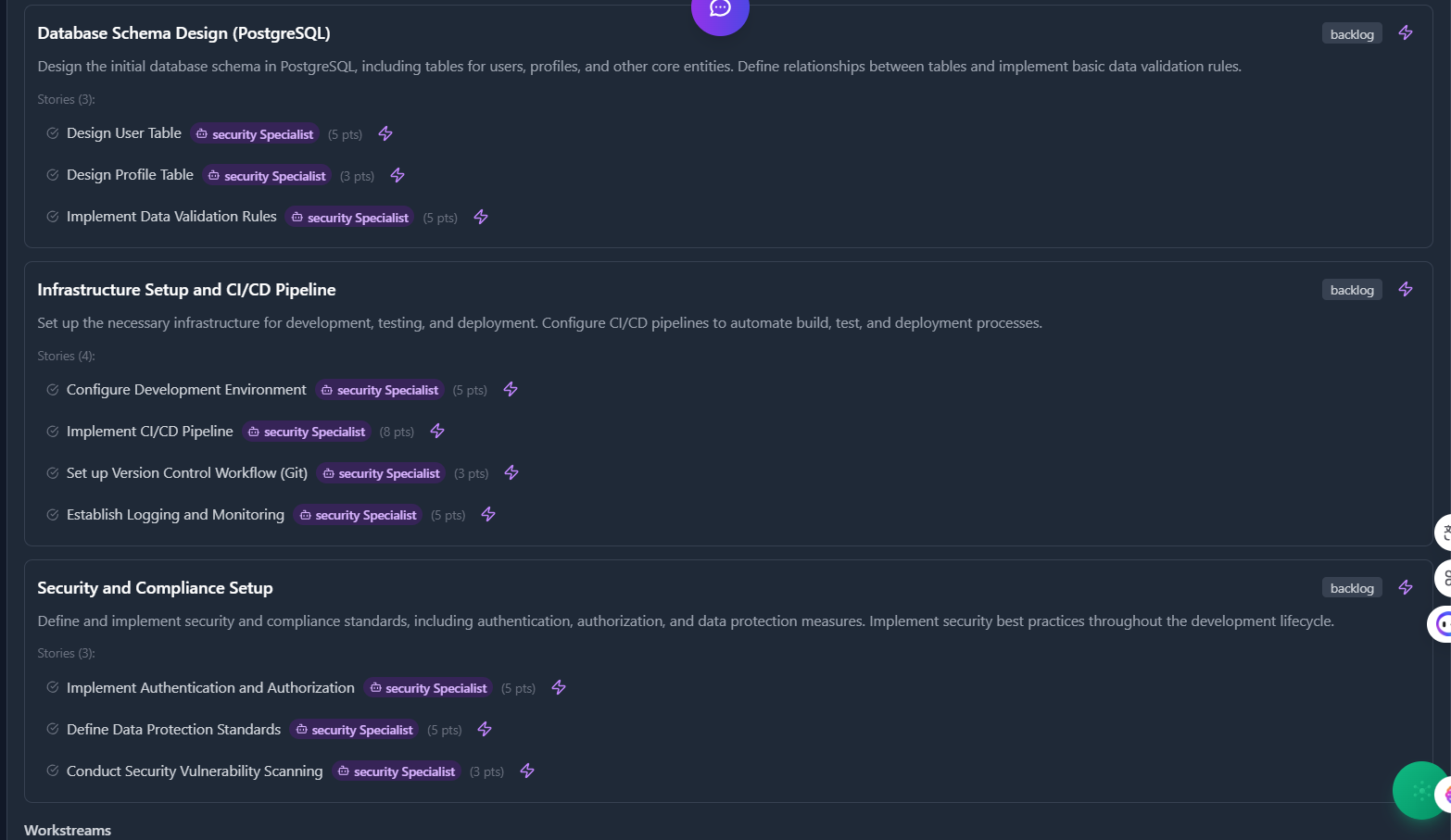
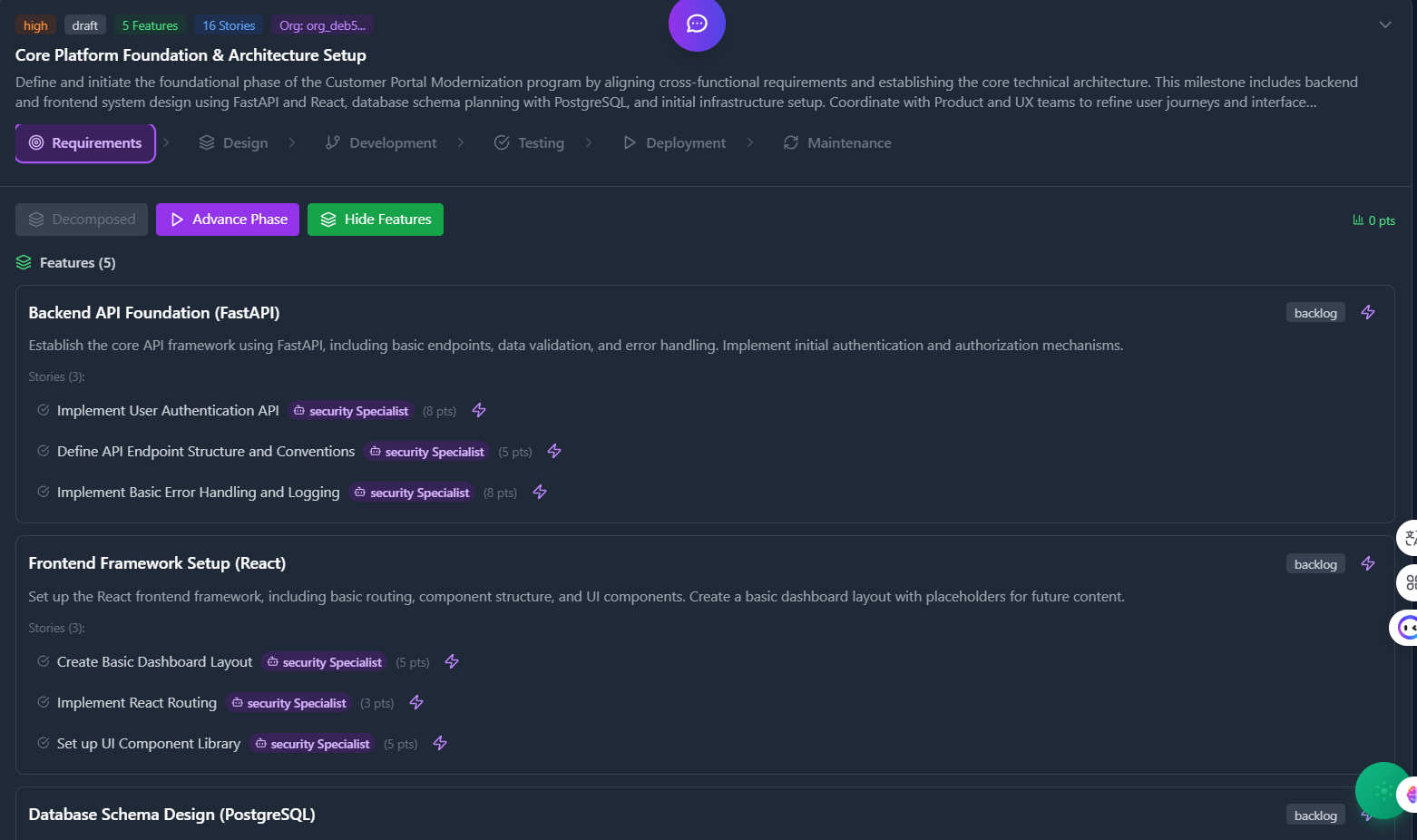
Synthesis automatically decomposes high-level Epics and Milestones into granular Stories and Tasks. Each decomposed item carries priority, story points, acceptance criteria, and dependency mappings — ready for agent execution without any manual decomposition effort.

  • AI-powered Epic-to-Story decomposition with smart prioritization
  • Automatic story point estimation and dependency mapping
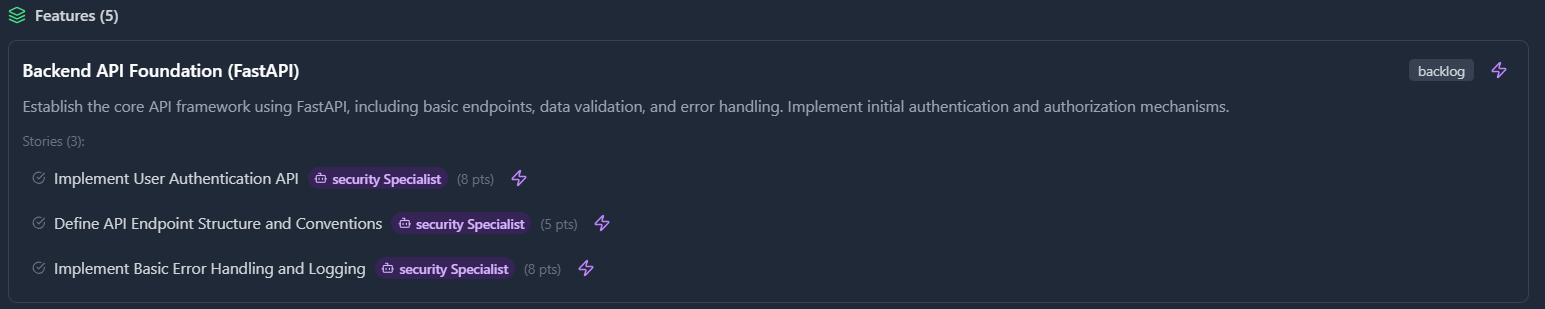
  • Bounded story-task relationship tracking for full traceability
  • Hierarchical view: Program > Epic > Milestone > Story > Task > Subtask
Epic Decomposition DAEDALUS • Intellecta

Epic & Milestone Decomposition

Automatic decomposition of Epics into Stories with priority and points

Story Task Bounded DAEDALUS • Intellecta

Story & Task Bounded View

Full traceability from stories to their decomposed tasks

3. Orion Execution Engine

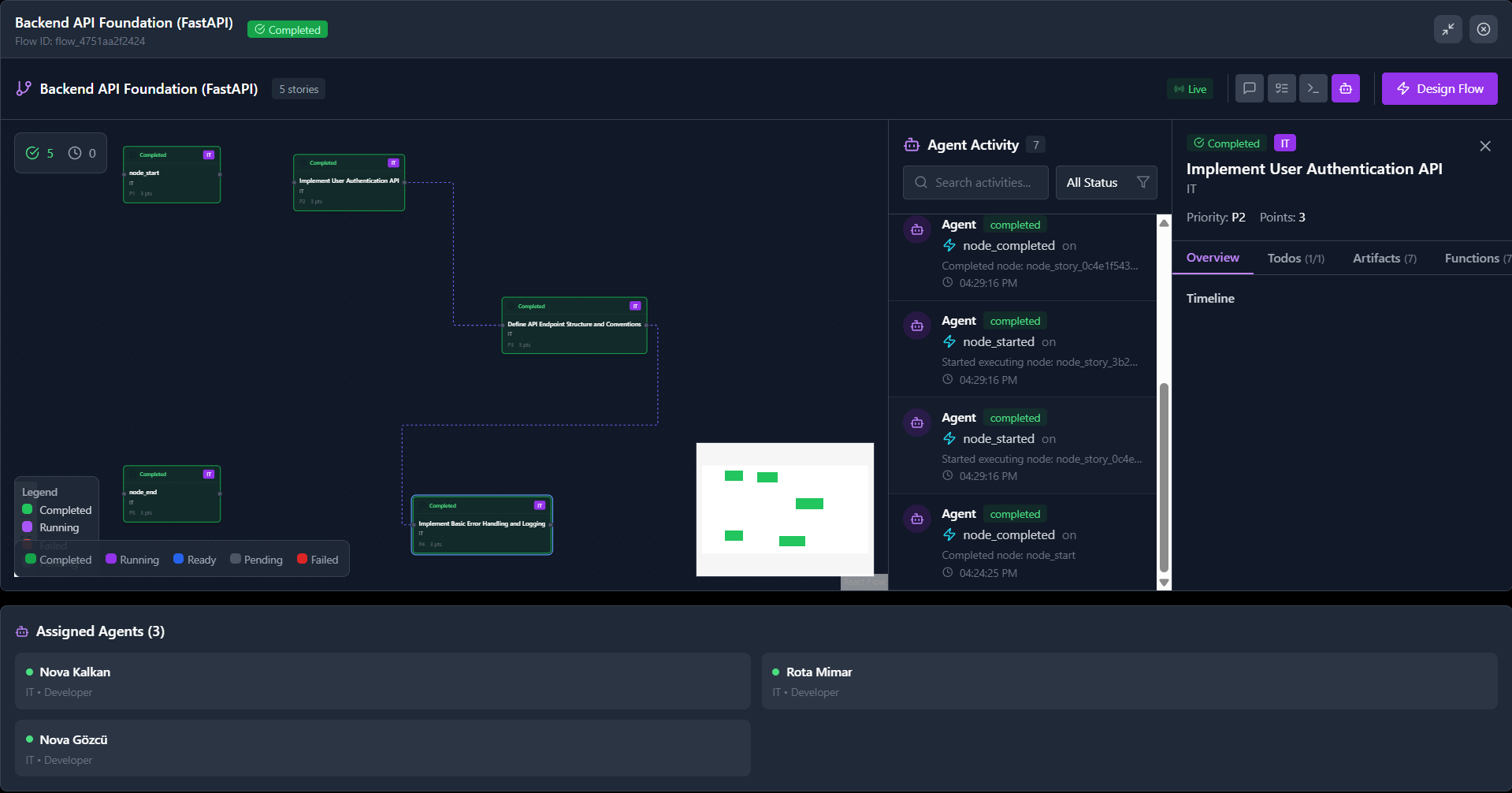
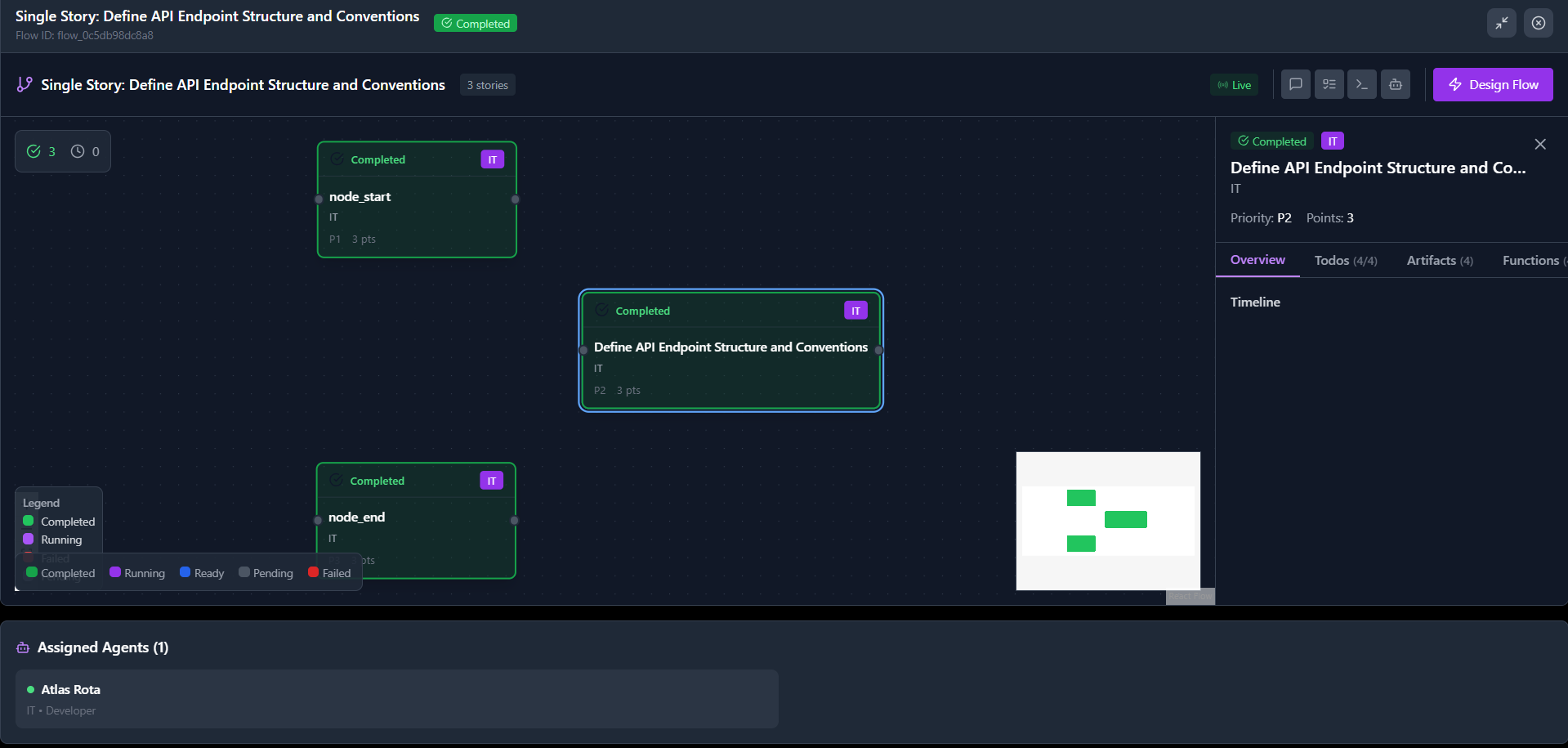
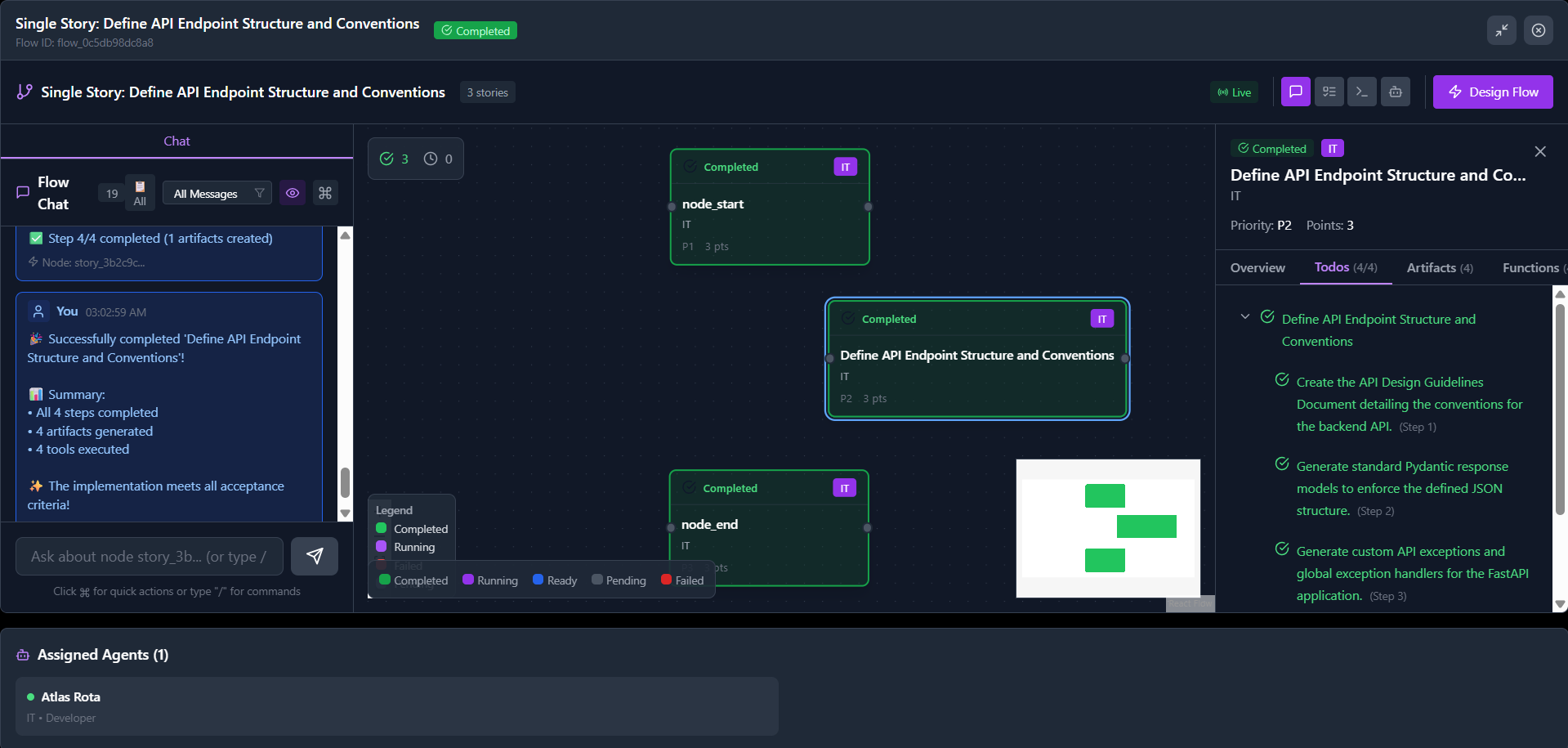
Orion is the autonomous execution backbone. It takes decomposed feature flows, assigns specialized agents to each story node, executes them in topological order (respecting dependencies), tracks real-time progress, and produces code artifacts — complete with todos, functions, and flow chat for human-agent collaboration.

  • Topological DAG execution with dependency-aware scheduling
  • Real-time agent activity monitoring and flow chat
  • Auto-generated code artifacts: source files, tests, configs, docs
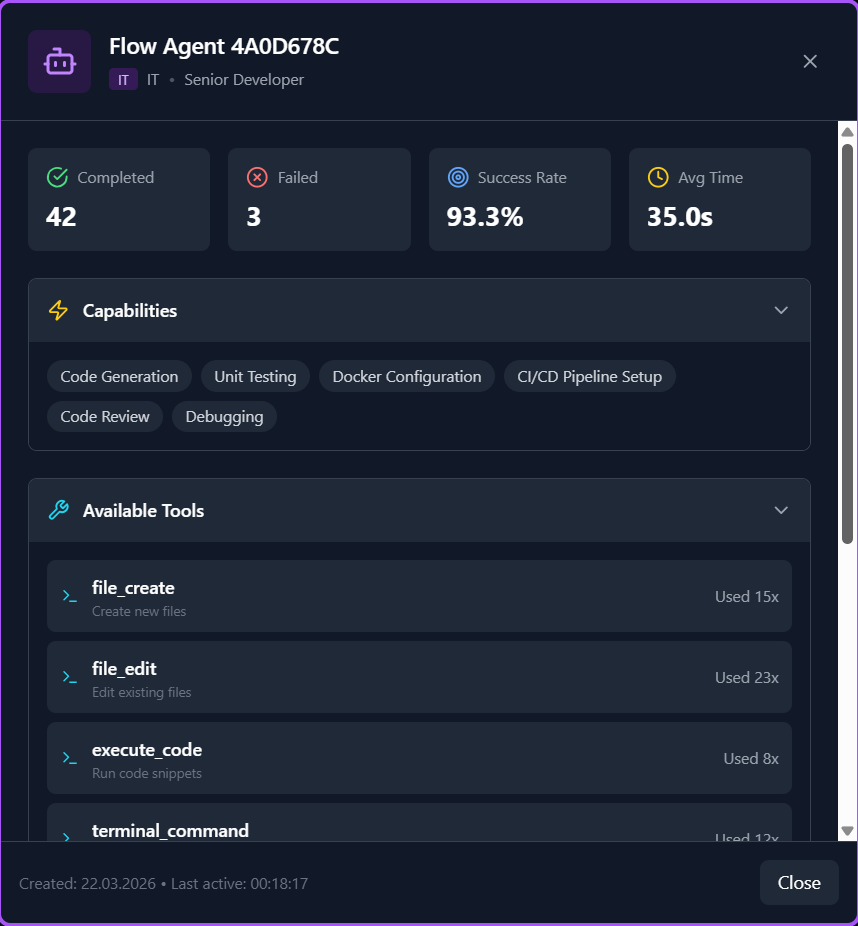
  • Agent assignment with capabilities, success rate, and performance metrics
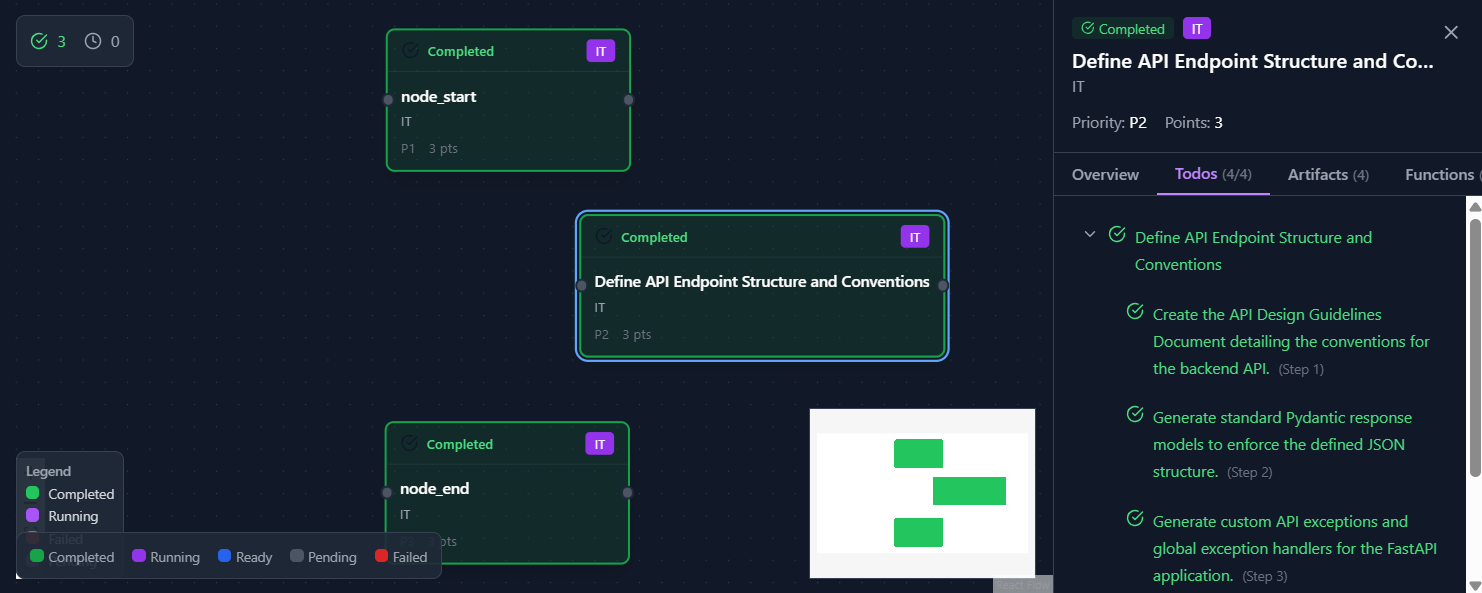
Orion Execution Flow DAEDALUS • Intellecta

Orion Execution Flow

DAG-based story execution with real-time status tracking

Orion Agent Activity DAEDALUS • Intellecta

Agent Activity & Artifacts

Live agent activity log with completed artifacts per story

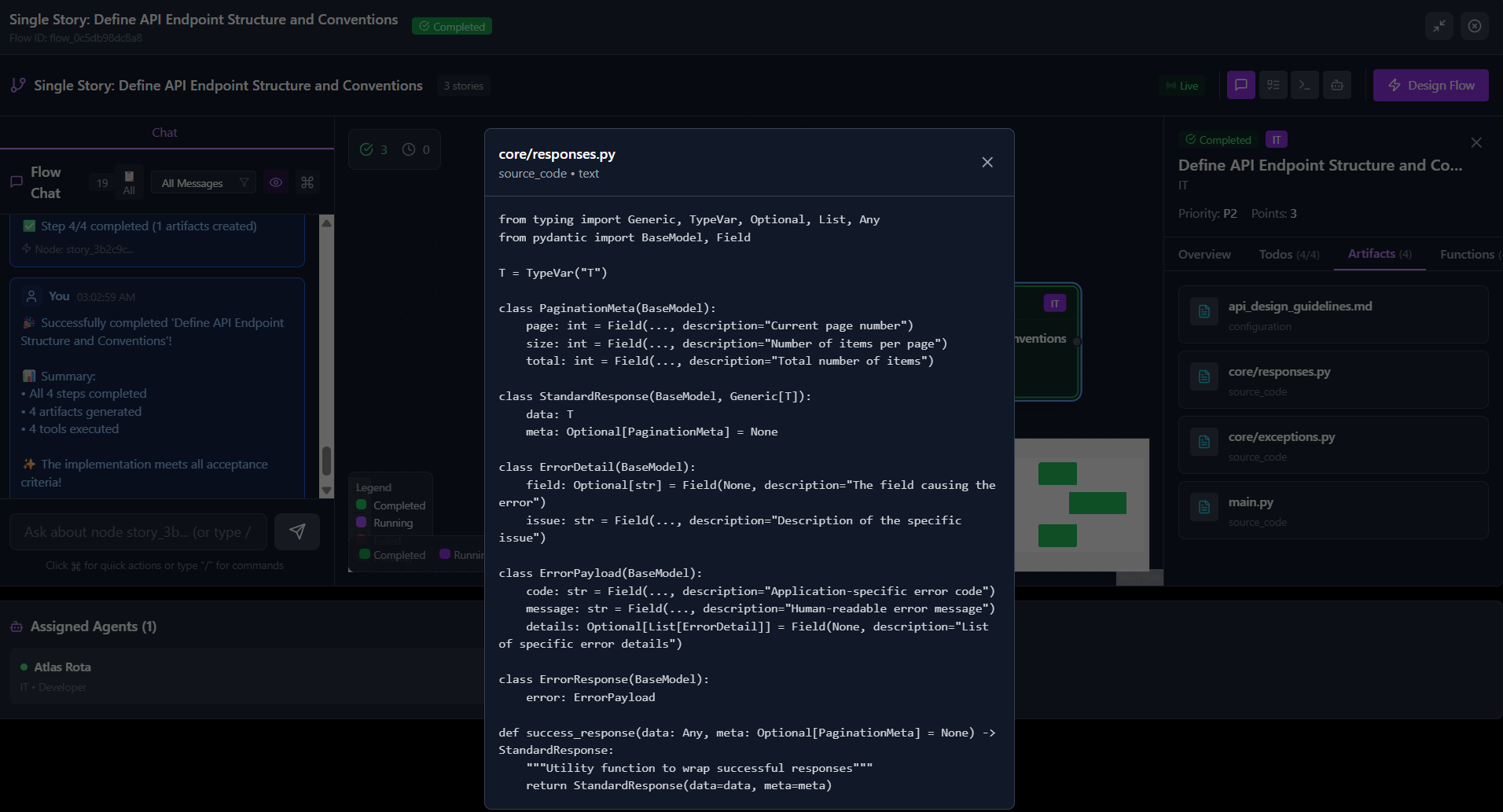
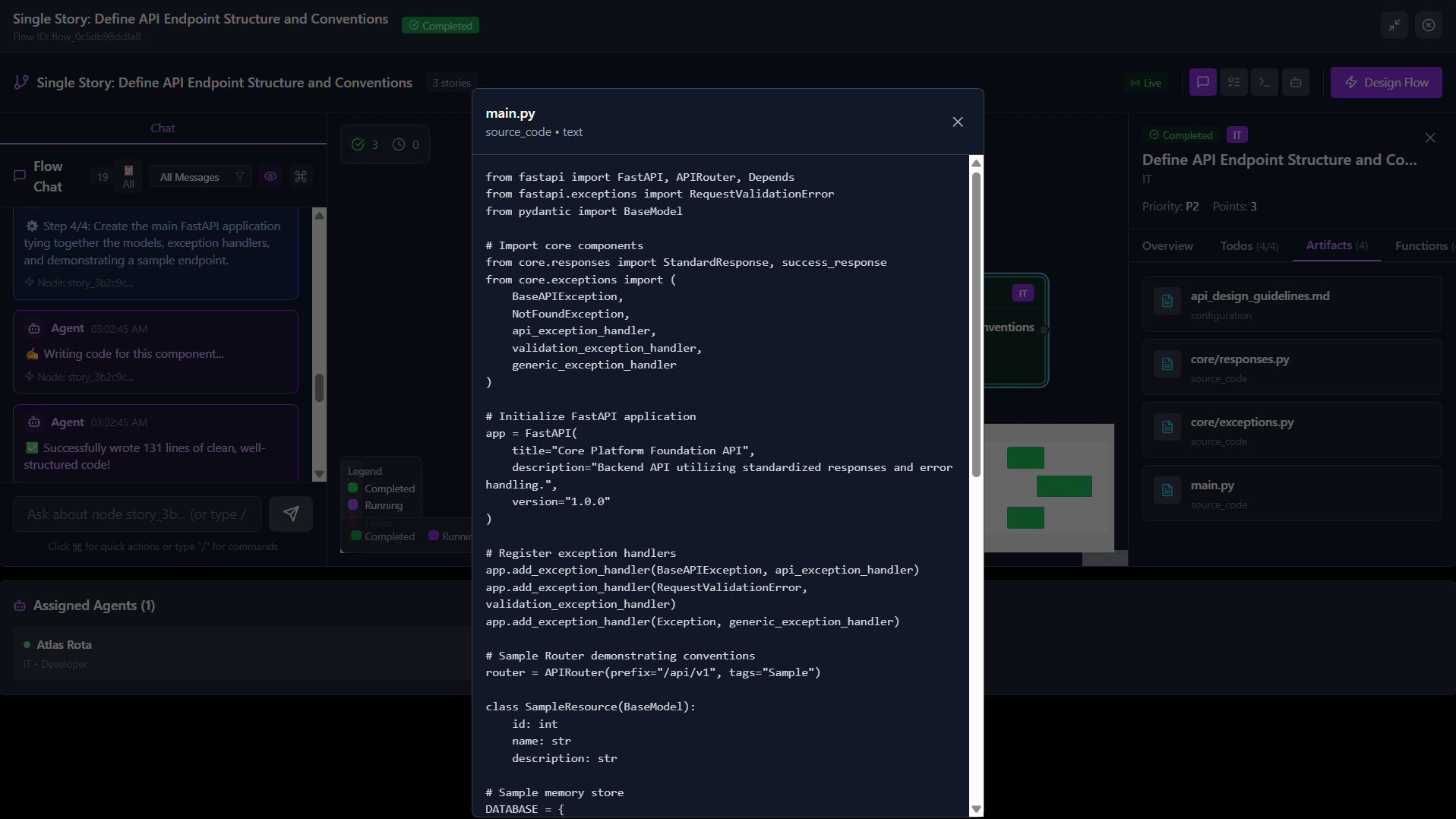
Orion Code Generation DAEDALUS • Intellecta

Code Artifact Generation

Production-ready source code generated by Orion agents

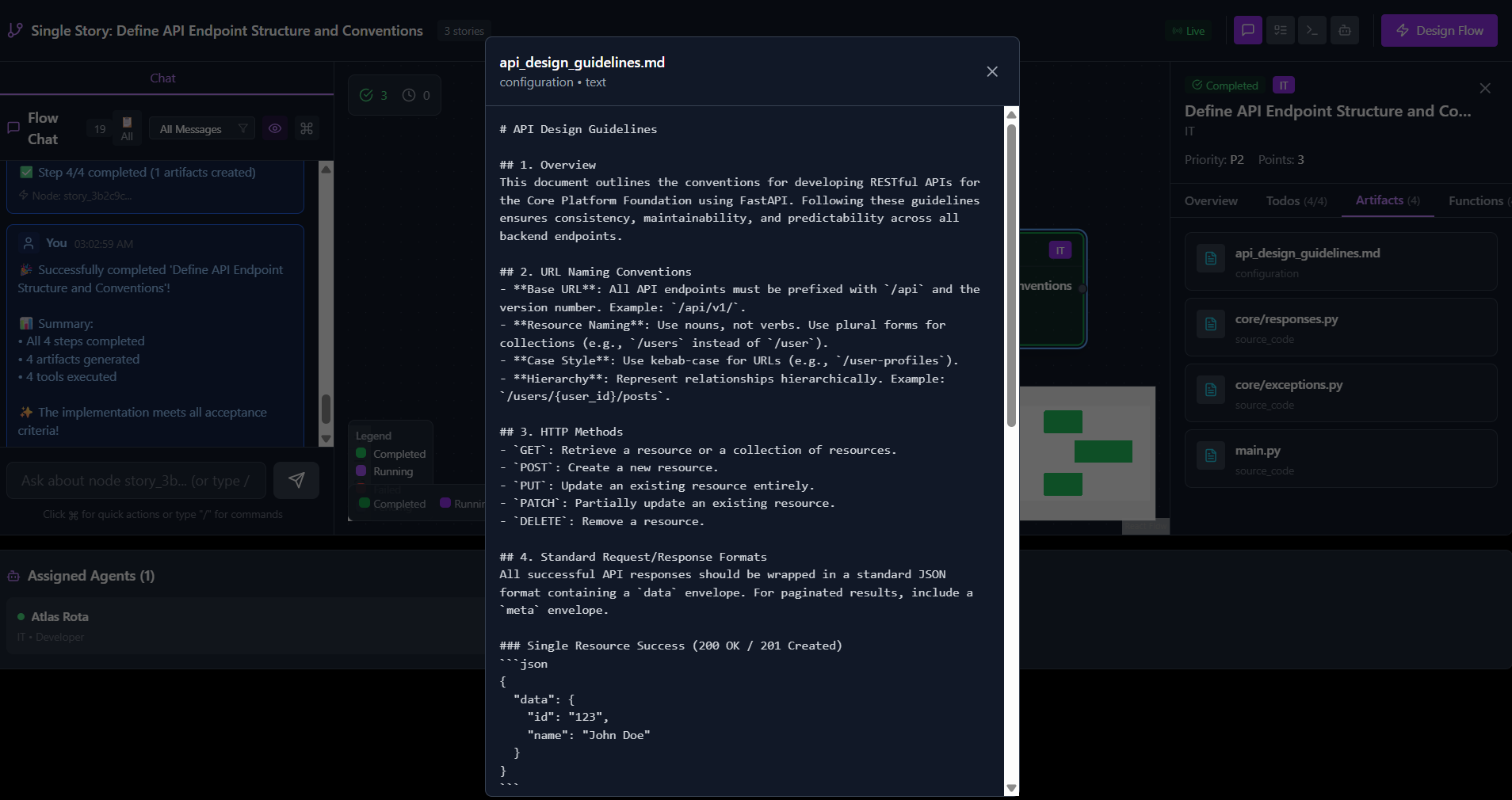
Orion Conventions DAEDALUS • Intellecta

API Conventions & Docs

Auto-generated API conventions and endpoint documentation

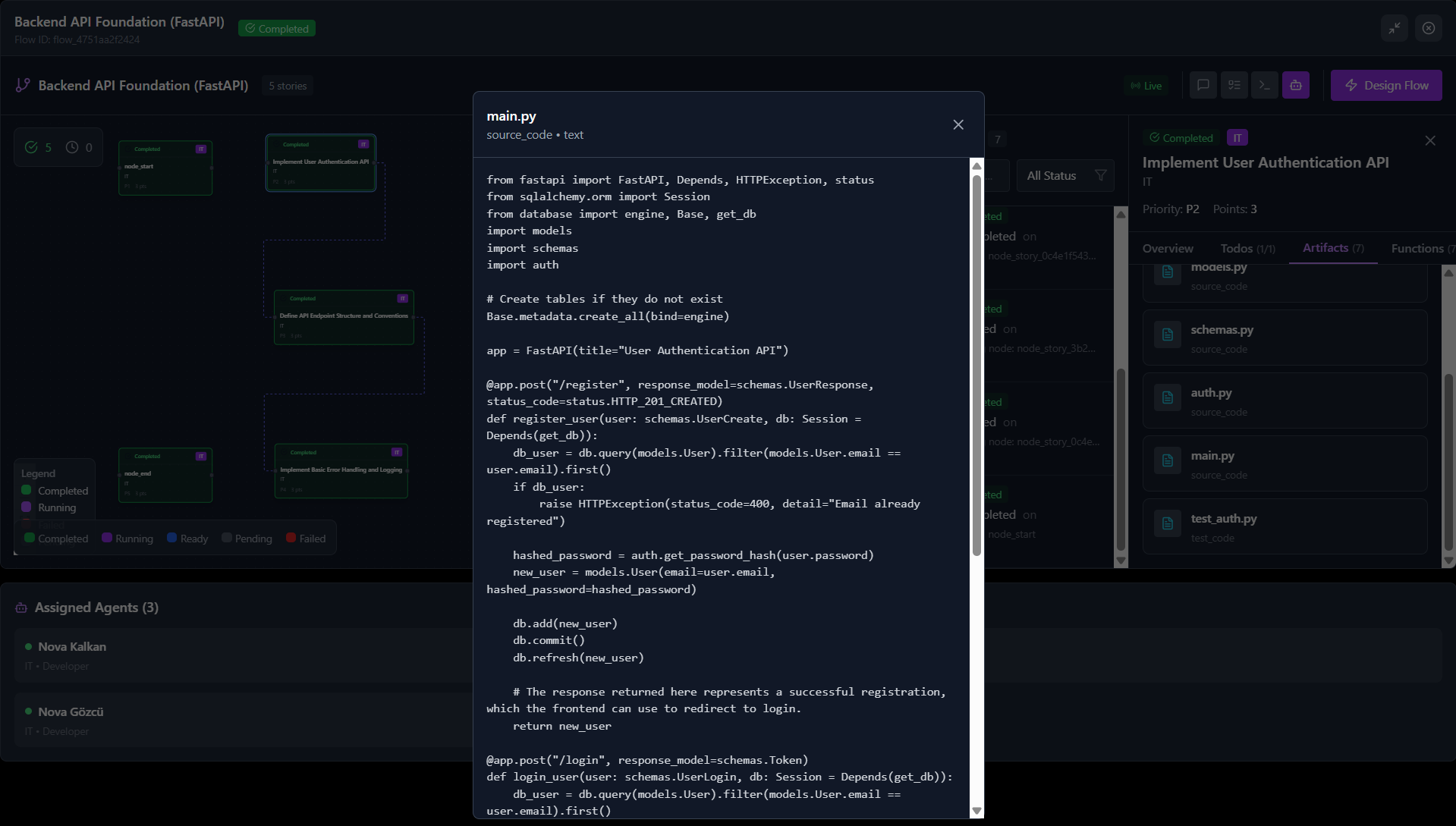
Orion Main Application DAEDALUS • Intellecta

Application Code Output

Full main.py application generated with authentication API

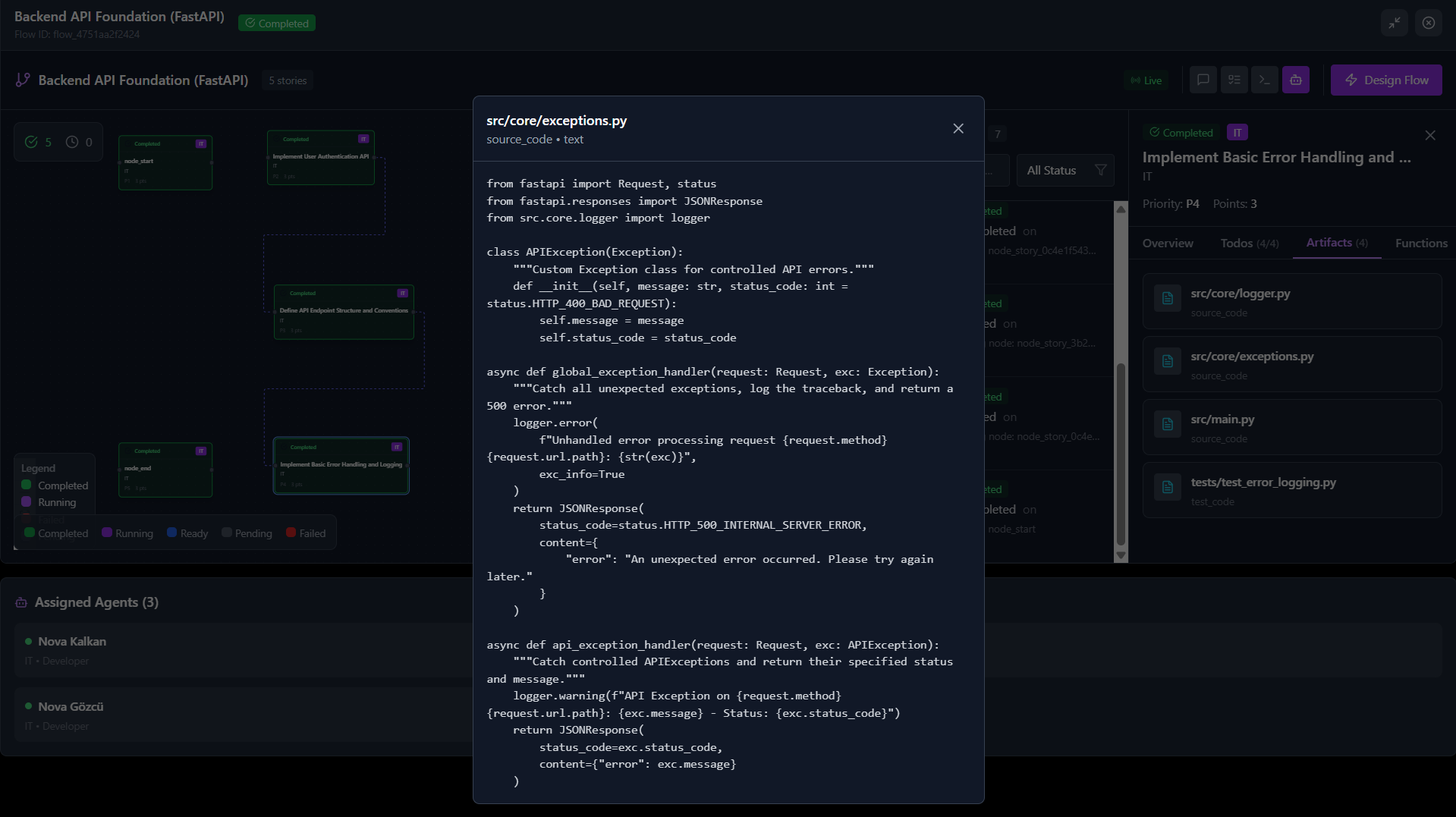
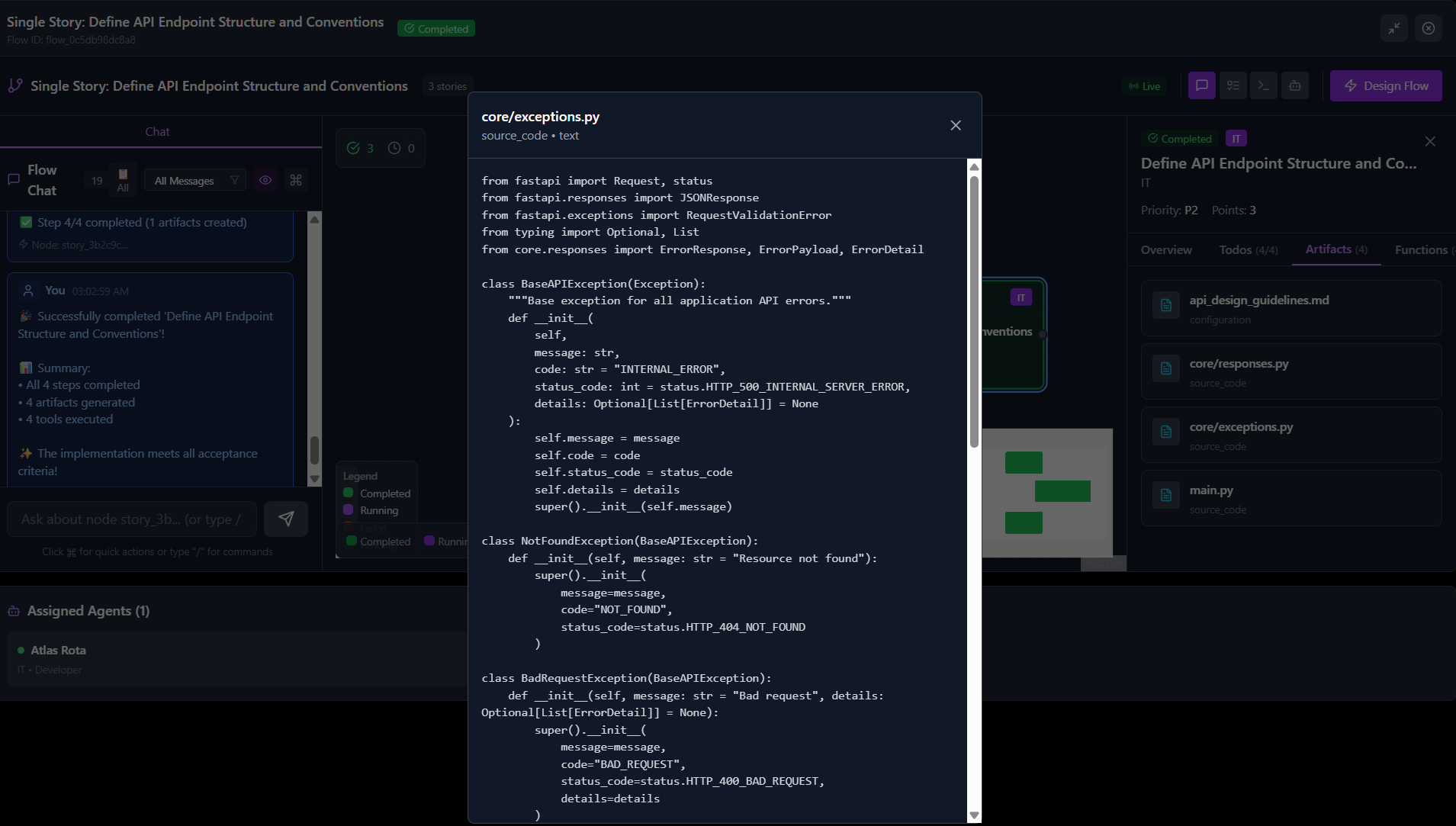
Orion Error Handling DAEDALUS • Intellecta

Error Handling & Logging

Auto-generated exception handlers and logging infrastructure

4. Task Execution & Agent Dashboard

Each story execution is fully transparent. View assigned agents, their real-time progress, generated artifacts (source code, configs, tests), todo completion status, function calls, and direct flow chat with agent teams — all from the execution dashboard.

  • Per-story execution dashboard with agent assignment details
  • Live artifact viewer: source code, requirements, schemas, tests
  • Todo tracking and function execution logs per story
  • Flow chat for human-agent collaboration during execution
Task Execution Dashboard DAEDALUS • Intellecta

Task Execution Dashboard

Comprehensive execution overview with story status and agents

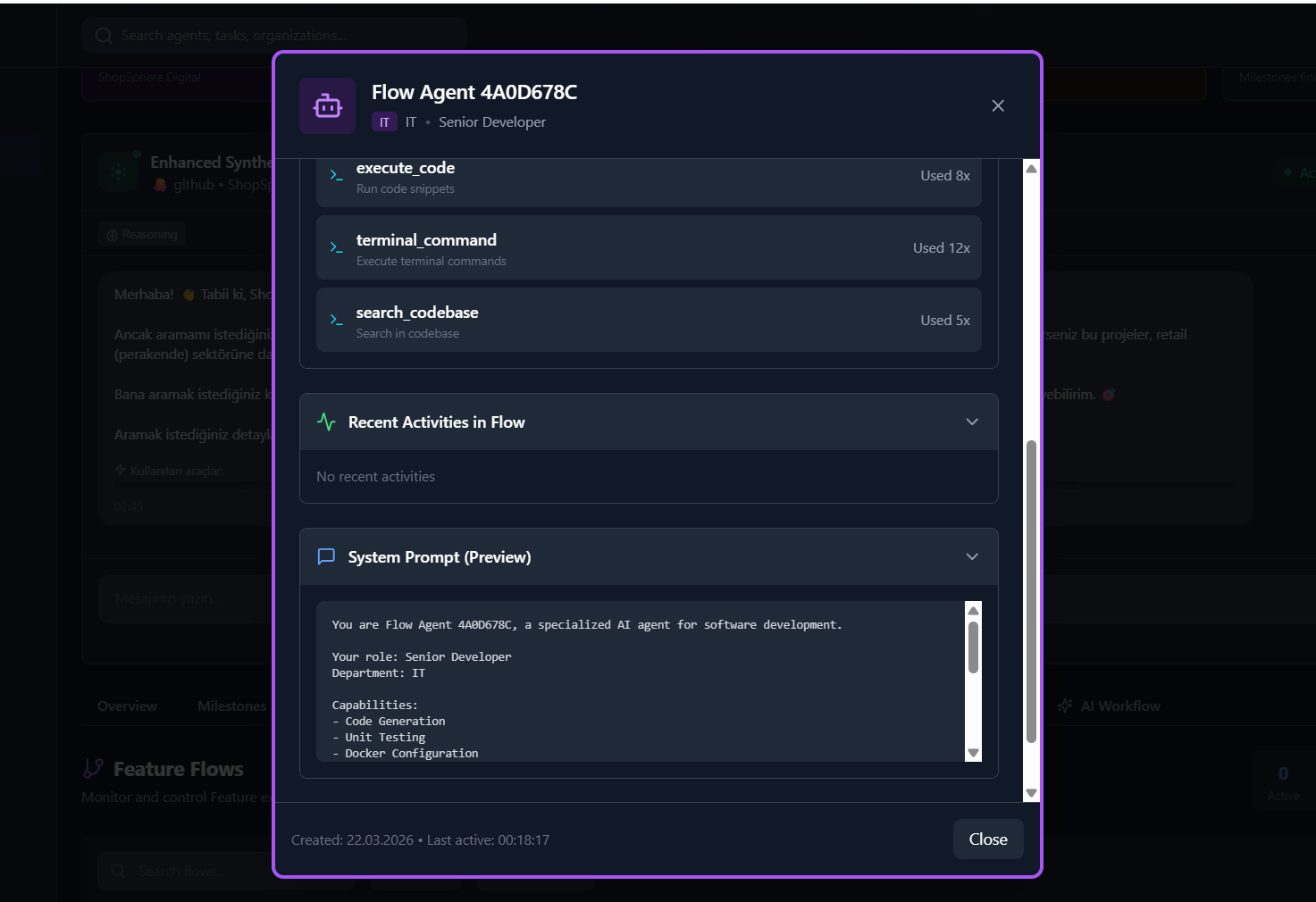
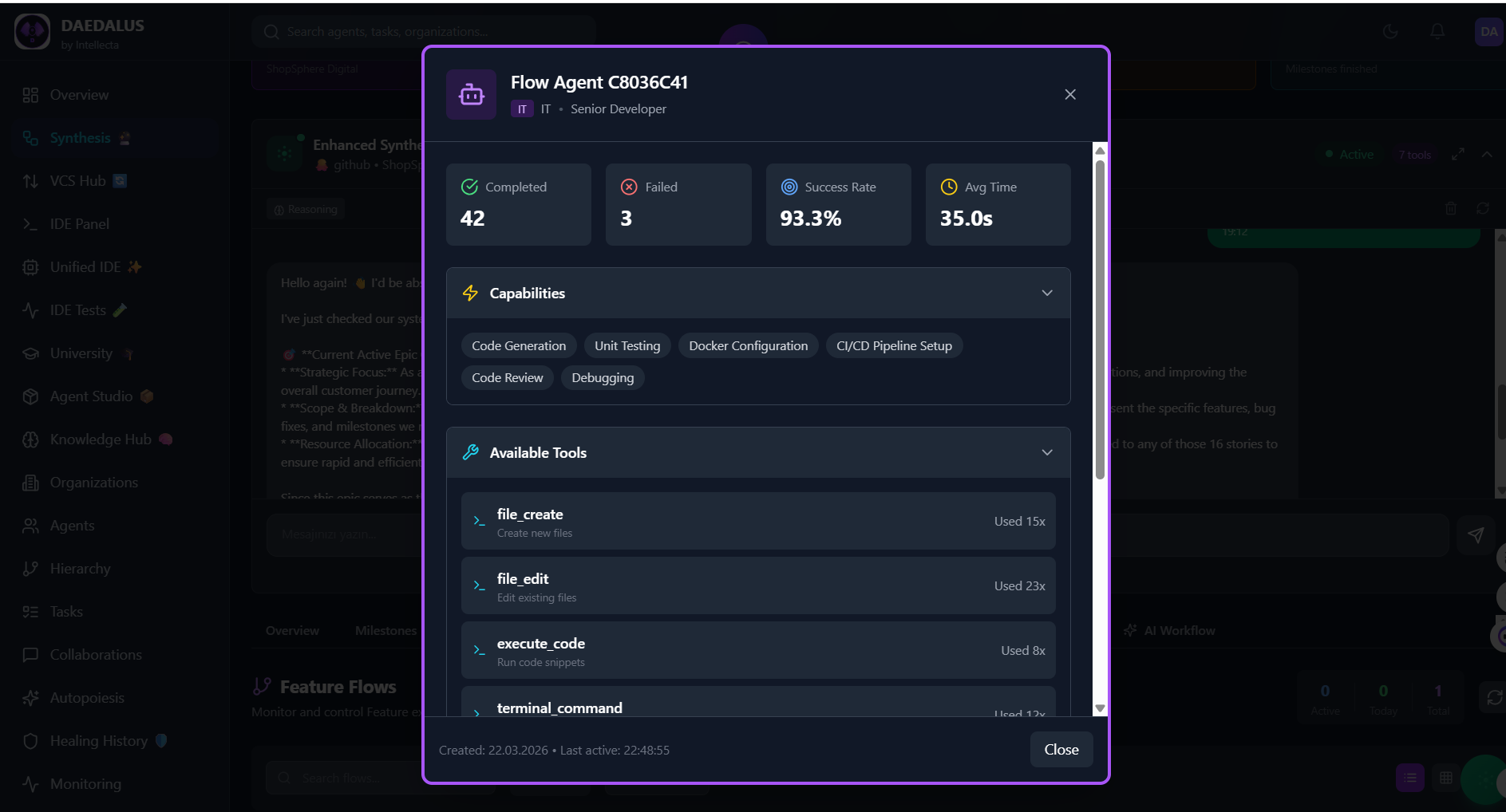
Execution Agent 1 DAEDALUS • Intellecta

Execution Agent Detail

Agent capabilities, success rate, and tool usage metrics

Execution Agent 2 DAEDALUS • Intellecta

Agent Performance View

Completed tasks, failed tasks, and average execution time

Story Task Flow DAEDALUS • Intellecta

Story-Task Flow Execution

Visual flow of story execution with task dependency graph

Orion Execution Agent DAEDALUS • Intellecta

Orion Execution Agent

Agent profile with full execution history and capabilities

5. Artifacts, Todos, Chat & Functions

Every executed story produces a rich set of outputs. Browse generated source code artifacts, track todo completion for each story step, review function execution logs, and communicate with agent teams through the integrated flow chat interface.

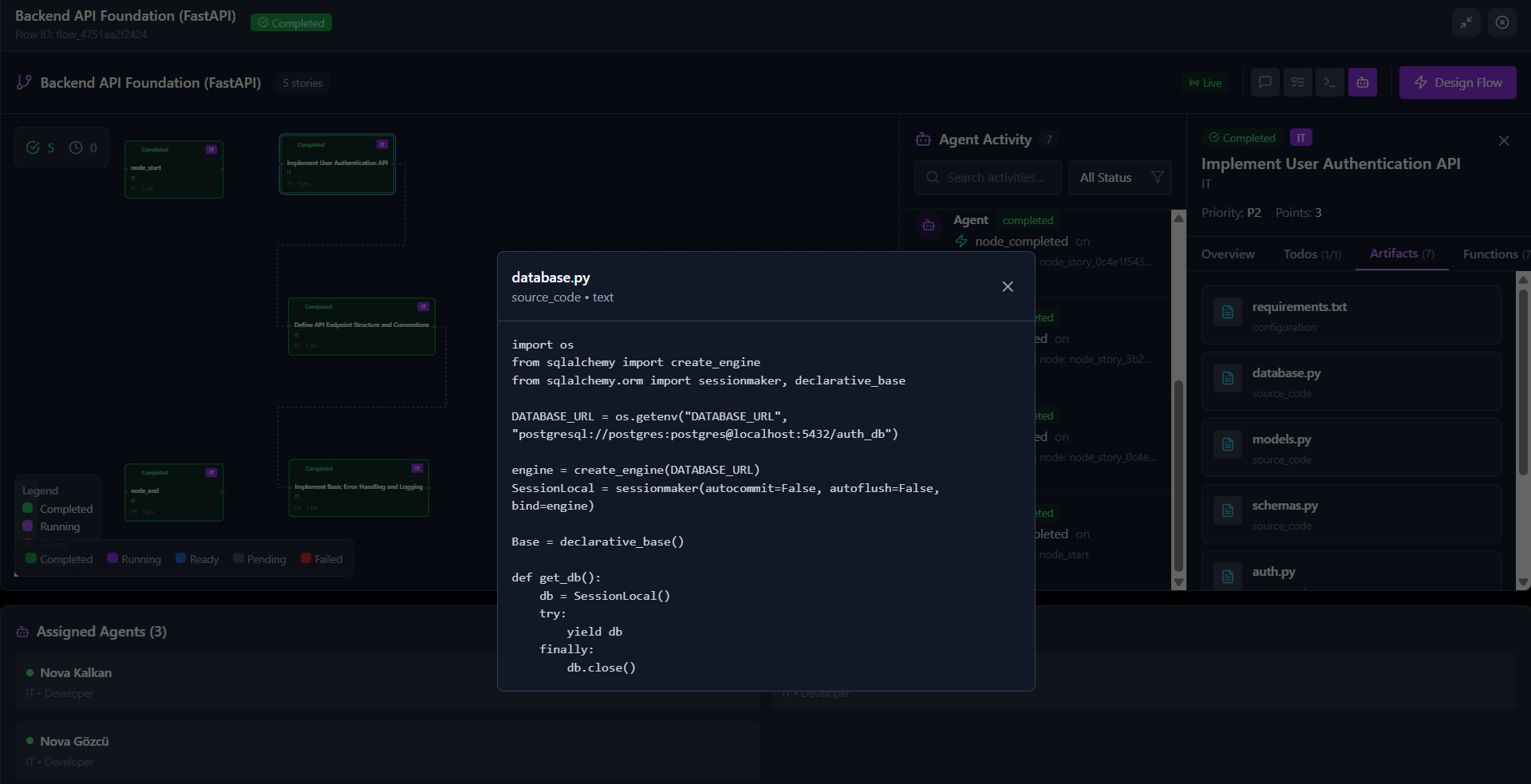
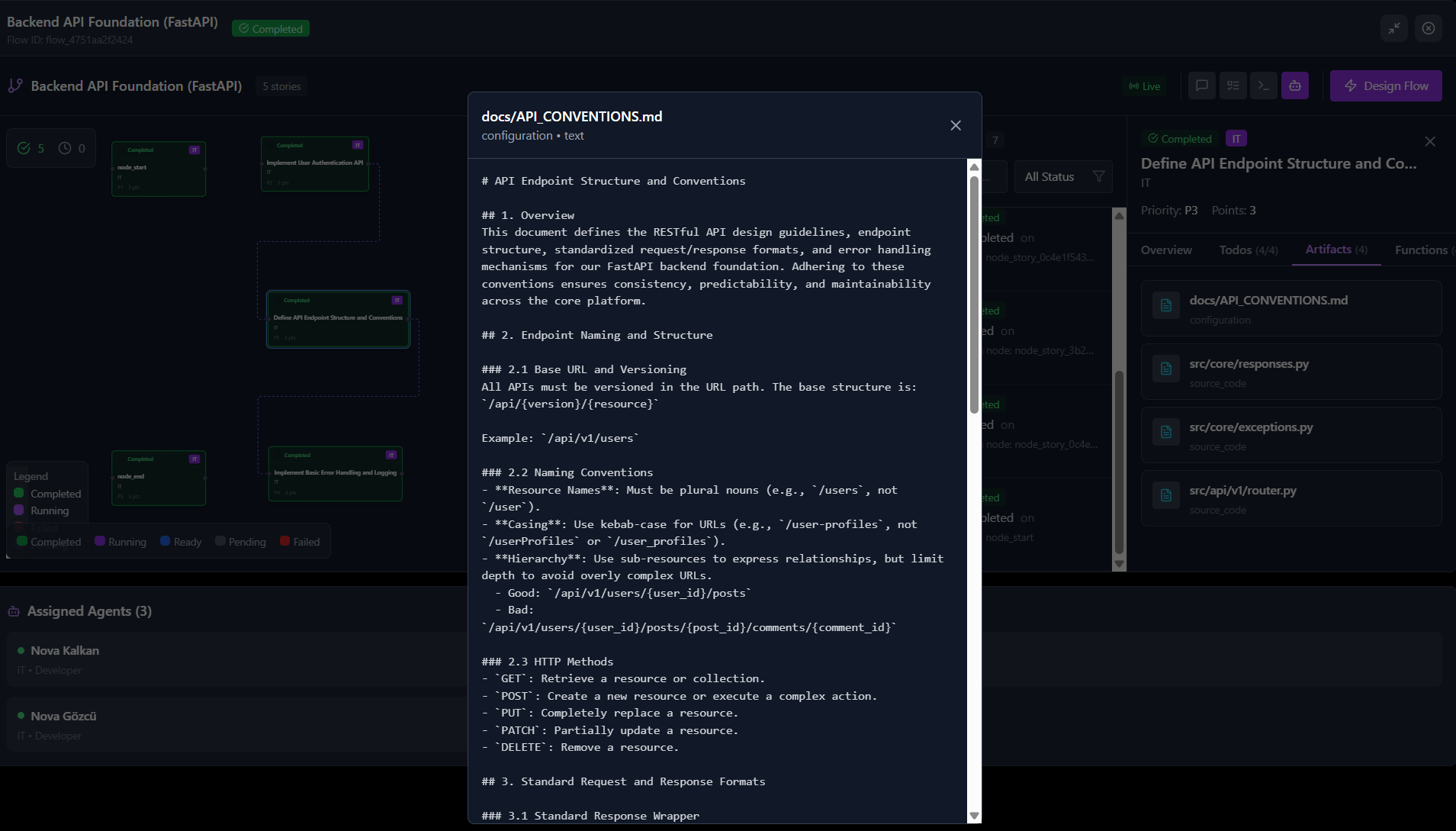
  • Multi-artifact viewer: database.py, models.py, schemas.py, auth.py, tests
  • Step-by-step todo tracking with completion status per story
  • Function execution log: file_create, file_edit, execute_code, terminal_command
  • Flow chat with full agent conversation history and summaries
Artifacts View 1 DAEDALUS • Intellecta

Artifacts: Requirements & Config

Auto-generated requirements.txt and configuration files

Artifacts View 2 DAEDALUS • Intellecta

Artifacts: Database & Models

database.py and models.py with SQLAlchemy ORM setup

Artifacts View 3 DAEDALUS • Intellecta

Artifacts: Schemas & Auth

Pydantic schemas and authentication module

Artifacts View 4 DAEDALUS • Intellecta

Artifacts: Exception Handling

Custom exception classes and global error handlers

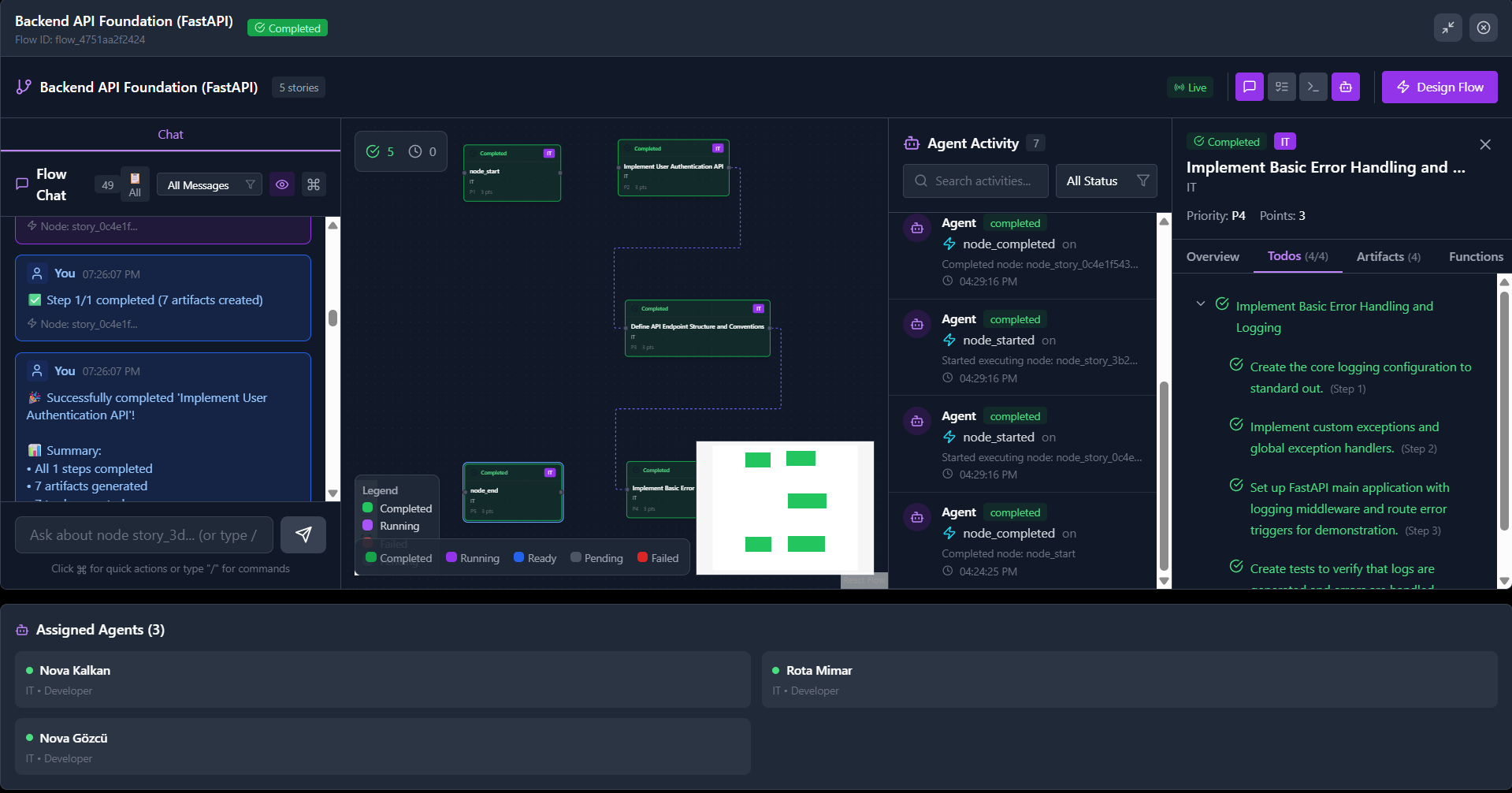
Todos View DAEDALUS • Intellecta

Todo Tracking

Step-by-step todo completion for each story execution

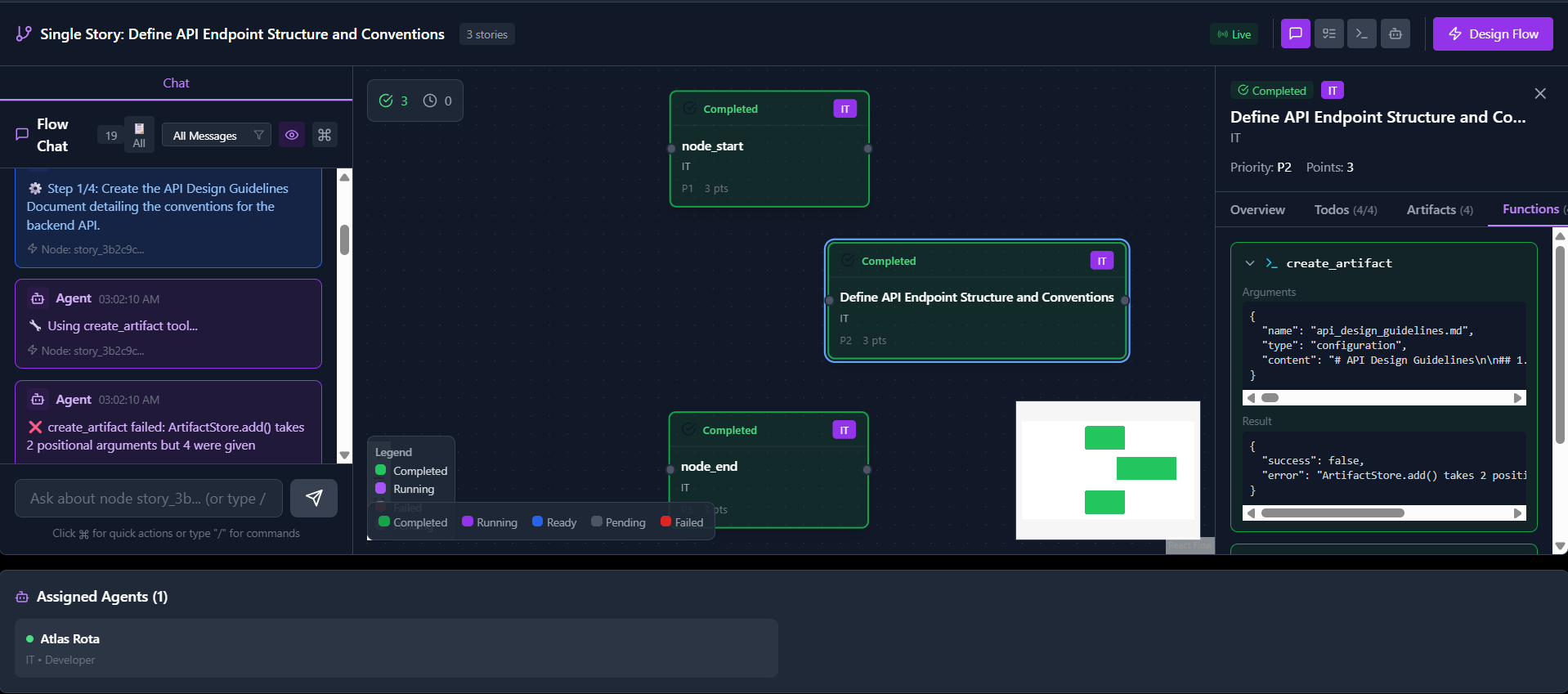
Functions View DAEDALUS • Intellecta

Function Execution Log

file_create, file_edit, execute_code operations tracked

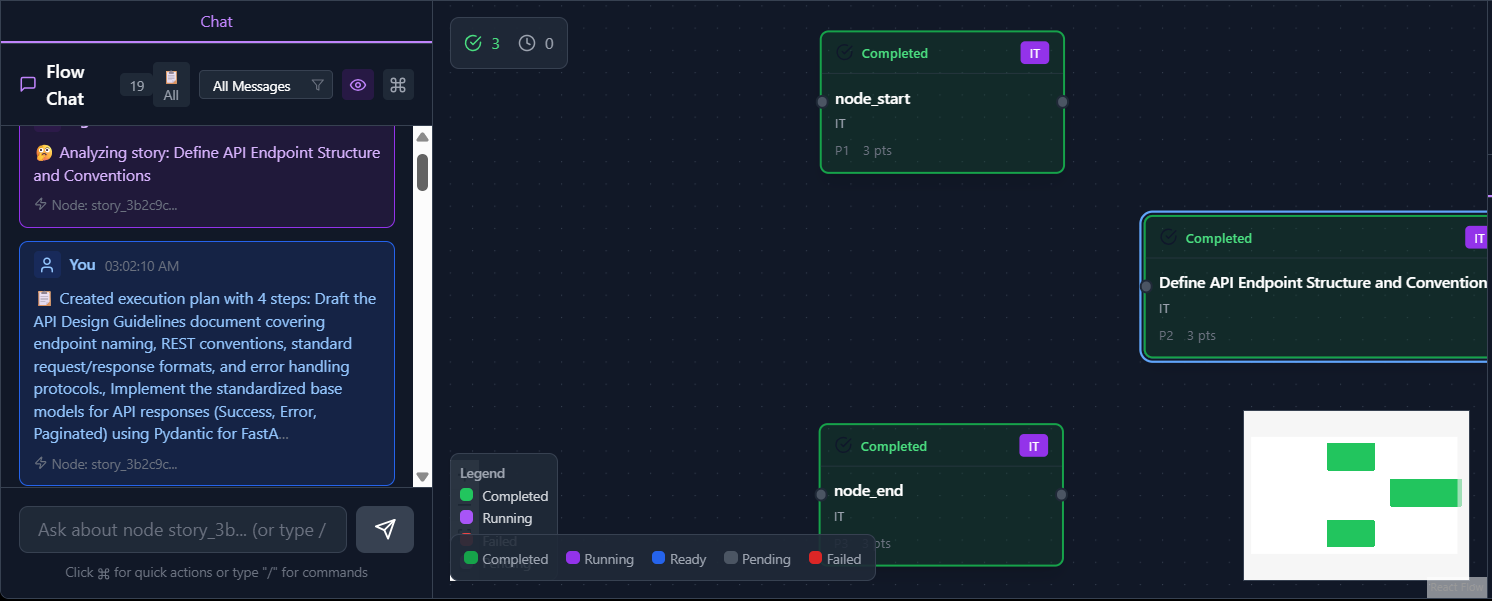
Flow Chat 1 DAEDALUS • Intellecta

Flow Chat: Agent Conversation

Real-time chat with executing agents for guidance and review

Flow Chat 2 DAEDALUS • Intellecta

Flow Chat: Completion Summary

Agent completion summaries with artifact count and status

6. VCS Integration: GitHub & GitLab

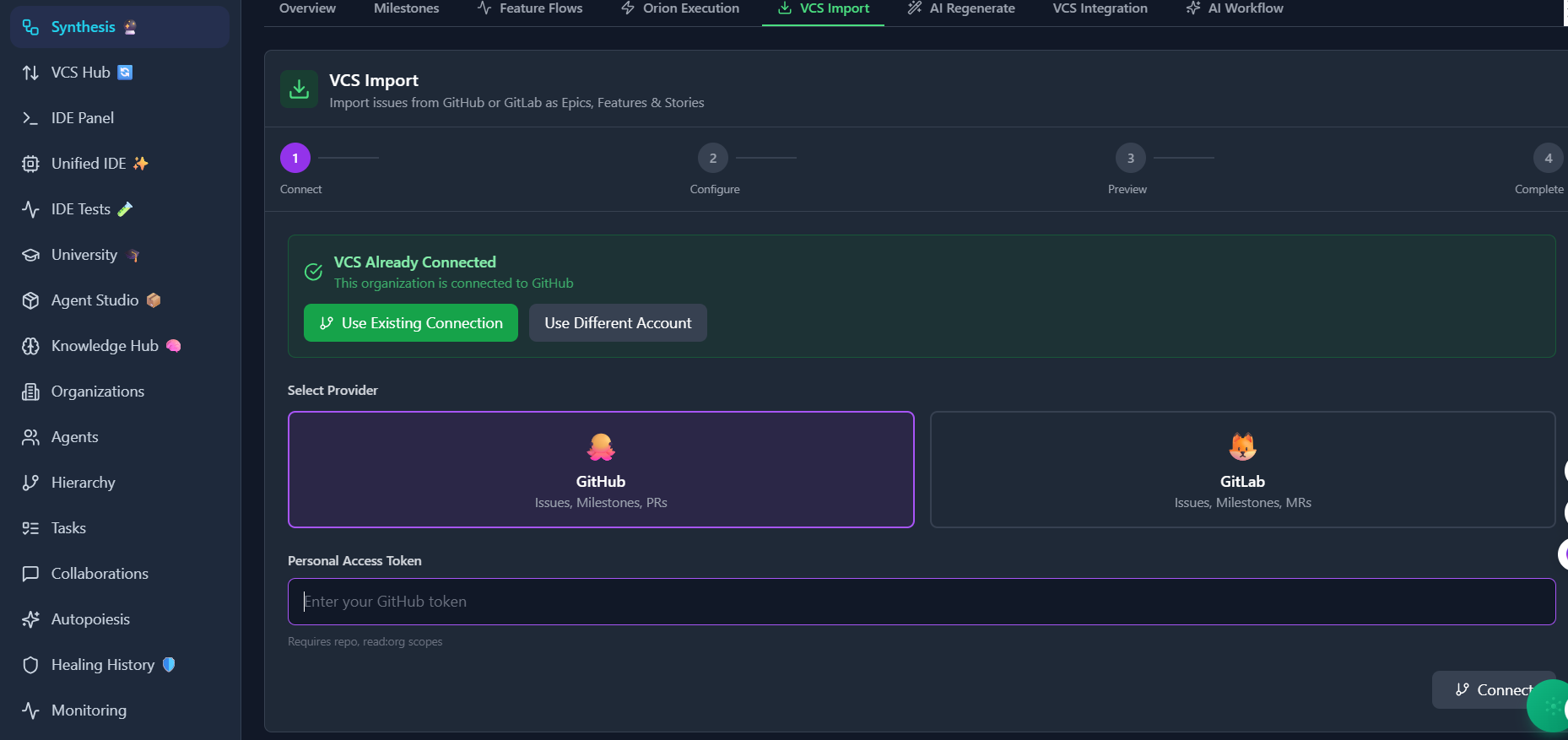
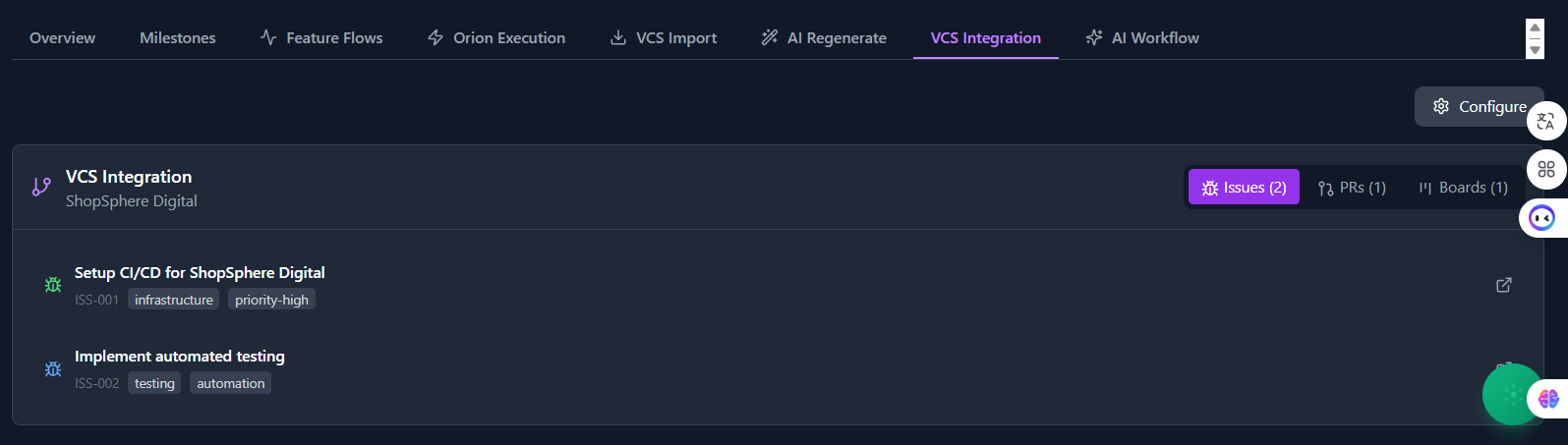
Synthesis connects directly to your version control system. Import existing issues from GitHub or GitLab as Epics, Features, and Stories. Push generated artifacts, sync milestone progress, and maintain complete traceability between Daedalus flows and your repository.

  • GitHub & GitLab provider support with OAuth/Token authentication
  • Import issues as Epics, Features, and Stories with full mapping
  • Bidirectional sync: Daedalus ↔ VCS for issues, PRs, and milestones
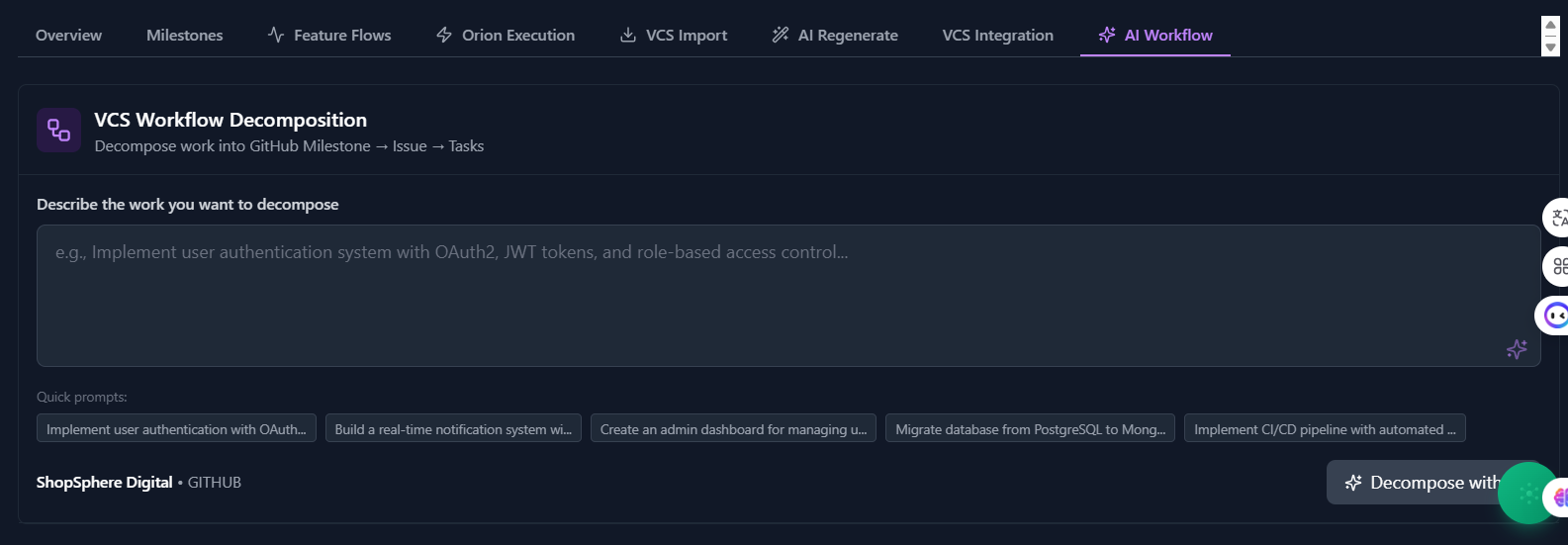
  • AI Workflow integration for automated CI/CD triggering
VCS Import DAEDALUS • Intellecta

VCS Import Wizard

Connect GitHub or GitLab and import issues as Epics & Stories

VCS Integration DAEDALUS • Intellecta

VCS Integration Dashboard

Bidirectional sync between Daedalus and your repository

AI Workflow DAEDALUS • Intellecta

AI Workflow

AI-powered workflow automation for CI/CD and deployment

Orion Execution Overview DAEDALUS • Intellecta

Orion Execution Overview

Complete execution pipeline from stories to deployed artifacts

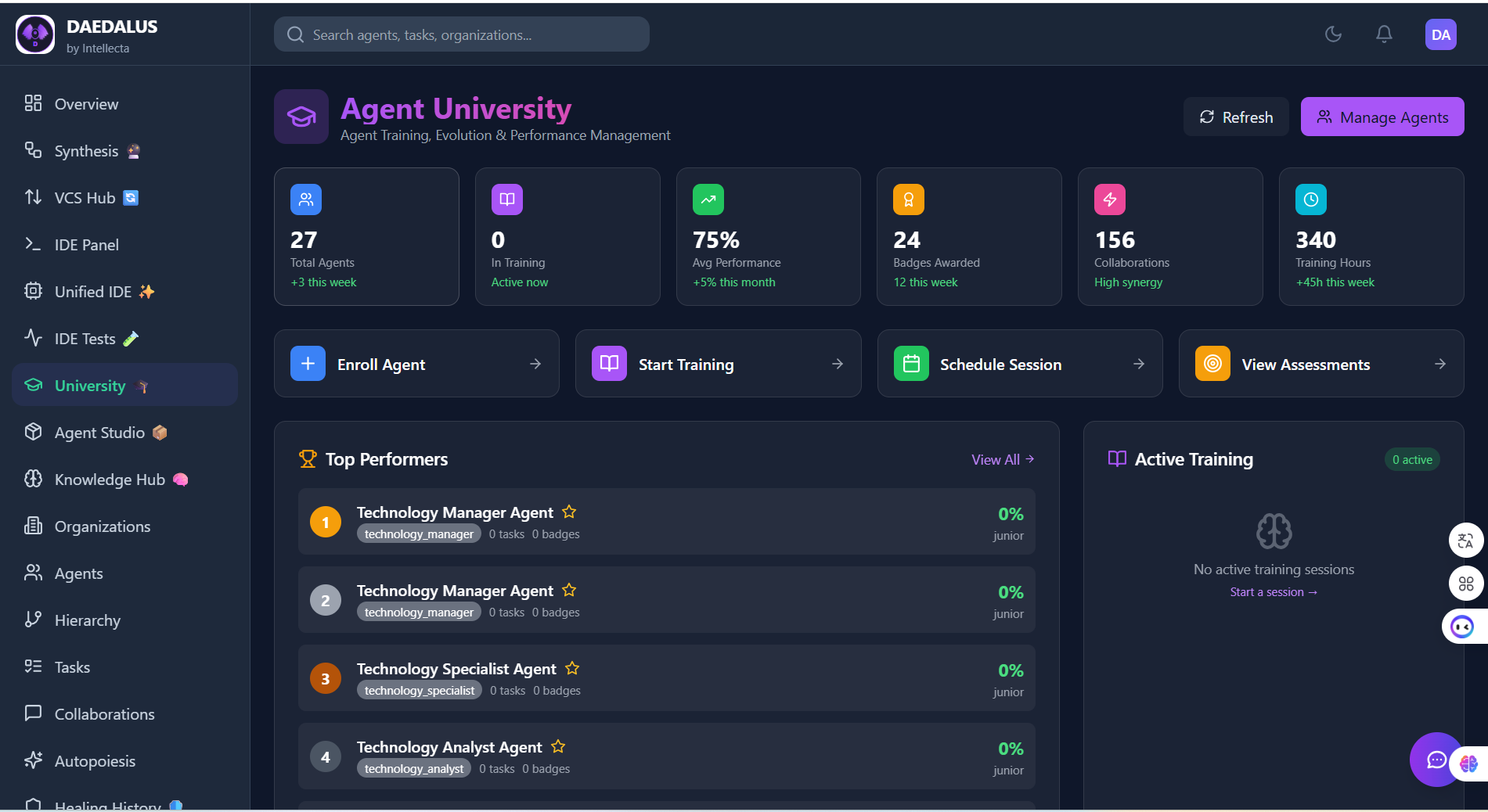
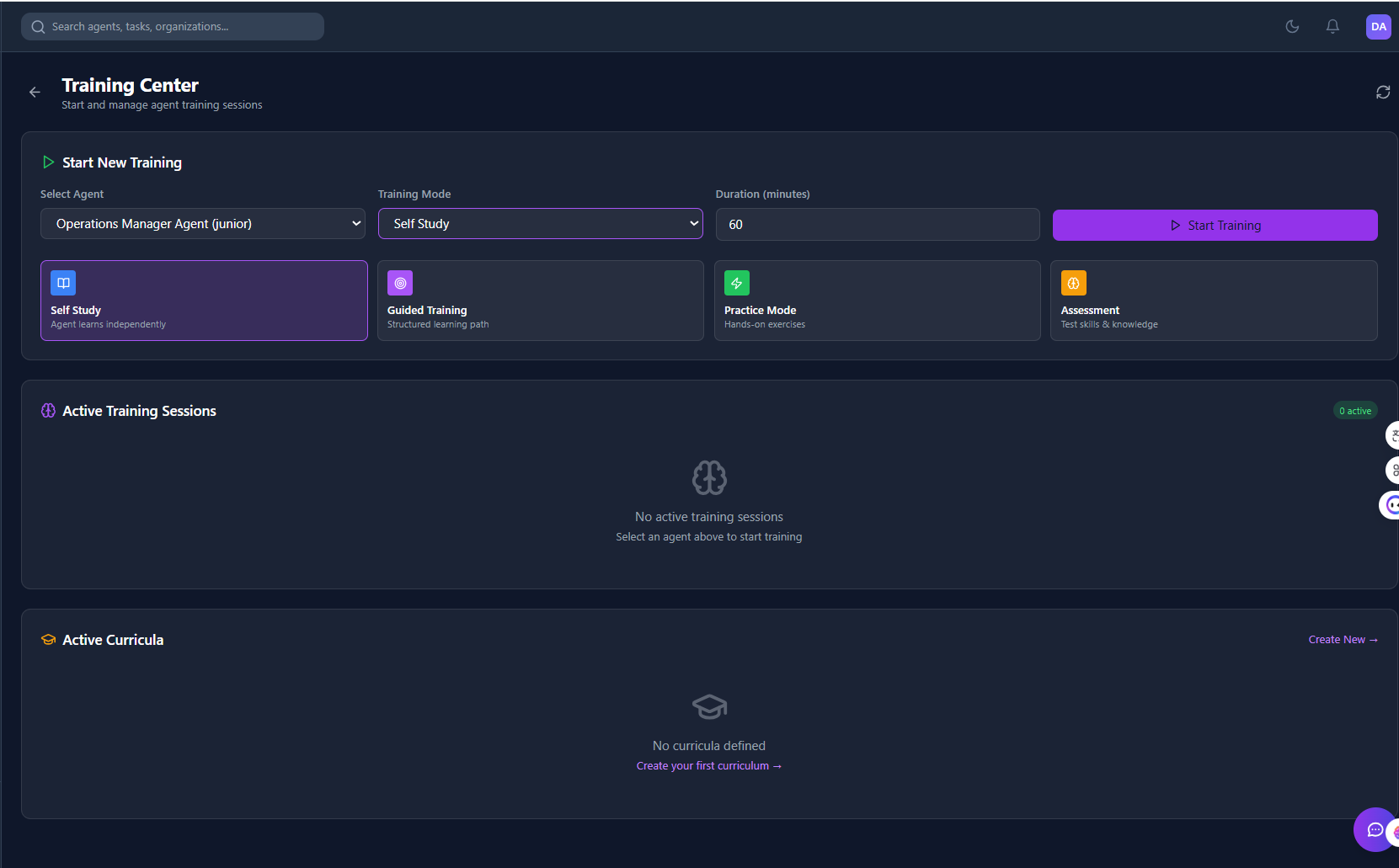
Agent University

Train, Certify & Evolve Your Agents

Agent University is Daedalus's structured learning ecosystem for AI agents. Enroll agents in curriculum-based programs, track their training progress in real time, certify specialists across domains, and enable continuous self-improvement — creating agents that get smarter with every interaction.

Curriculum Training
Agent Enrollment
Training Schedules
Progress Assessment
Self-Training Mode
Agent Management
Feature Assessment
Training Programs
Auto
Self-Training Mode
Live
Progress Tracking
AI
Assessment Engine

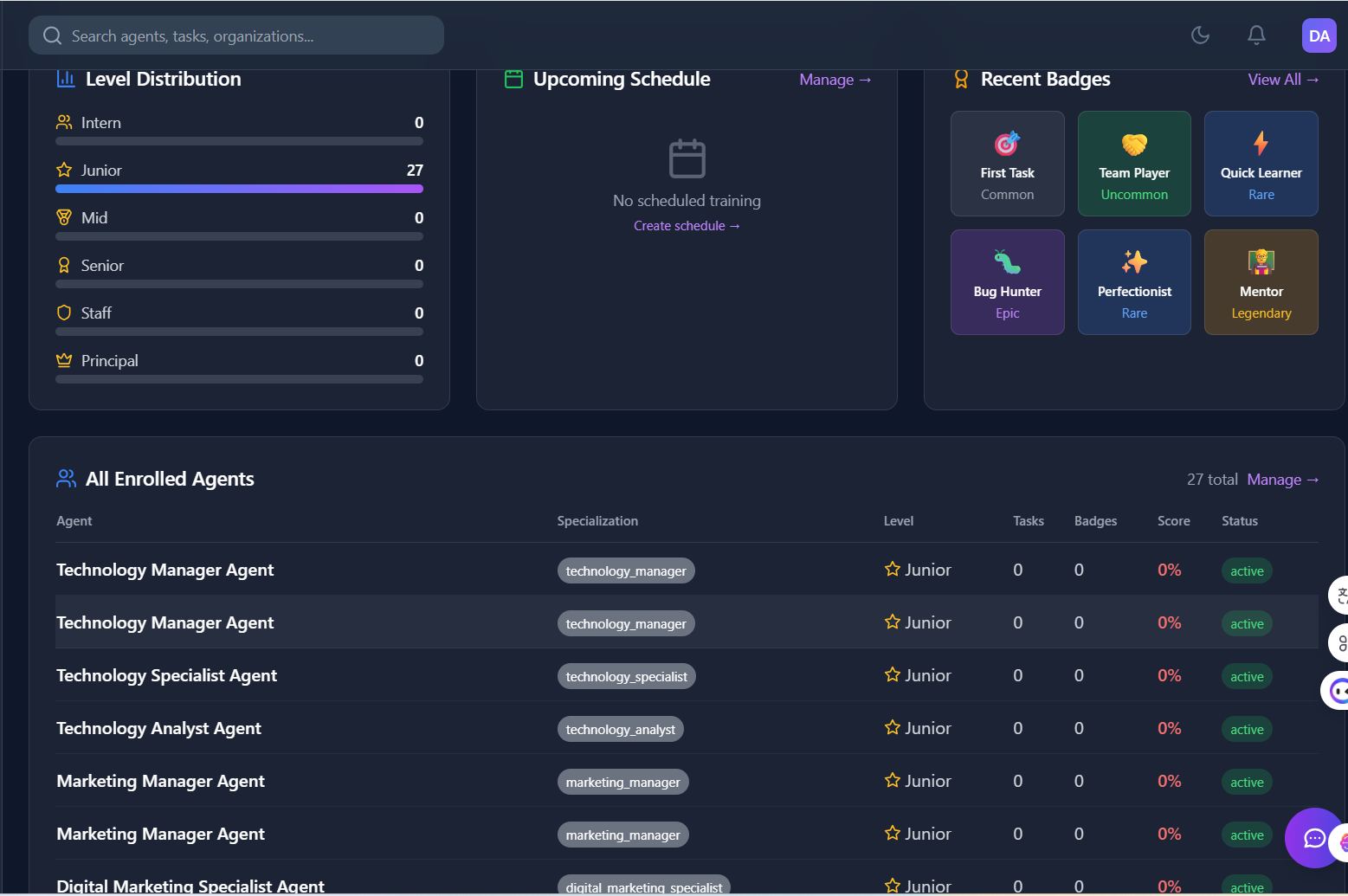
1. University Overview Dashboard

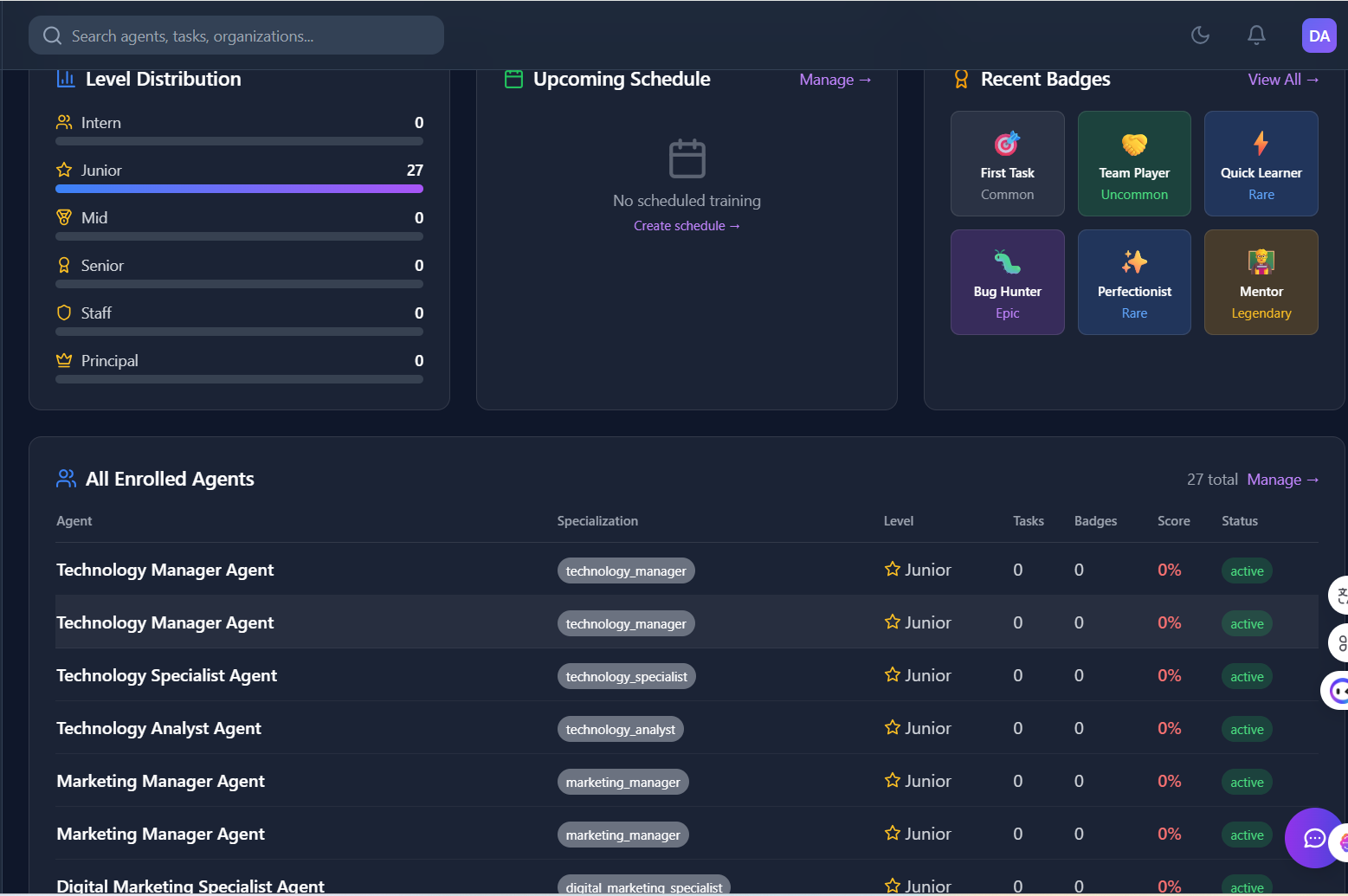
The University Dashboard gives you a complete real-time view of all enrolled agents, their training progress, scheduled programs, and performance metrics. Monitor the intellectual development of your entire agent workforce from one central hub.

  • Live enrollment status for all agents
  • Training progress visualization per agent and cohort
  • Upcoming training schedule with calendar view
  • Performance benchmarks and improvement trends
University Dashboard

Agent University Dashboard

Central hub for managing the intellectual development of your agent workforce

University Overview 2

University Program Overview

Full catalog of available training programs and specialization tracks

2. Agent Training Process

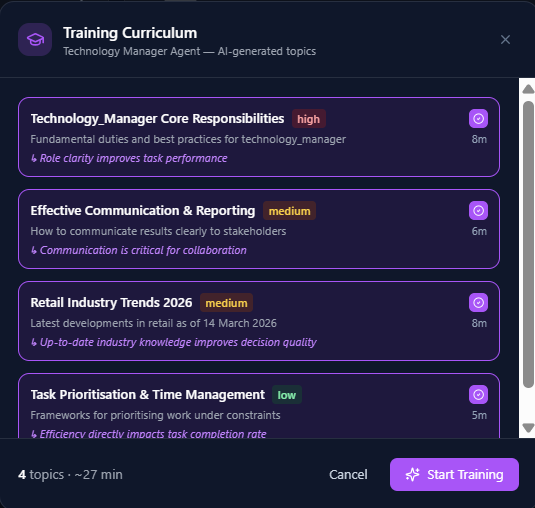
The training process is a structured multi-stage journey that takes an agent from baseline capability through specialized mastery. Each stage is tracked, assessed, and logged — with the agent's knowledge base enriched at every milestone.

  • Multi-stage training pipeline with visual progress tracking
  • Domain specialization tracks — code, data, support, ops, and more
  • Knowledge base enrichment at each training milestone
  • Full training timeline with detailed stage logs
Training Overview

Training Overview

End-to-end training flow with stage overview and completion status

Training Stage 1

Foundation Training Stage

Initial capability building with core knowledge ingestion

Training Stage 2

Specialization Training Stage

Domain-specific deep dive training with advanced skill building

Training Stage 3

Mastery & Certification Stage

Final assessment and certification of specialized agent capabilities

3. Manage & Enroll Agents

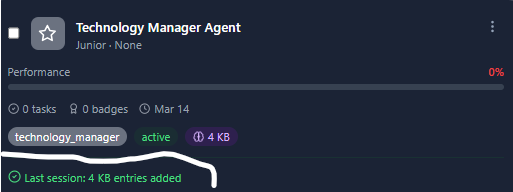
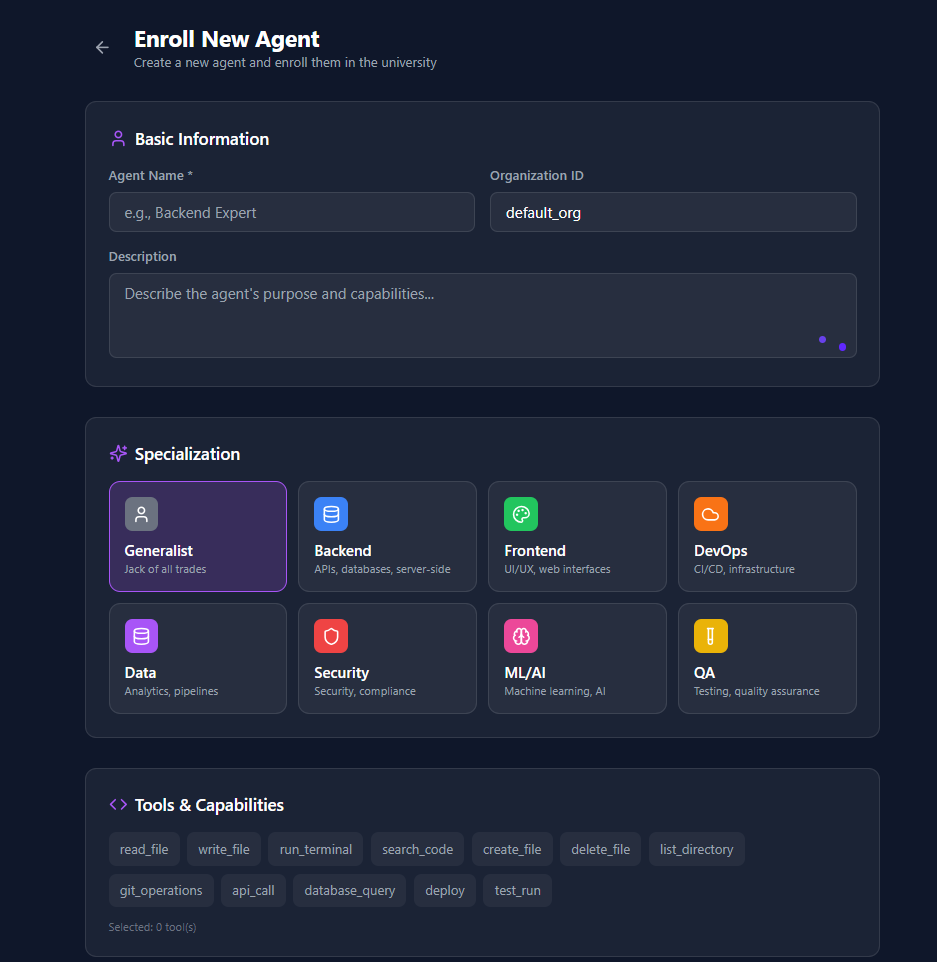
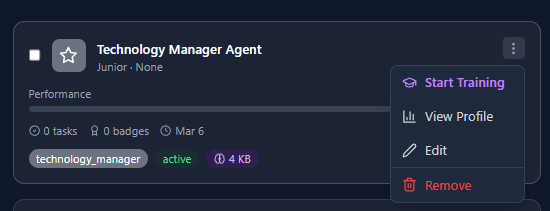
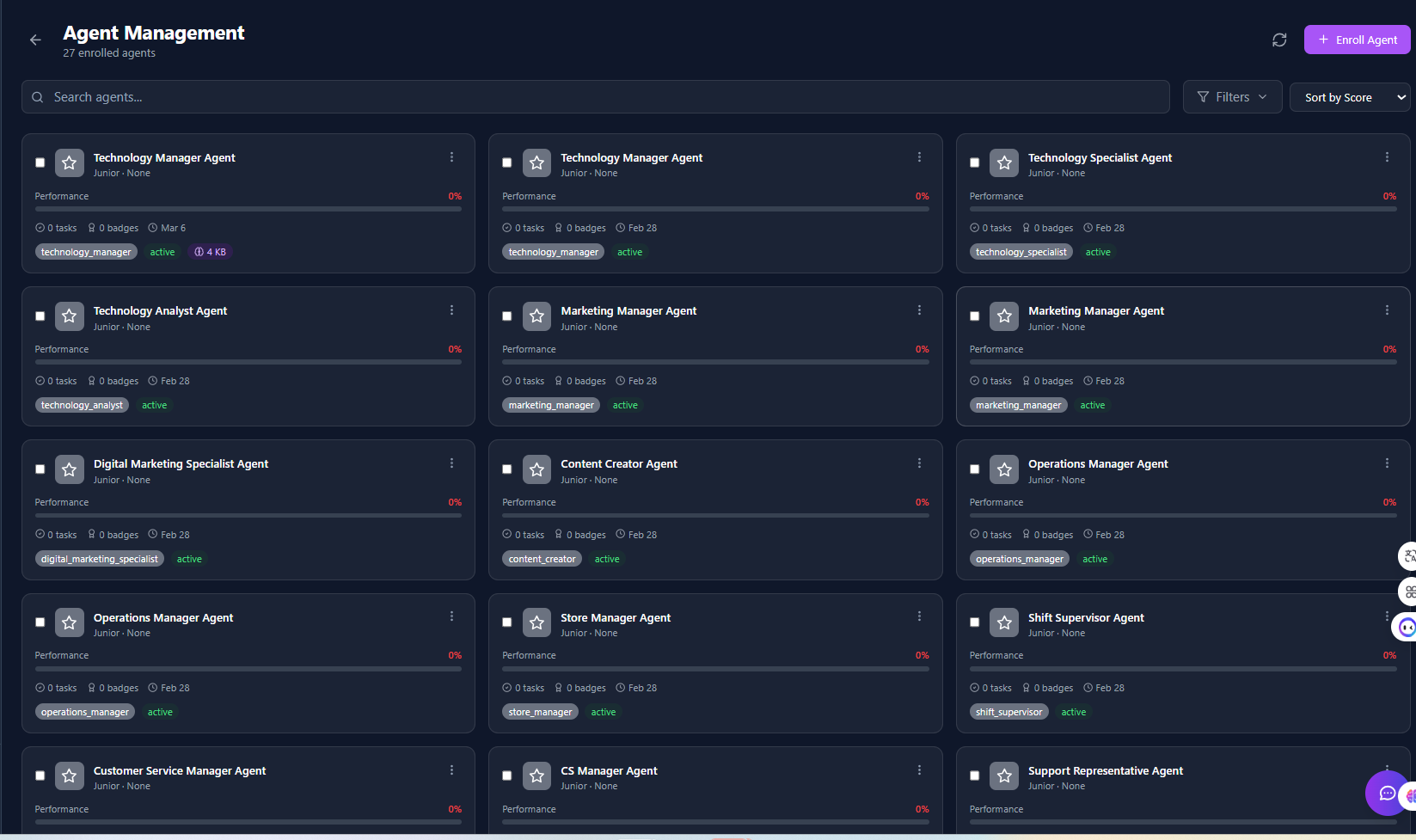
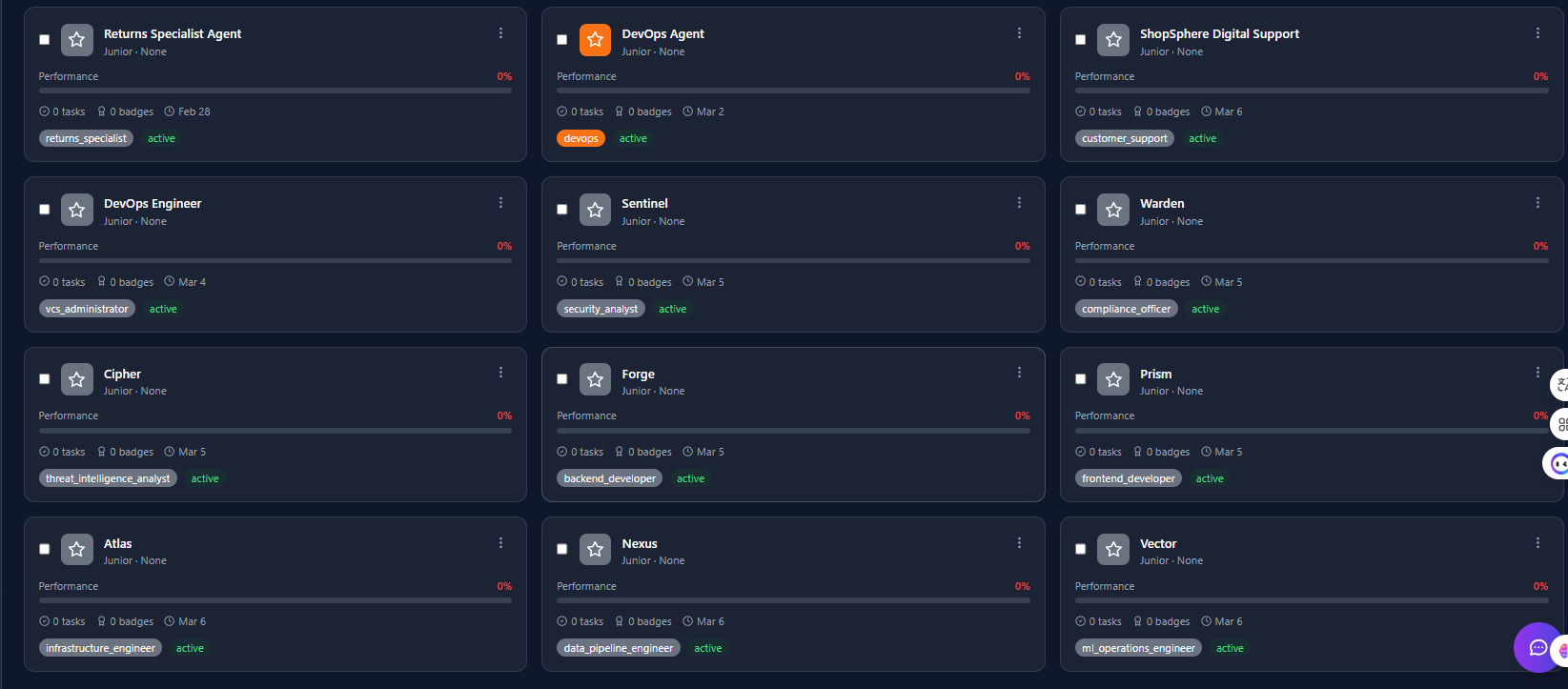
The Agent Management interface gives you full control over your agent workforce. View all active agents, their specializations, training history, and performance scores. Enroll new agents into training programs with a guided onboarding flow.

  • Full agent roster with specialization tags and status
  • One-click enrollment into any available training program
  • Agent feature comparison and capability matrix
  • Training history timeline per agent
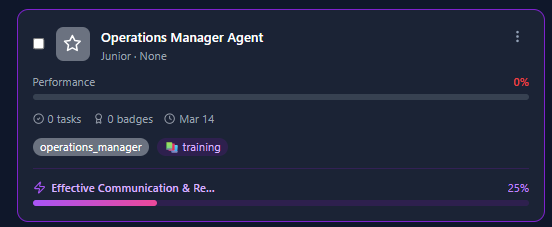
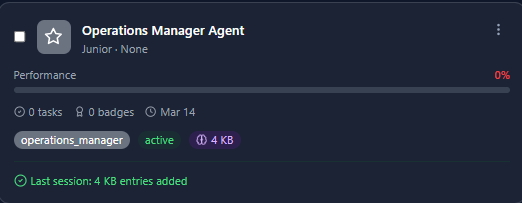
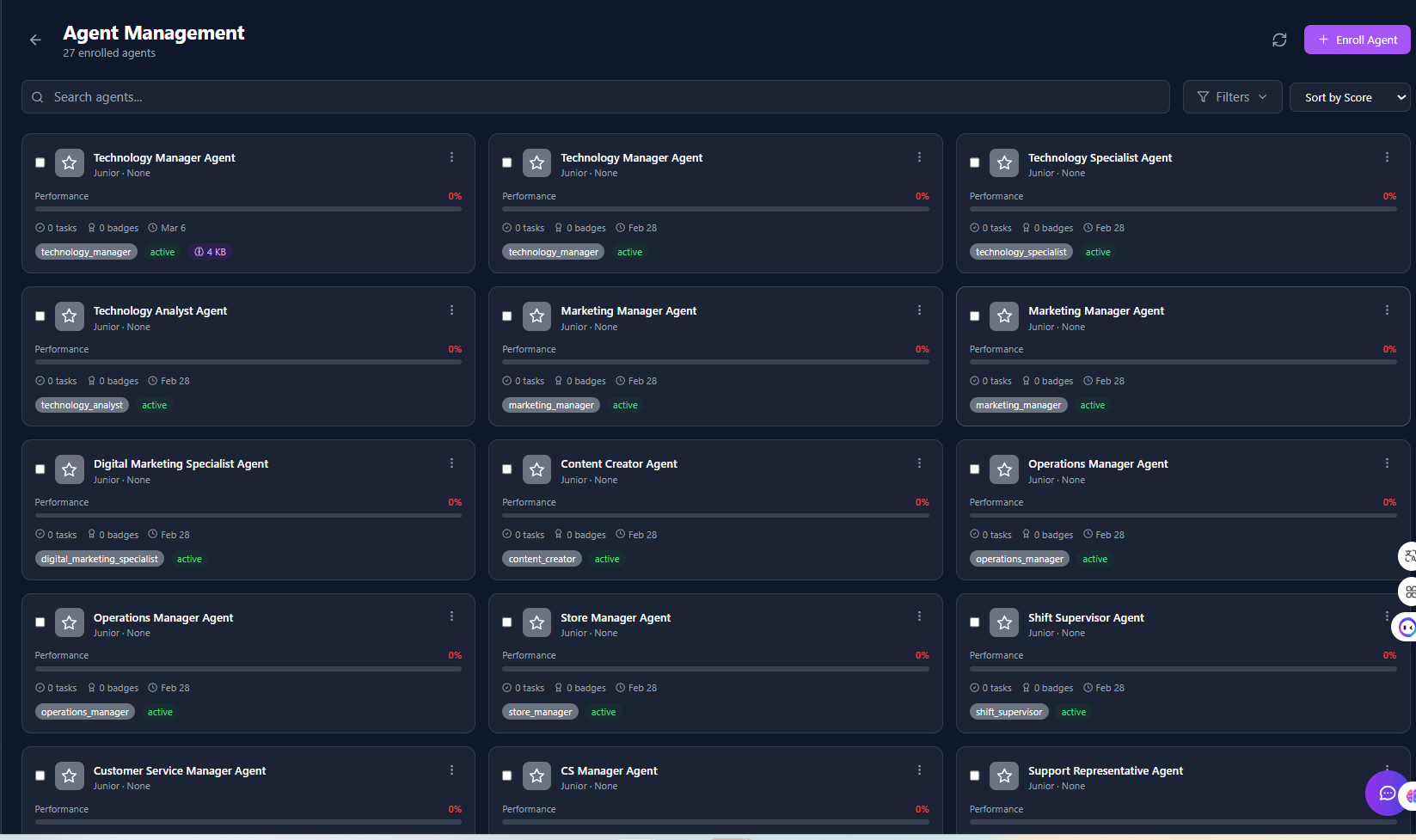
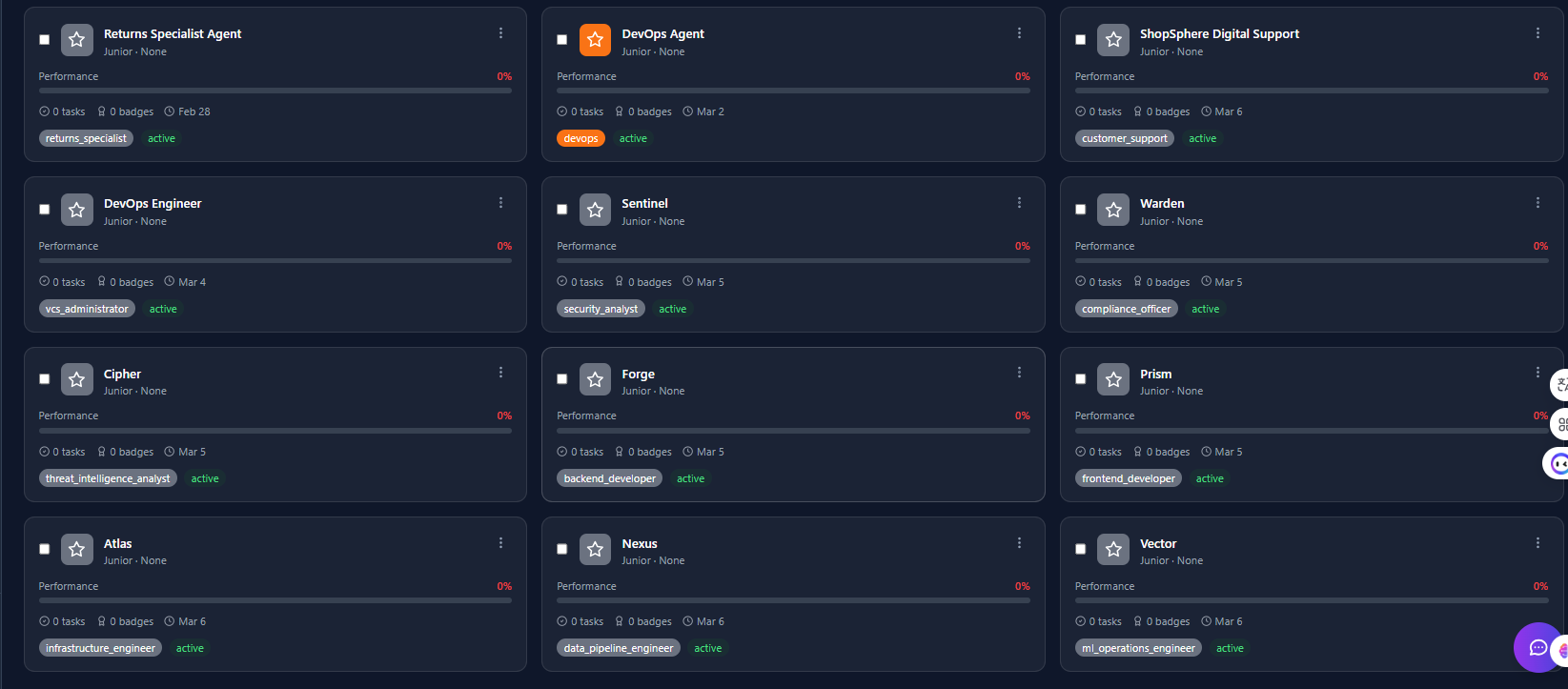
Manage Agents

Agent Management Console

Comprehensive roster view of all agents with training status and capabilities

Manage Agents Detail

Agent Detail View

Deep dive into individual agent performance, training history, and capabilities

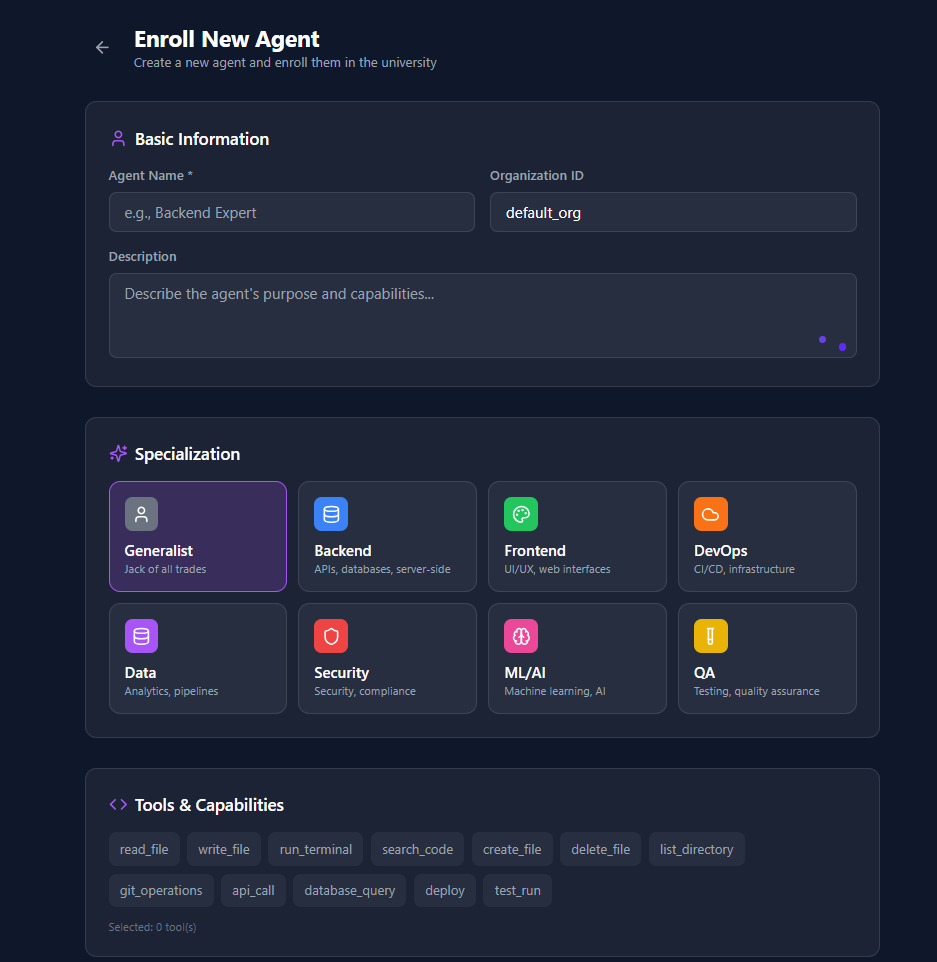
Enroll New Agent

Enroll New Agent

Guided onboarding flow to enroll new agents into university training programs

4. Assessment, Scheduling & Self-Training

Daedalus agents don't just wait for training — they self-improve. The self-training mode enables agents to autonomously identify knowledge gaps, request training resources, and schedule their own learning sessions. Combined with structured assessment and scheduling, agents continuously evolve.

  • AI-powered agent assessment with detailed capability report
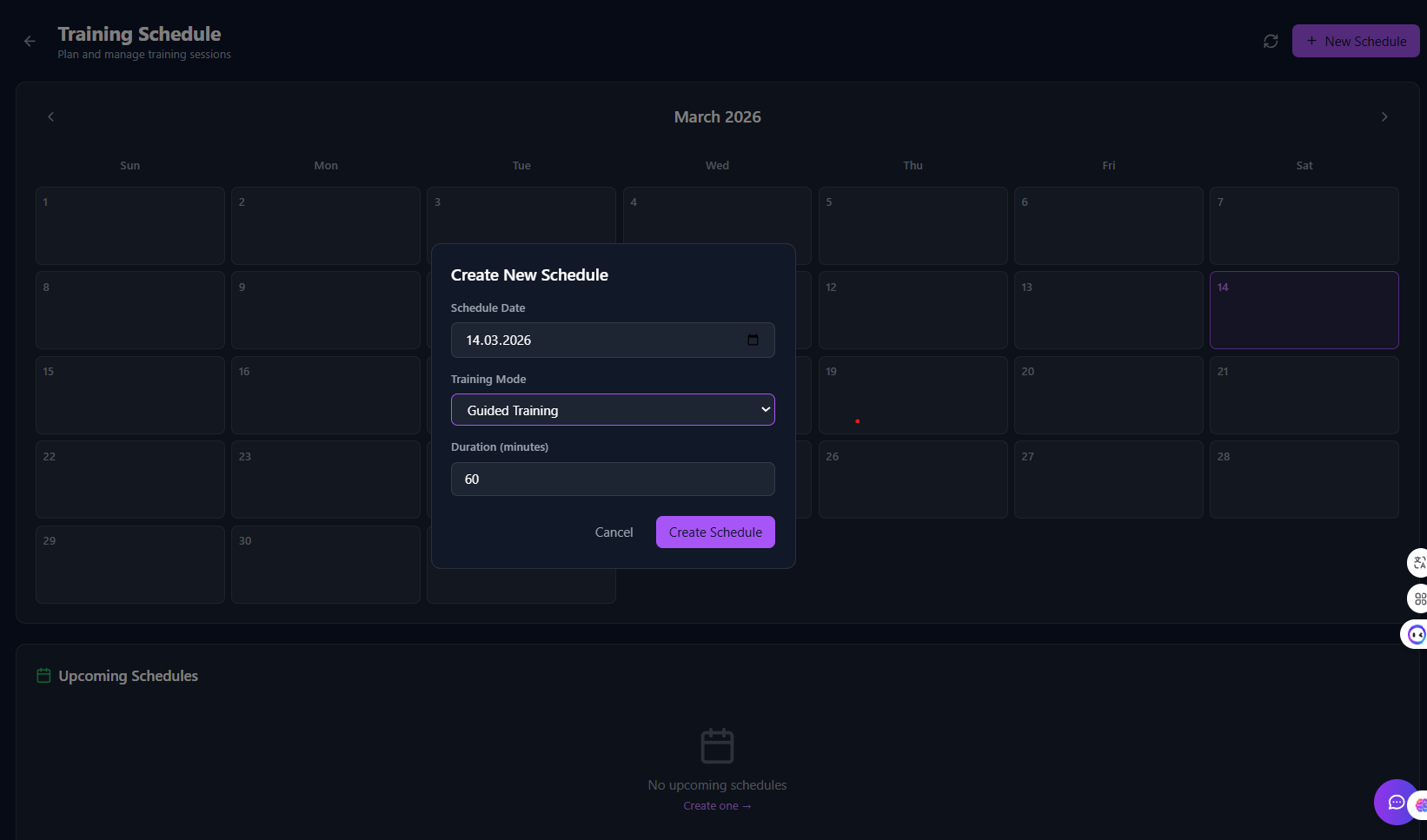
  • Training schedule management with conflict detection
  • Self-training mode — agents autonomously request and complete learning
  • Feature assessment matrix for multi-dimensional agent evaluation
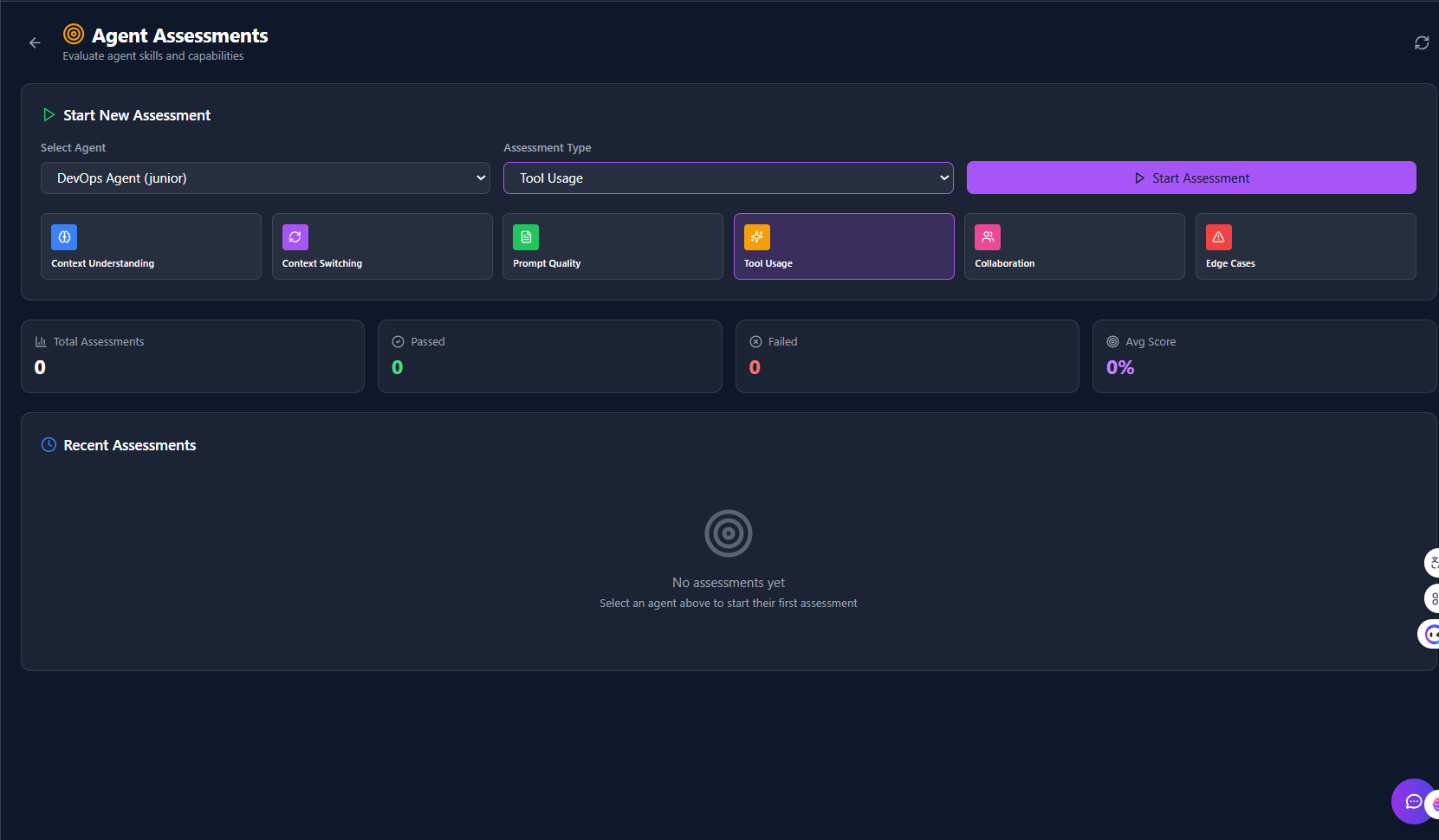
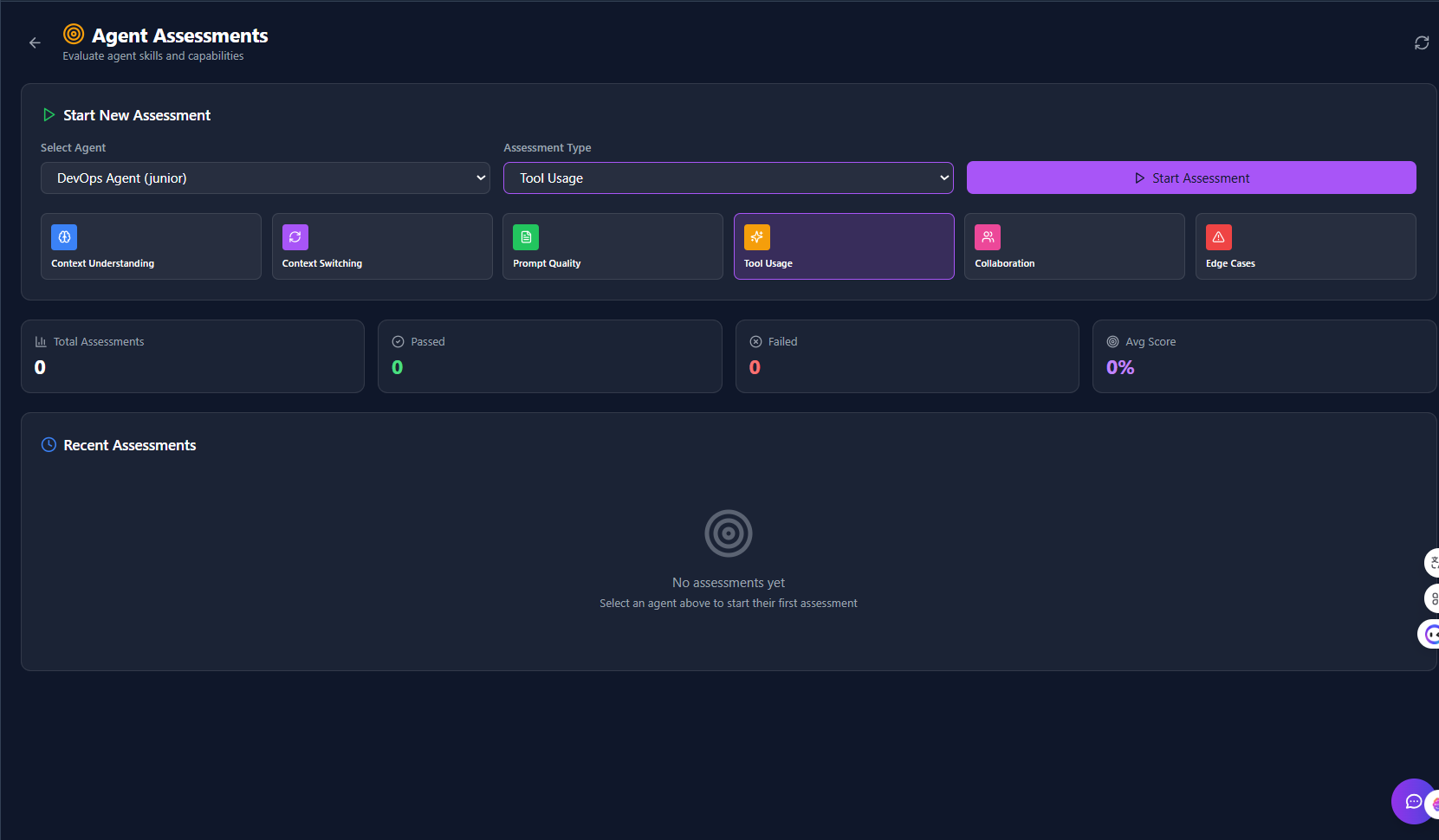
Agent Assessment

Agent Assessment

AI-powered capability assessment with multi-dimensional scoring

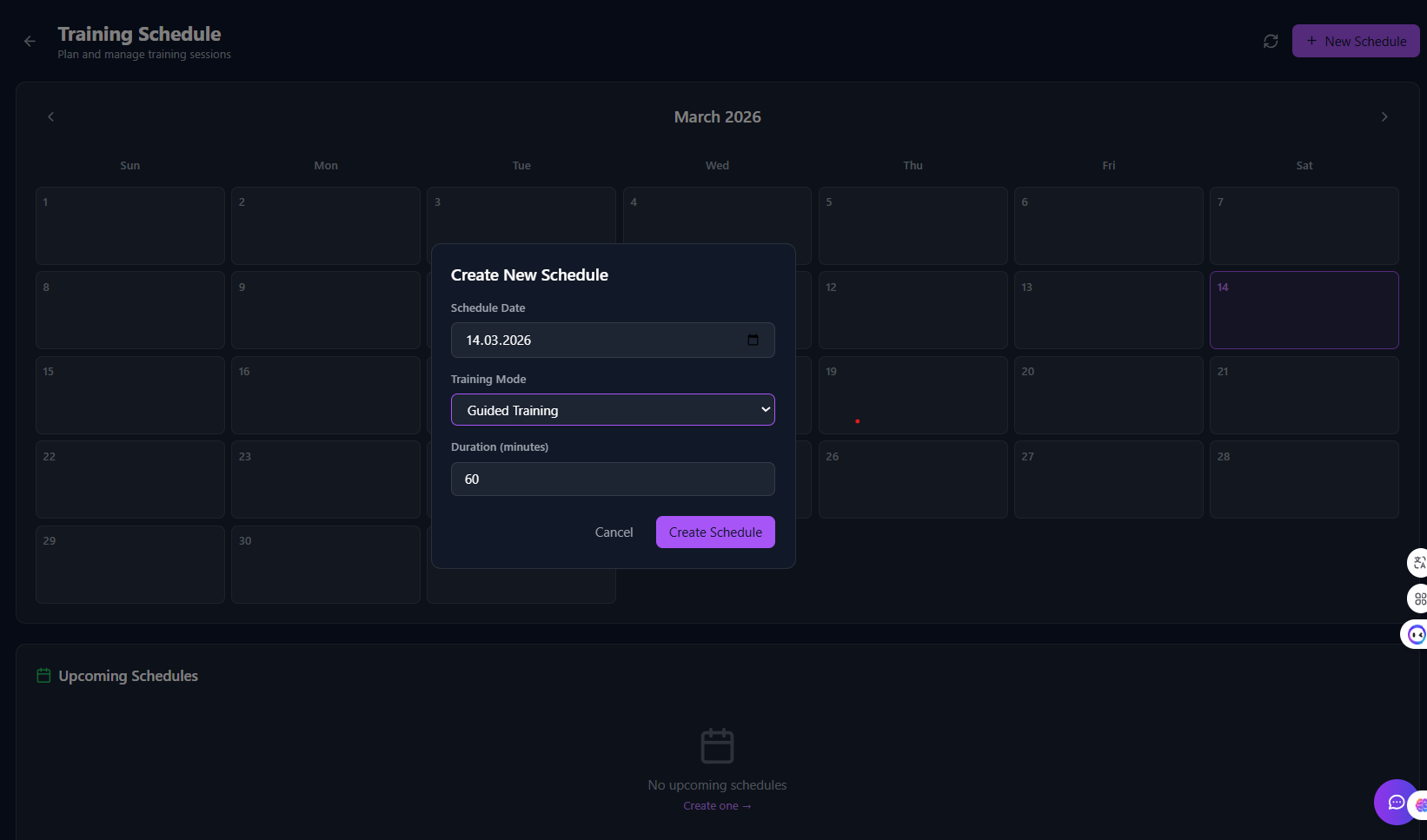
Training Schedule

Training Schedule

Calendar-based scheduling for all active and planned training sessions

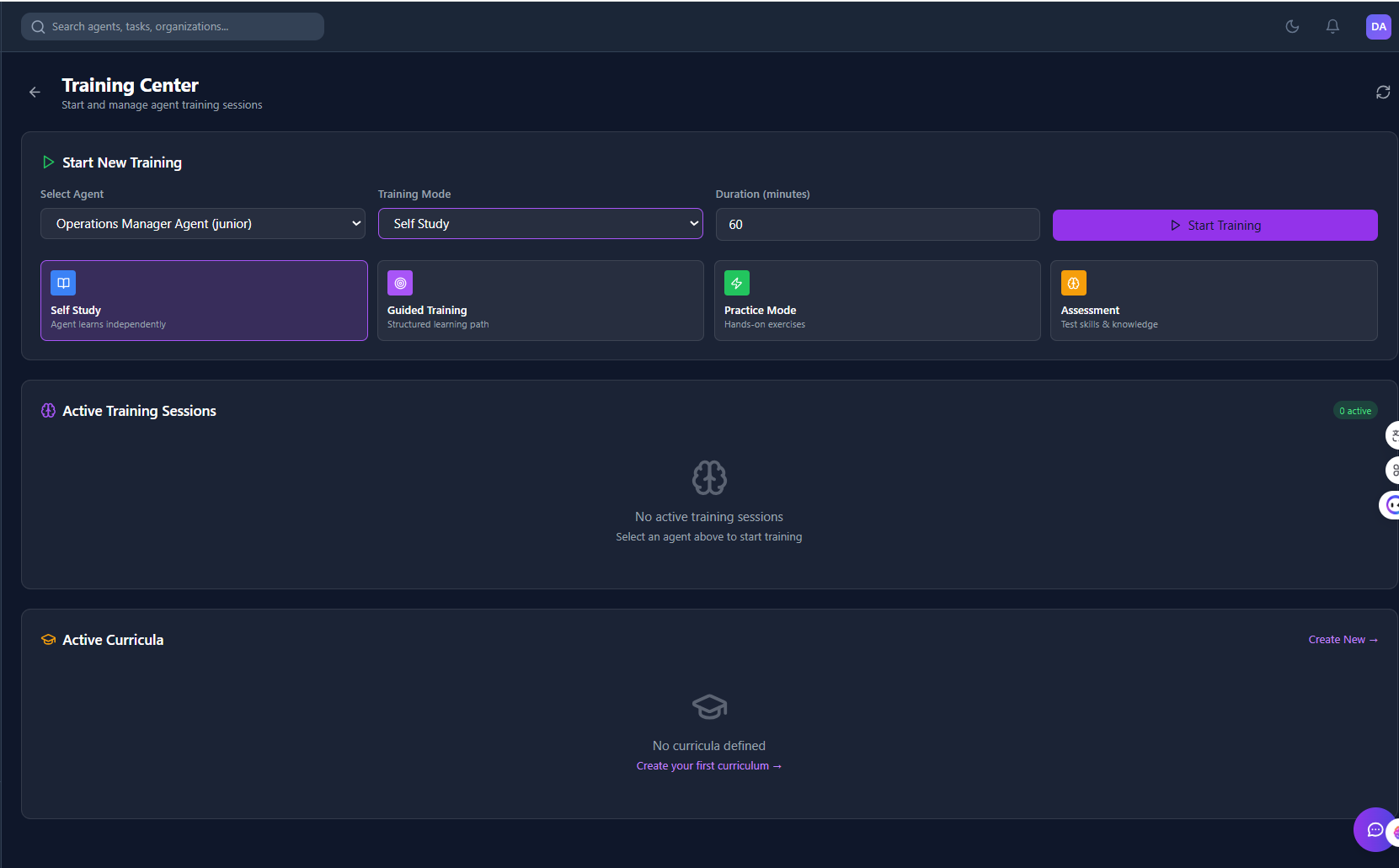
Self Training

Self-Training Mode

Agents autonomously identify gaps and initiate their own learning sessions

Agent Features

Agent Feature Matrix

Comprehensive feature comparison and capability matrix across agent types

Agent Training

Agent Training Program

Structured training program view with curriculum, timeline, and outcomes

Task-Agent Mode — Deep Dive

TaskFlow IDE: Intelligent Multi-Agent Orchestration

DAEDALUS TaskFlow IDE redefines how complex work gets done. From a single natural-language prompt, it intelligently decomposes tasks, assembles specialized agent teams, executes real-time flow graphs, audits quality autonomously, and heals itself when things go wrong — all without human micromanagement. Below is a detailed walkthrough of every major capability.

LLM Smart Decomposition
Smart Flow Creation
Real-Time Node Execution
Autonomous Agent Assignment
Real Auditor Check
Self-Learning
Self-Healing
Dynamic Orchestration
Memory Selection
Function Tool Calls
Artifact Management
Flow-Aware AI Chat
12+
Specialized Agent Types
Parallel Flows
100
Auditor Quality Score
0
Manual Interventions Needed
Real-Time
Node Execution Visibility

1. TaskFlow IDE Dashboard

The central command hub — your real-time window into all running flows, active agents, task states, and system health. Every metric is live, every agent action is traceable, and every decision is auditable.

The Dashboard is designed for zero cognitive overhead. At a glance you see which flows are running, which agents are busy, which tasks are blocked, and where the auditor has raised flags. The sidebar surfaces quick actions: create a task, spawn an agent, inspect an artifact, or trigger a healing cycle.
  • Live flow status grid (running / paused / failed / completed)
  • Per-agent activity timeline
  • System health indicators (CPU, memory, LLM token usage)
  • One-click task creation & agent assignment
  • Rewarding & feedback loop controls
Zoom TaskFlow IDE Dashboard
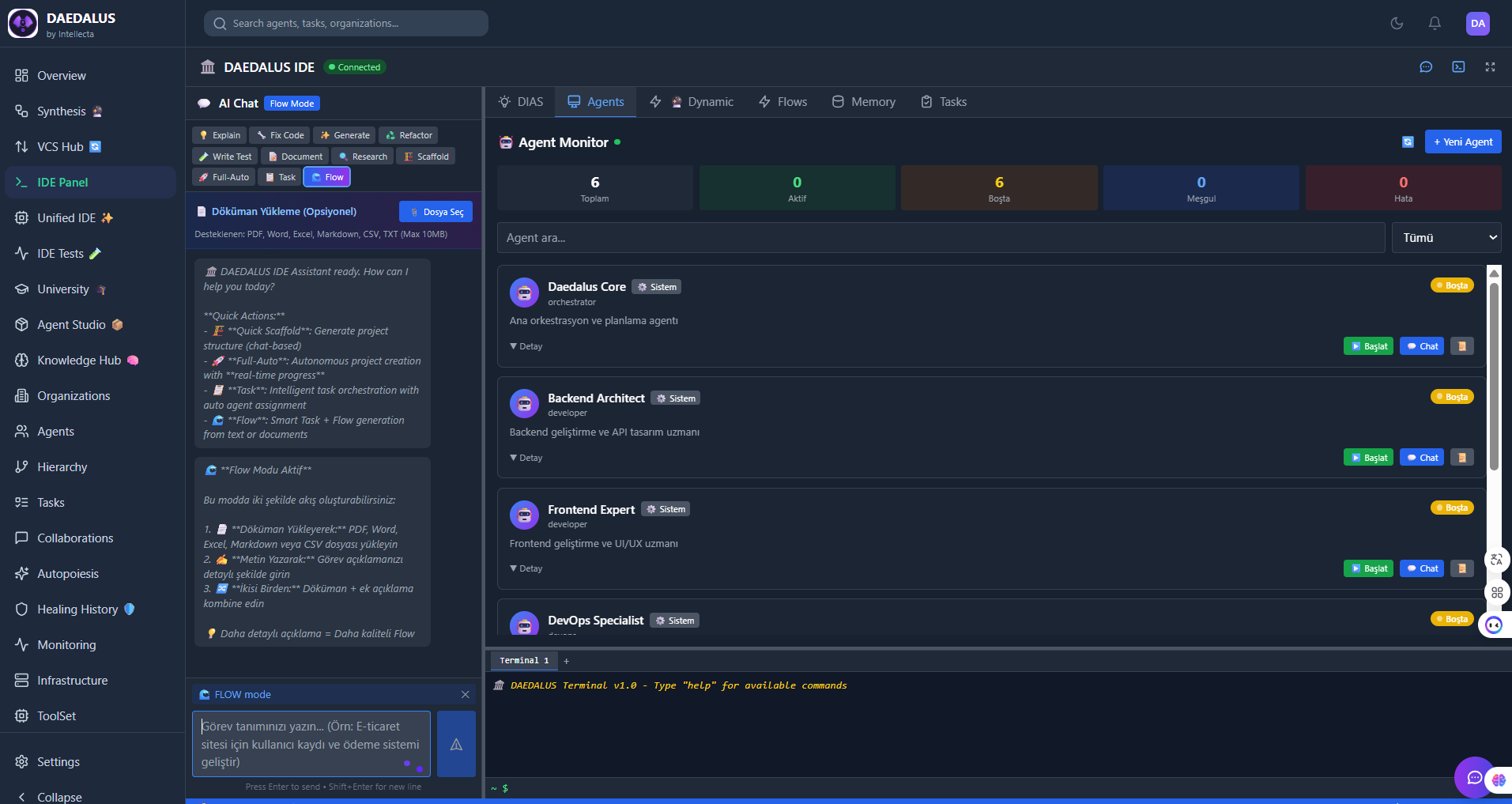
Main Dashboard

Full command center — live flows, agent states, metrics, and quick-action controls in one unified view.

Zoom Agent Communication & Rewarding
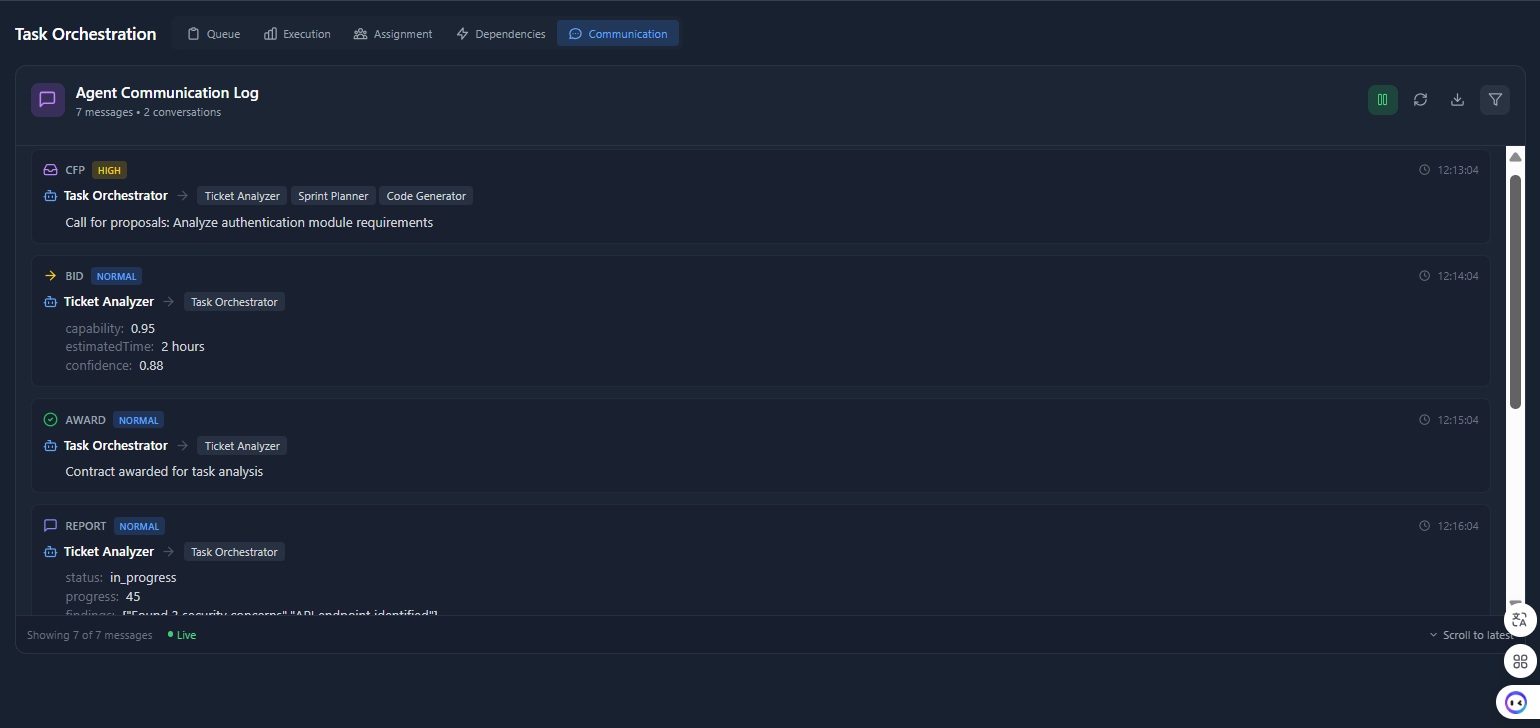
Agent Communication & Rewarding

Agents exchange messages, negotiate task ownership, and receive performance rewards — all surfaced in real time.

2. Smart Task Creation & LLM Smart Decomposition

Type a high-level goal in natural language. DAEDALUS's LLM Decomposition Engine breaks it down into an optimal set of interdependent sub-tasks, reasons about parallelism opportunities, estimates effort, and maps each piece to the right specialist agent — automatically.

How it works: The Decomposition Engine runs a multi-pass reasoning chain (ReAct + Tree-of-Thought). Pass 1 extracts intentions. Pass 2 identifies dependencies. Pass 3 sizes each sub-task and scores parallelism. Pass 4 generates the flow graph. The entire process typically completes in under 3 seconds, producing a production-ready execution plan with no human input.
  • Natural language → structured task tree in <3 s
  • Multi-pass ReAct + Tree-of-Thought reasoning
  • Automatic dependency graph construction
  • Parallelism scoring & effort estimation
  • Editable task tree before execution
  • Context-aware: reads your project files & history
Zoom Smart Task Creation
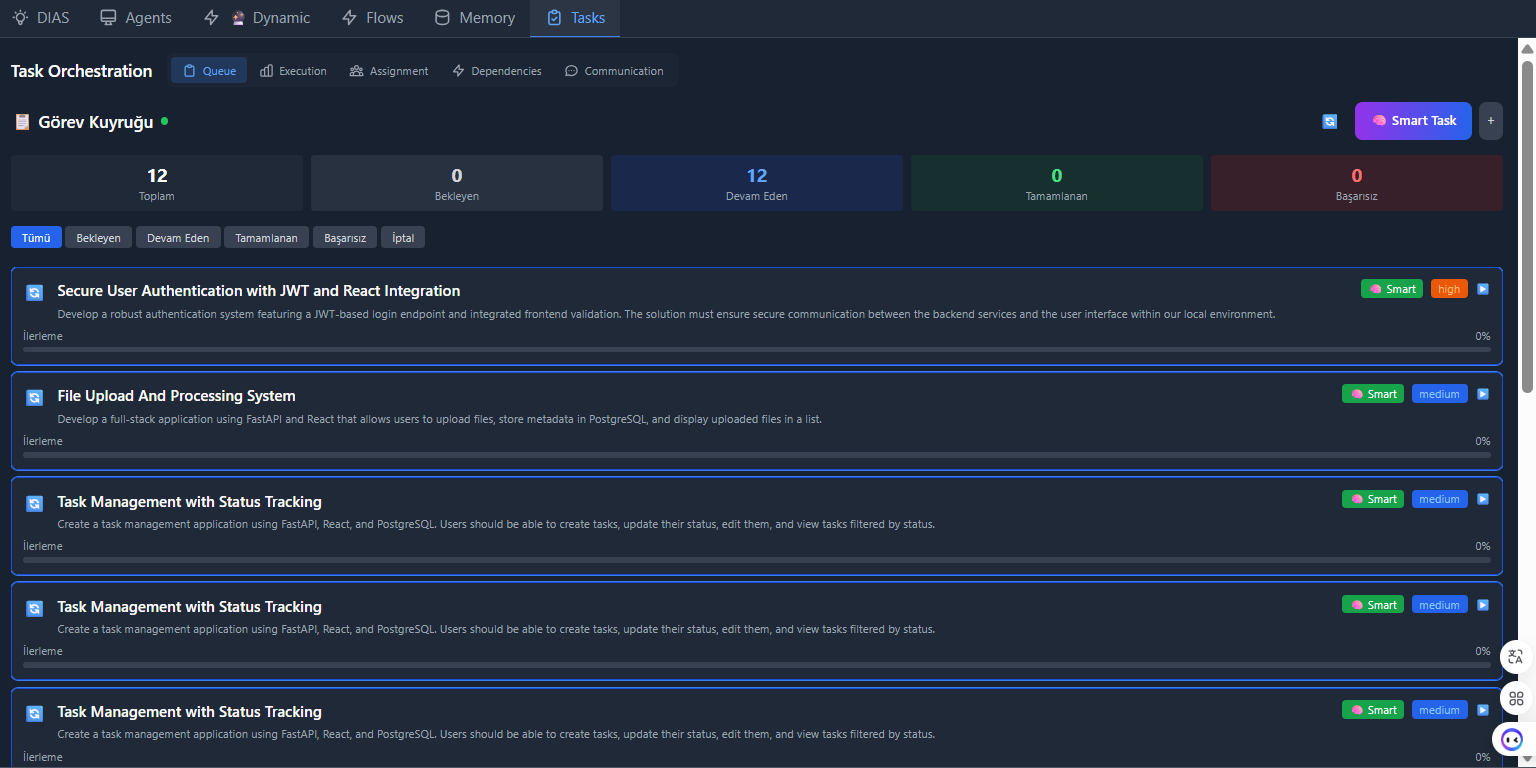
Smart Task Creation Panel

Enter a goal, choose scope, and watch the LLM break it into an actionable, dependency-aware task graph ready for execution.

Zoom Flow Decomposition
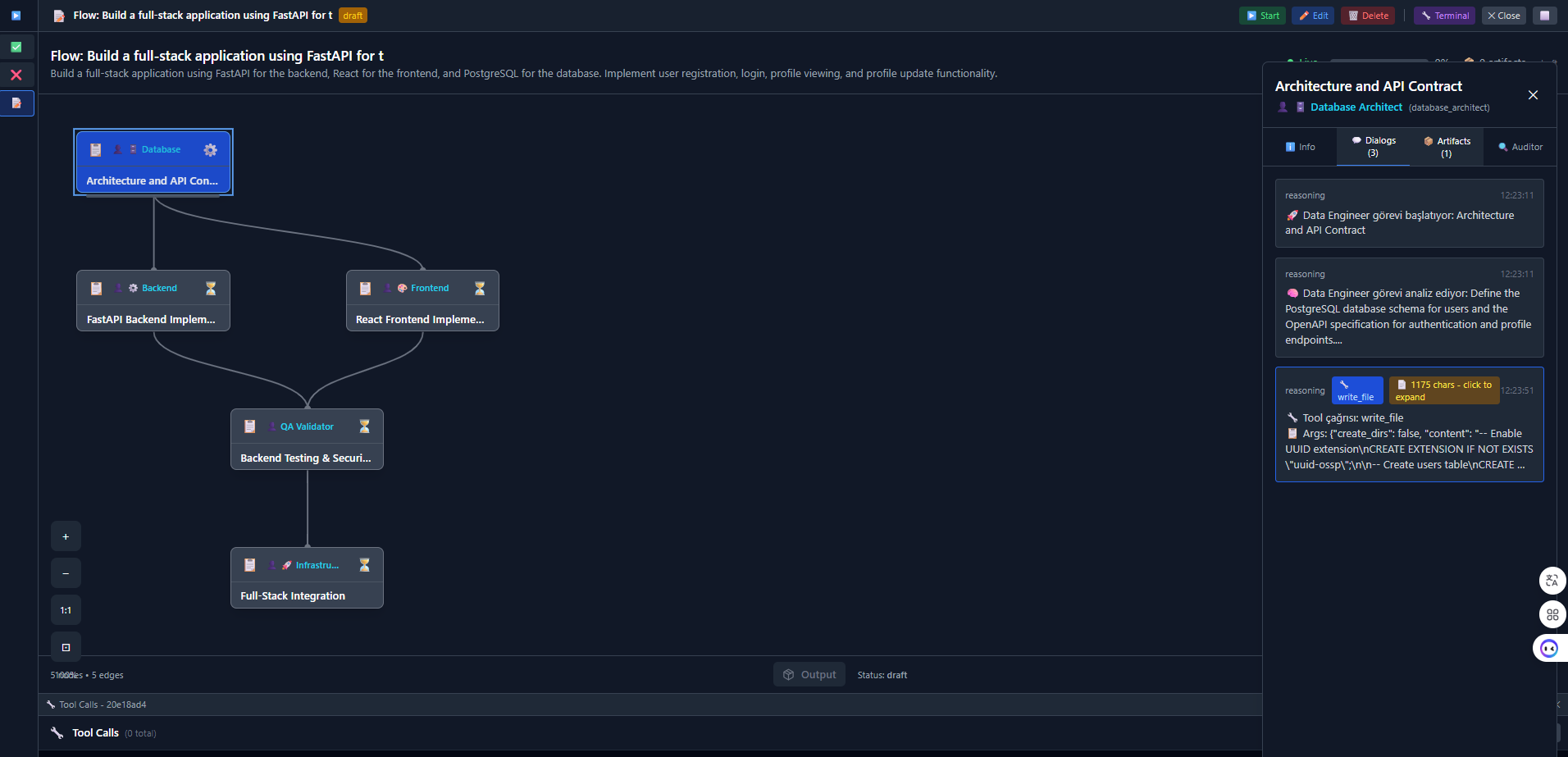
Decomposition Output → Flow Node

Each decomposed sub-task becomes a live node in the flow graph, wired with correct dependency edges.

3. Smart Flow Diagrams & Real-Time Node Execution

Every task plan materializes as a live visual flow graph. Nodes represent tasks, edges encode dependencies (strict serial / parallel / soft). As agents execute, each node pulses with live status — running, completed, blocked, failed — with millisecond precision.

What makes it different: Unlike static Gantt charts or simple to-do lists, the TaskFlow graph is a living execution engine. It routes work around failures (Watchdog integration), auto-reschedules blocked nodes when dependencies resolve, and surfaces bottlenecks visually. You can interact with any running node — pause it, reassign it, inject additional context, or skip it entirely.
  • Interactive DAG (Directed Acyclic Graph) visualization
  • 3 edge types: Strict Sequential · Parallel · Soft Dependency
  • Live node state: pending / running / completed / failed / blocked
  • Click any node → inspect agent logs, artifacts, audit score
  • Watchdog integration: auto-reroute on failure
  • Multi-flow management (run dozens in parallel)
Zoom Flow Execution
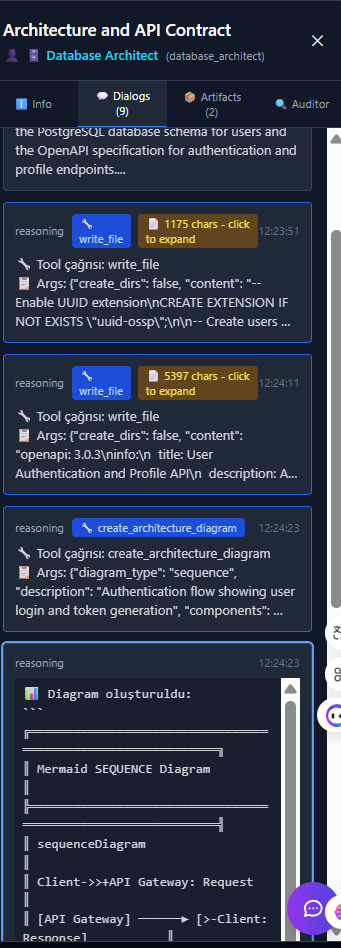
Flow Running — Live State

Nodes turn green as completed, amber while running, red if blocked.

Zoom Flow Nodes
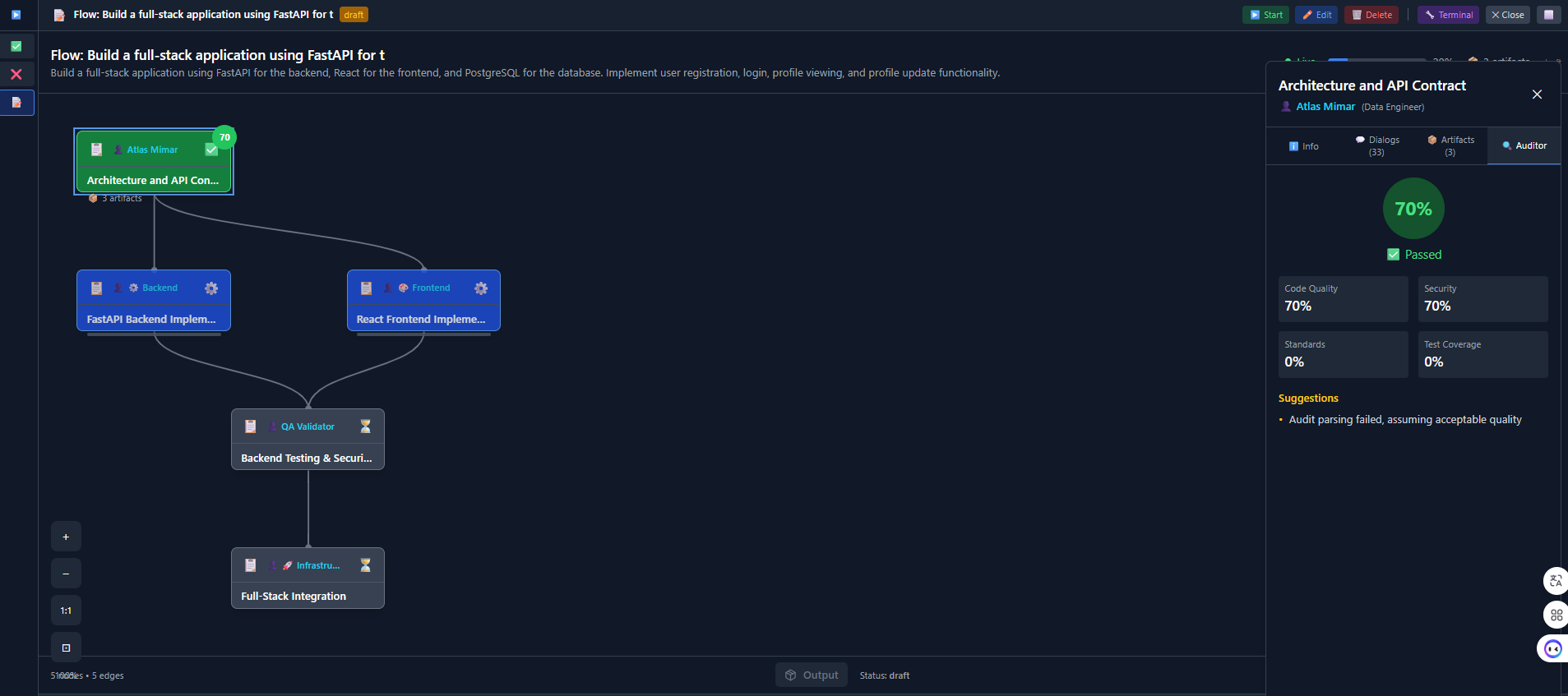
Parallel Execution Paths

Multiple agent branches executing simultaneously — true parallel orchestration.

Zoom Flow Dependencies
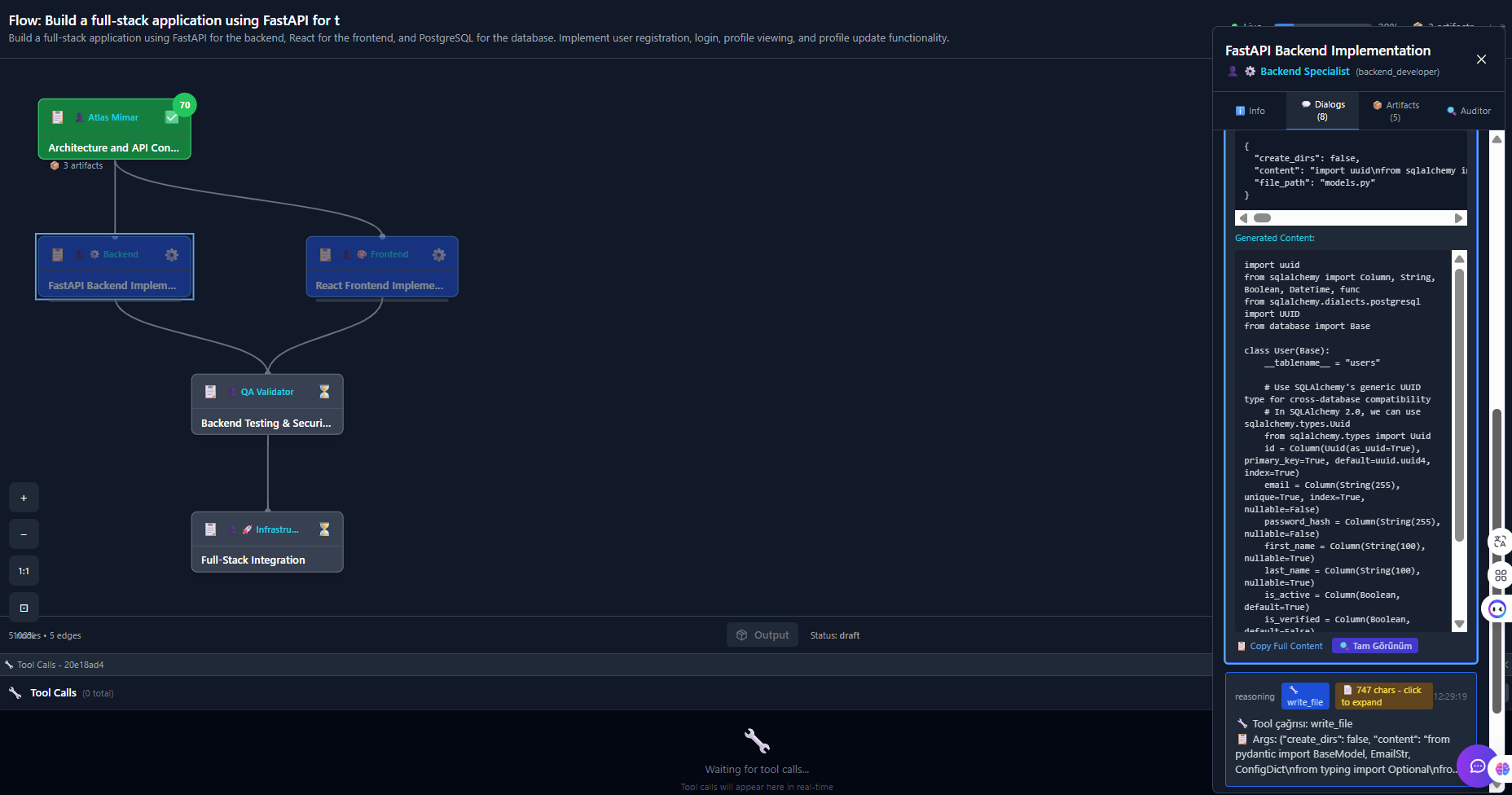
Dependency Edge Types

Visual distinction between strict, parallel, and soft dependency relationships.

Zoom Flow Timeline
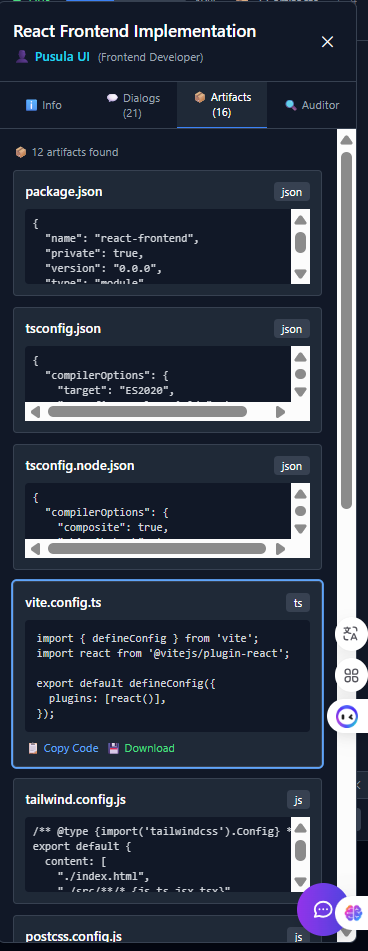
Execution Timeline View

Phase-based timeline: Foundation → Implementation → Finalization with milestone markers.

Zoom Flow Node Detail
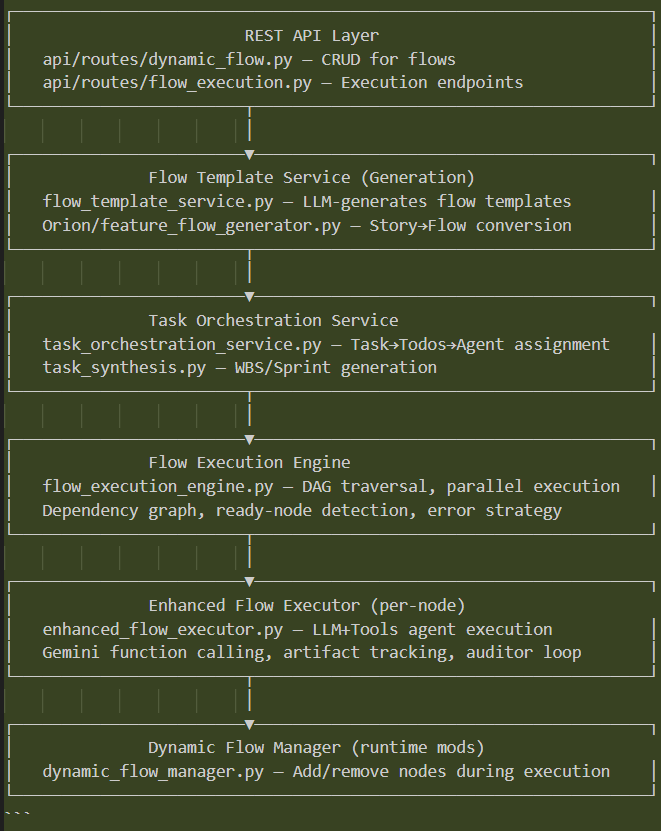
Node Detail Drawer

Click any node to reveal its agent, sub-tasks, logs, artifacts, and auditor verdict.

Zoom Flow Agent Execution
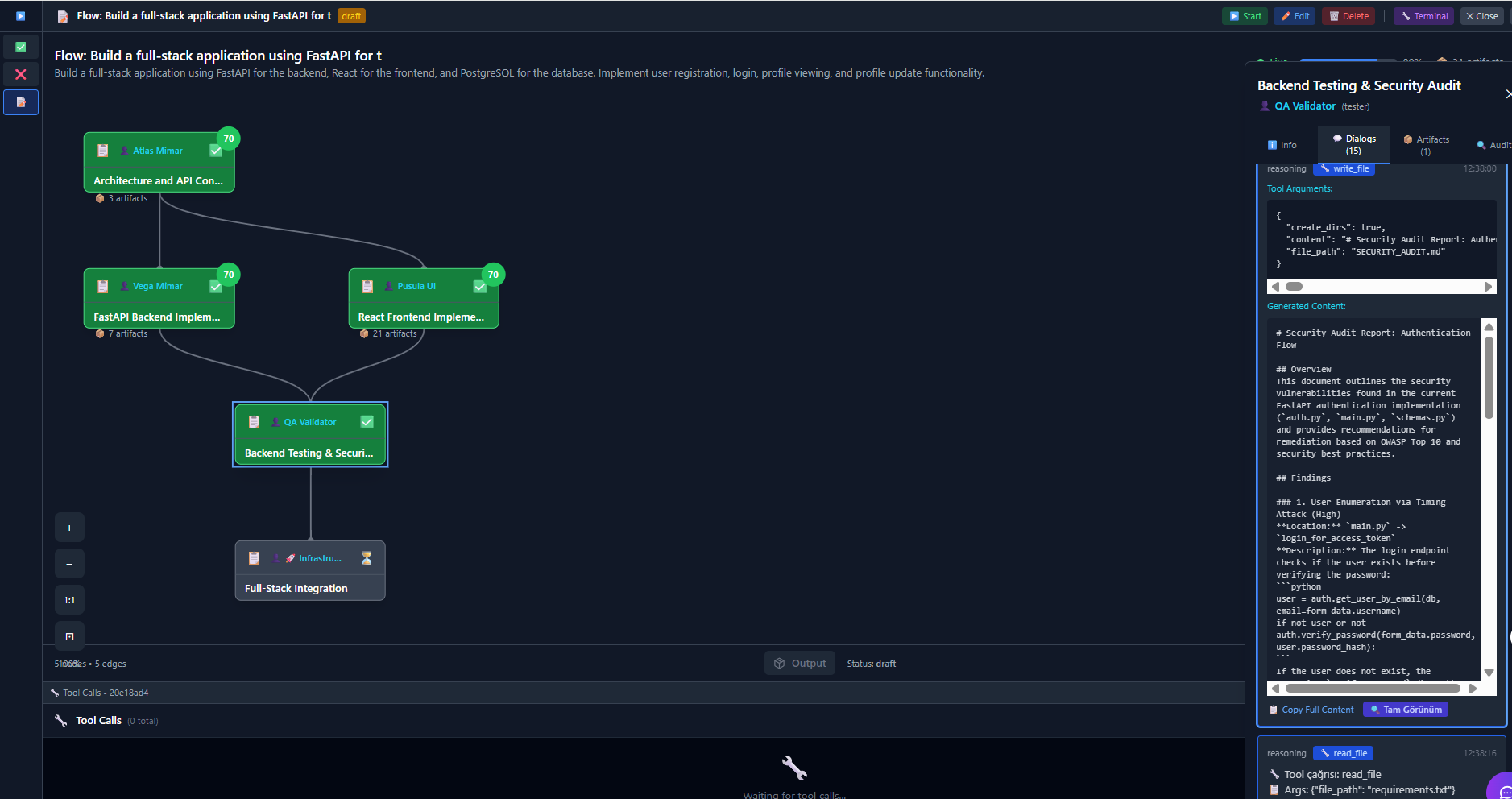
Agent Execution Inside Node

Live agent reasoning log — see exactly what the agent is thinking, deciding, and doing.

Zoom Flow 8
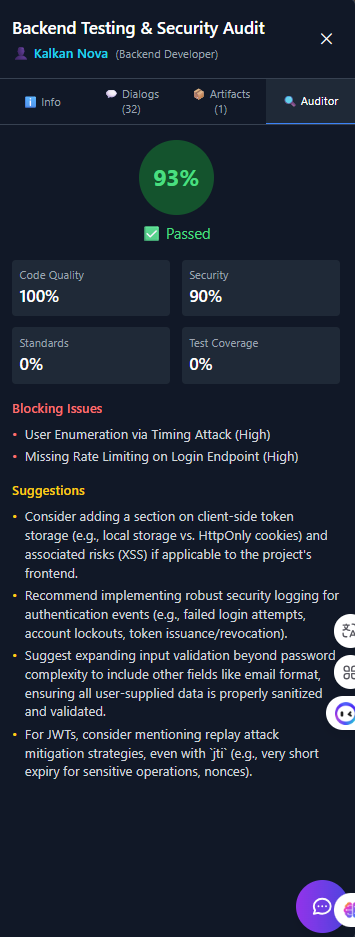
Failure Recovery

Watchdog detects failure; Daedalus auto-reroutes the blocked node.

Zoom Flow 9
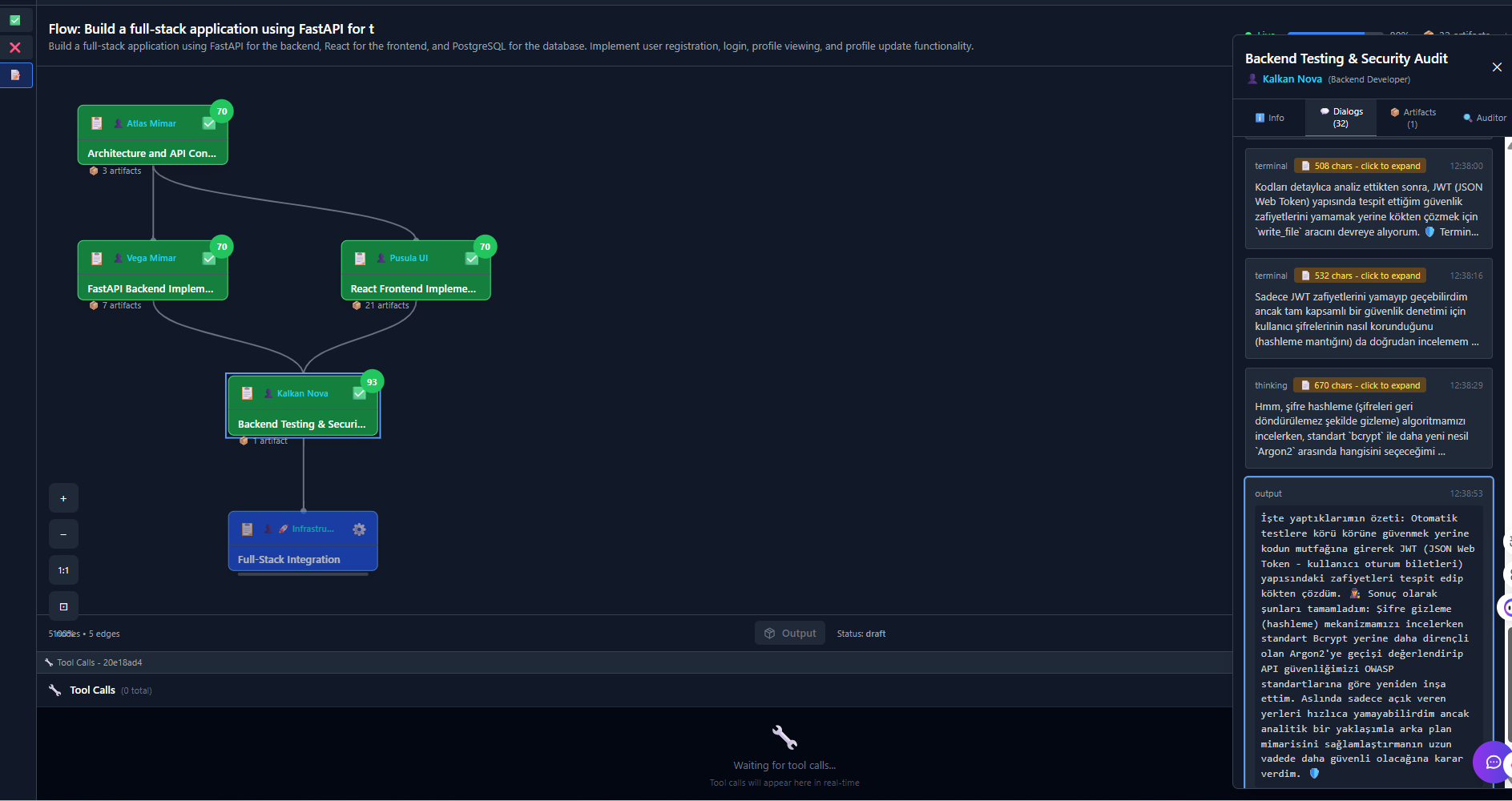
Multi-Flow Overview

Multiple independent flows managed simultaneously from one dashboard.

Zoom Flow 10
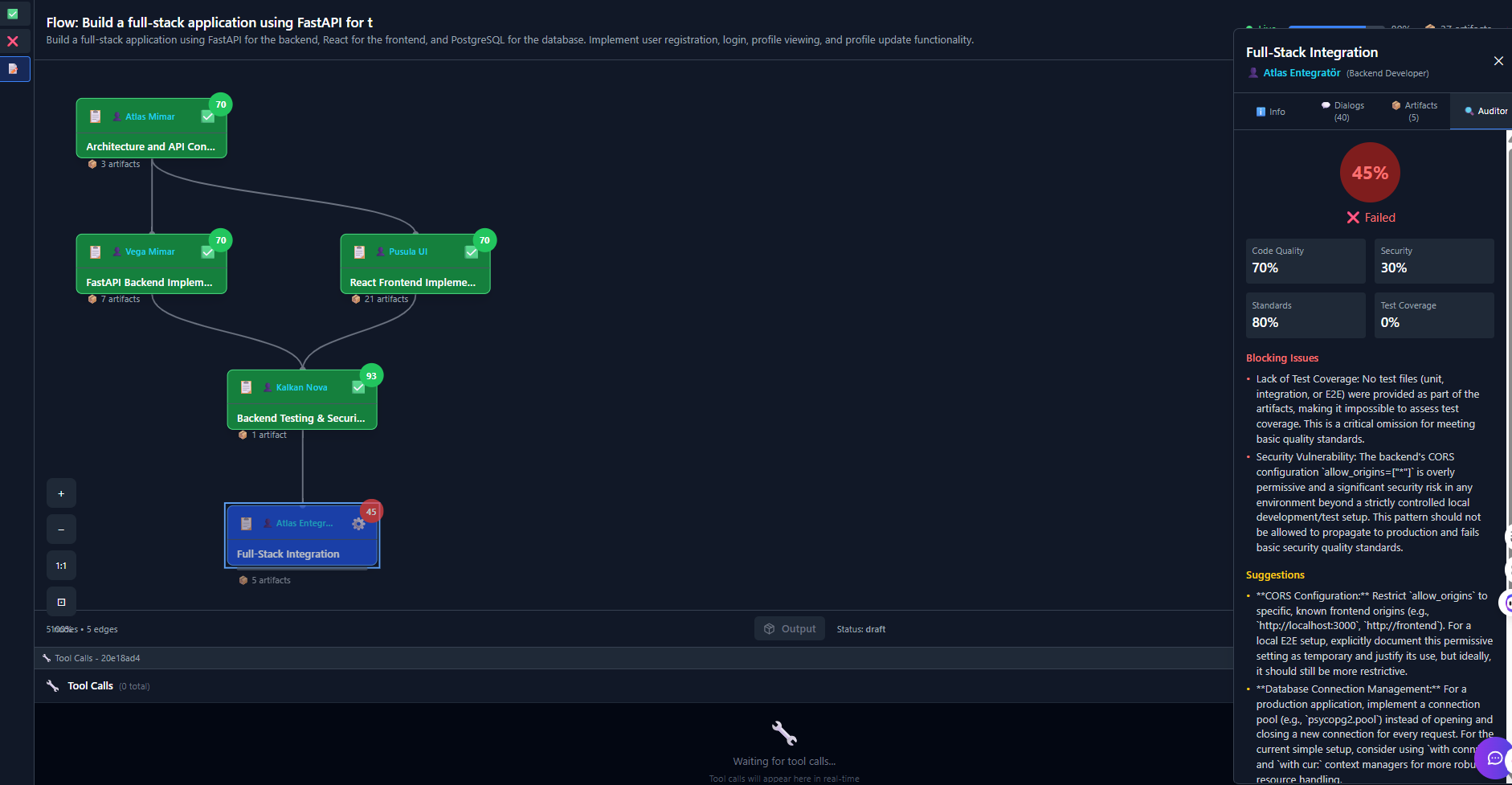
Completed Flow Report

Post-execution summary: artifacts produced, time taken, quality scores.

Zoom Flow 11
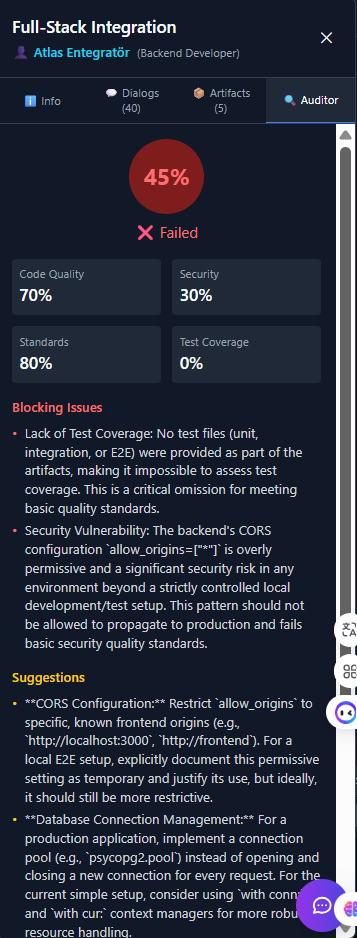
Advanced Flow Graph

Complex real-world flow with 15+ nodes, multiple agent types, and hybrid dependencies.

Zoom Flow 12
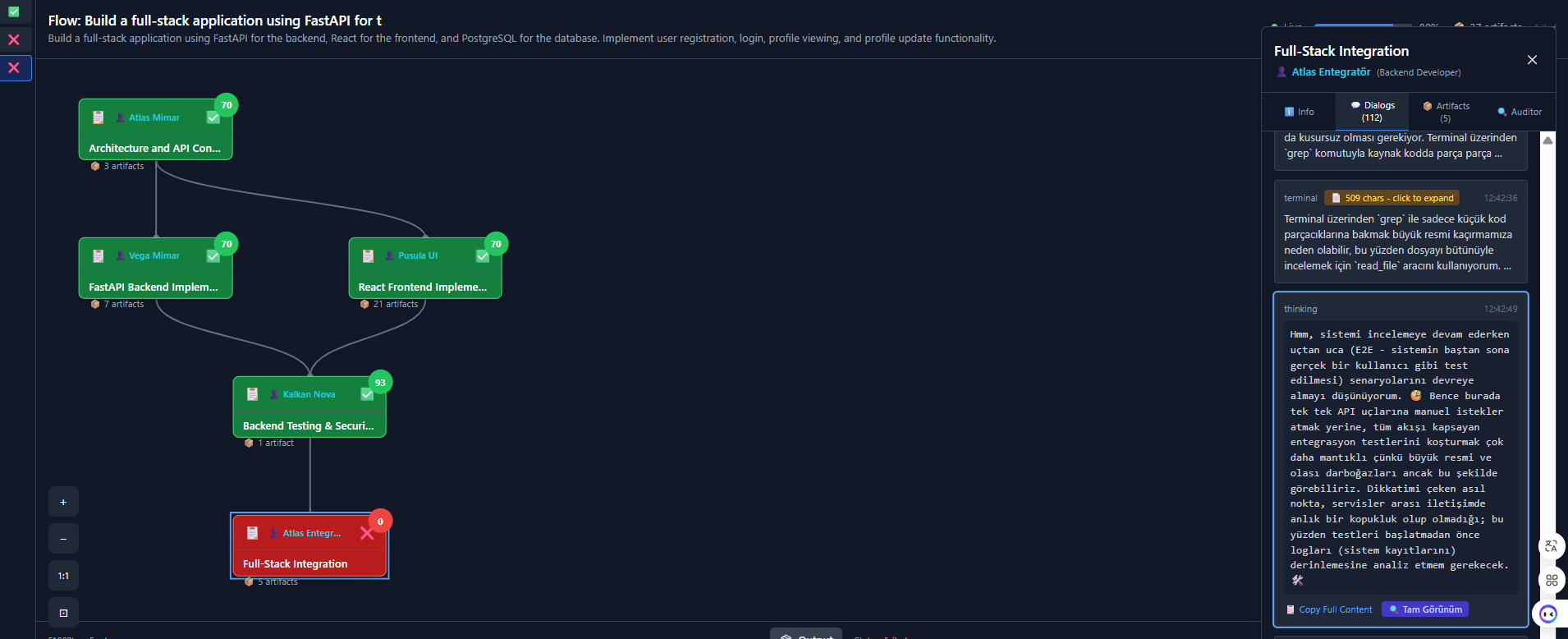
Sub-Flow Nesting

Flows can spawn child flows — enabling recursive task delegation to specialized teams.

Zoom Flow 13
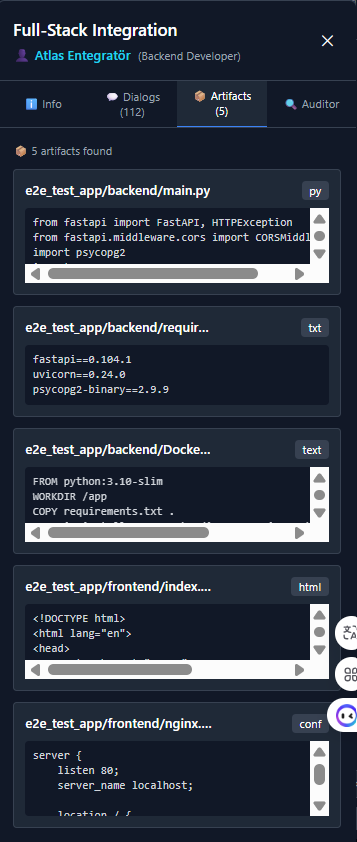
Flow Metrics Panel

Per-flow performance metrics: throughput, latency per node, agent efficiency scores.

Zoom Flow 14
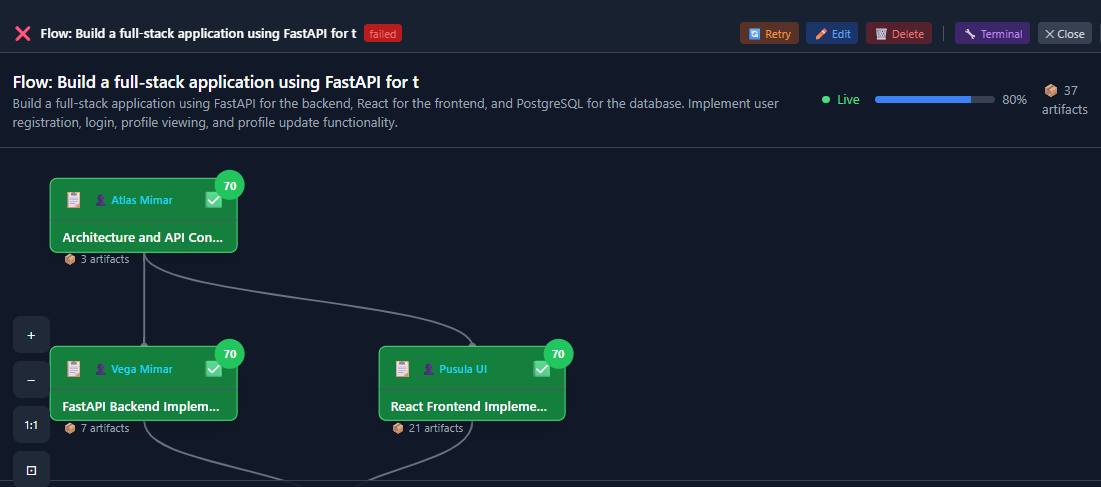
Flow Audit Trail

Every decision logged: when, by whom, why — full immutable audit trail for compliance.

4. Autonomous Agent Assignment

DAEDALUS doesn't just create tasks — it selects the optimal agent for each task automatically. The assignment engine evaluates agent capability profiles, current workload, specialization scores, and historical performance before making a binding assignment.

The Agent Assignment Engine runs a multi-criteria decision process: capability matching (does this agent know how to do this?), availability check (is the agent's queue clear?), performance history (how did it handle similar tasks before?), and cost optimization (which assignment minimizes total flow time?). If no existing agent fits, the system spawns a new specialized agent on the fly using the Agent Genesis Engine.
  • Multi-criteria agent-task matching
  • Real-time workload balancing across agent pool
  • Dynamic agent spawning when no match exists
  • Performance-weighted assignment scoring
  • Manual override always available
  • Reward signals feed back into future assignments
Zoom Agent Task Assignment
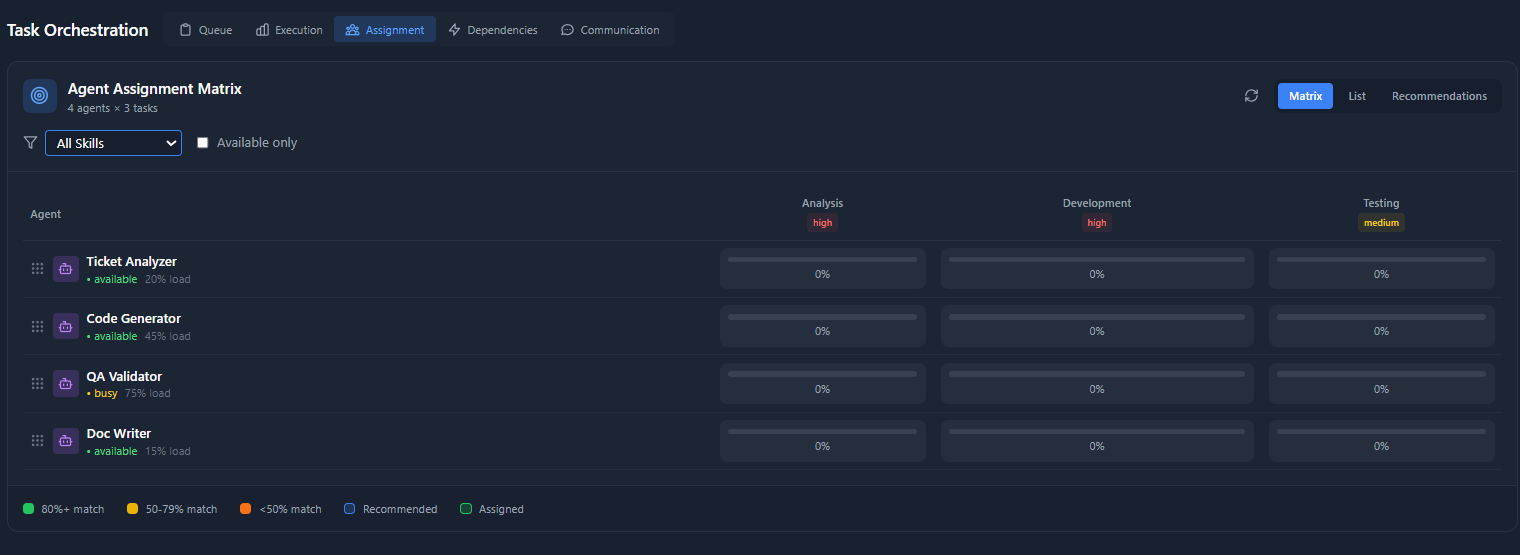
Agent Task Assignment Panel

Visual matrix showing which agent is assigned to which task — with capability score, workload, and match confidence.

Zoom Agent Info
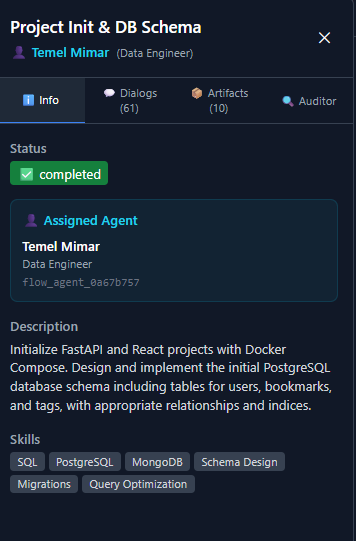
Agent Profile & Capability Info

Deep dive into any agent: roles, skills, cognitive profile, active tasks, and performance history.

5. Real Auditor Check & Quality Scoring

Every artifact and task output is automatically reviewed by the Real Auditor — an independent LLM-powered quality inspector that scores work across multiple dimensions and blocks low-quality outputs from propagating downstream.

The Real Auditor runs asynchronously in parallel with agent execution. It evaluates: code correctness, security vulnerabilities, performance patterns, architecture adherence, documentation completeness, and test coverage. Each dimension produces a sub-score, combined into a single Audit Score out of 100. Outputs scoring below the threshold are automatically sent back for revision — closing the quality loop without human intervention.
  • 6-dimension quality scoring (correctness, security, perf, arch, docs, tests)
  • Audit score 0–100 per task output
  • Auto-rejection & revision loop for low scores
  • Line-by-line finding annotations
  • Configurable thresholds (organization policy)
  • Audit history log for compliance & traceability
Zoom Audit Score
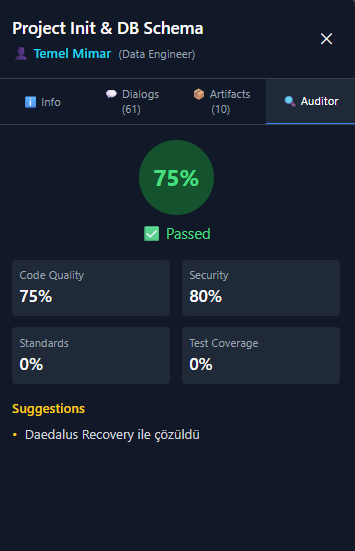
Audit Score Dashboard

Per-artifact audit score with sub-dimension breakdown — see exactly where quality gaps exist and what the agent needs to fix.

Zoom Flow 15 Audit Integration
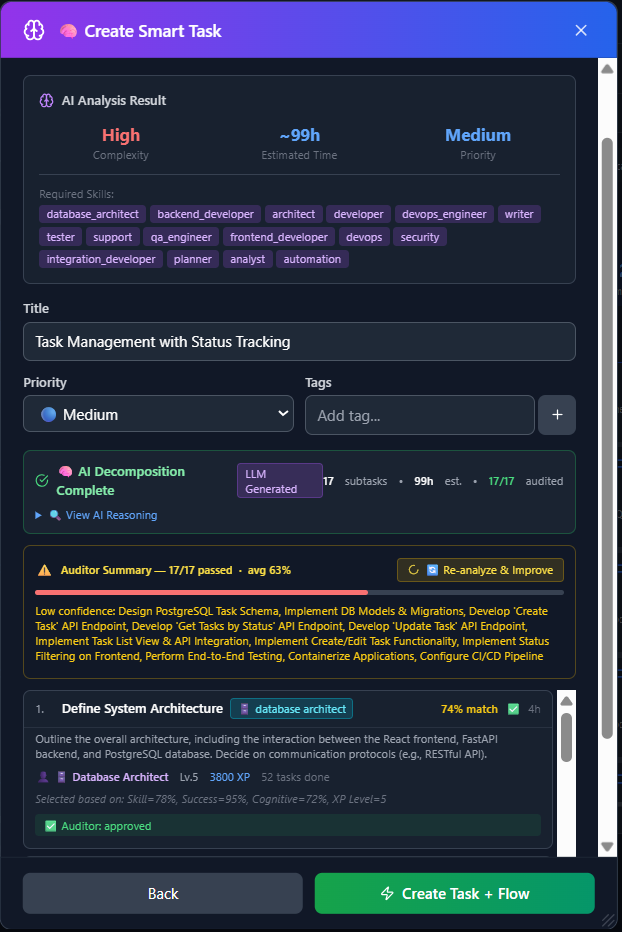
Auditor Node in Flow Graph

The Auditor manifests as a dedicated node in the flow — outputs only pass through once quality gates are cleared.

6. Self-Learning & Self-Healing in TaskFlow

TaskFlow is not static. Every completed flow improves the system. Agents learn from execution outcomes, audit feedback, and peer comparisons. When an agent fails, the Self-Healing engine diagnoses the root cause and applies targeted remediation — automatically.

Self-Learning: After each flow completes, a learning signal is extracted: what worked, what was slow, what produced low audit scores. This signal updates the agent's knowledge substrate and influences future task planning and agent assignment decisions.

Self-Healing: When a node fails, the Watchdog classifies the failure type (tool timeout, LLM hallucination, dependency deadlock, resource exhaustion) and applies the appropriate recovery strategy: retry, reassign, rollback, or spawn a specialist healing agent.
  • Per-flow learning signals extracted automatically
  • Agent knowledge substrate updated post-execution
  • 5 failure classification types with dedicated recovery strategies
  • Watchdog monitors all nodes 24/7 with <1 s response time
  • Healing history log — track every recovery event
  • Integrates with Agent University for deep retraining when needed
Zoom Learning from Audit

Learning from Audit Feedback

Audit findings feed directly into the agent's learning pipeline as structured training signals.

Zoom Self-Heal Info

Self-Healing Agent Profile

View an agent's healing history — number of recoveries, types of failures overcome, and improvement trajectories.

Zoom Rewarding

Rewarding System

Positive reinforcement signals reinforce successful patterns — agents improve continuously with every task cycle.

7. Dynamic Agent Interaction & Multi-Agent Dialogs

Agents in DAEDALUS are not isolated workers. They communicate, negotiate, delegate, escalate, and collaborate — forming an emergent organizational intelligence. Every inter-agent conversation is logged and surfaced in the Dialogs panel.

The Agent Dialog system implements the ACL (Agent Communication Language) protocol. Agents can: request help from peers, broadcast availability, form ephemeral sub-teams, escalate to the orchestrator, and report task outcomes with structured payloads. All communication is observable and replayable — critical for debugging complex multi-agent workflows.
  • ACL-based inter-agent messaging
  • Task negotiation & delegation protocols
  • Escalation chains to orchestrator
  • Full conversation replay & inspection
  • Pheromone-based stigmergic coordination for large teams
Zoom Agent Dialogs
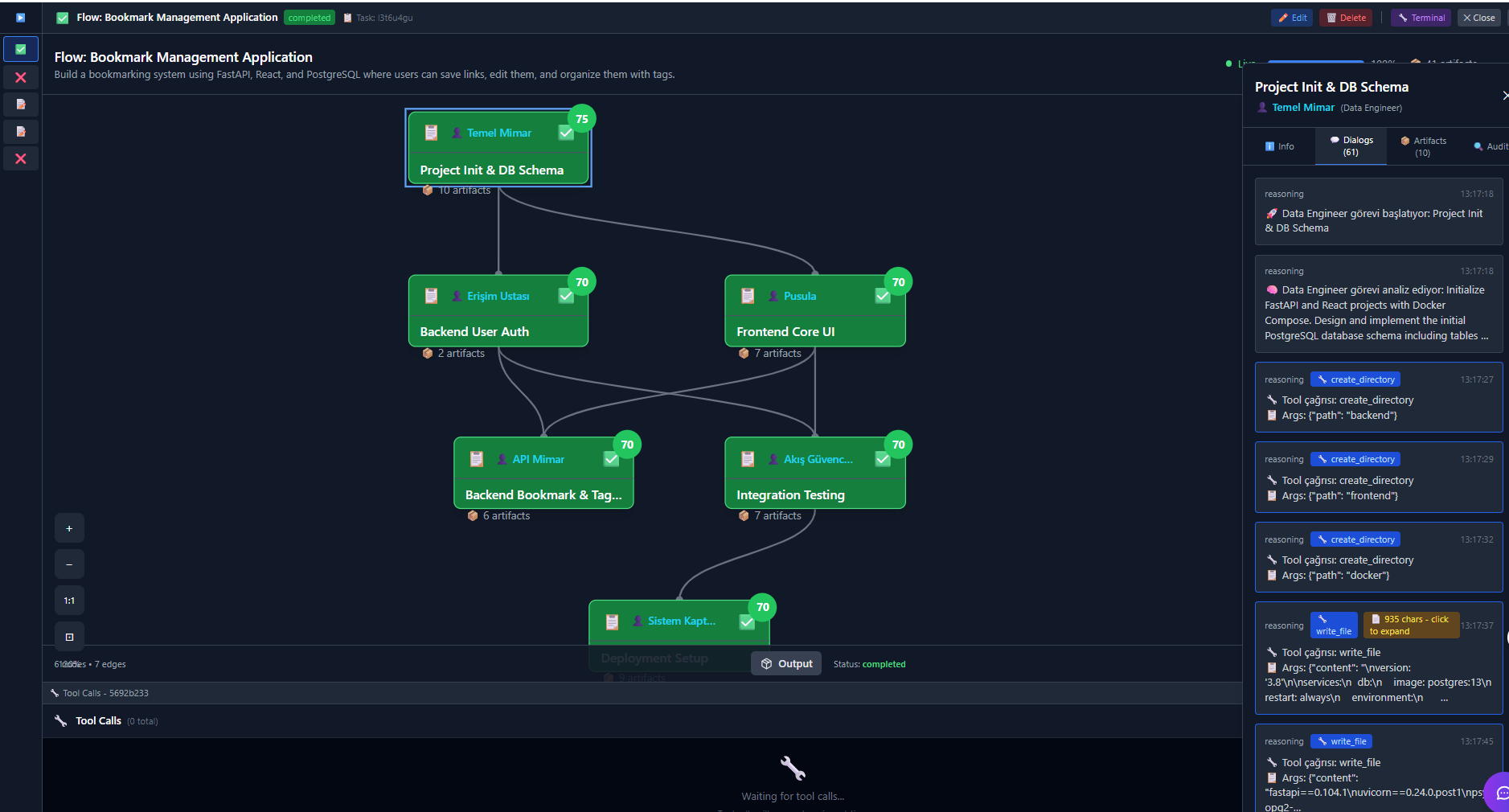
Agent Dialog Panel

Complete inter-agent conversation thread — see how agents reason together, delegate work, and reach consensus on complex tasks.

Zoom Agent Communication

Communication & Dynamics Board

Real-time visualization of agent communication frequency, collaboration patterns, and reward distribution across the team.

8. Flow-Aware AI Chat Panel

Every flow has an embedded AI Chat Panel that understands its full context: which tasks are running, which agents are assigned, what artifacts have been produced. Ask questions, give mid-flight instructions, or request status summaries — the chat assistant responds with flow-specific precision.

The Chat Panel operates in Flow Mode — it's not a generic chatbot. It has direct access to the live execution graph, agent states, task outputs, and audit results. You can say "pause the DB migration node", "summarize what Agent-3 has produced so far", or "why is the authentication task blocked?" — and get instant, accurate, context-grounded answers.
  • Live flow context injection (knows your current flow state)
  • Natural language flow control (pause / resume / skip)
  • Artifact inspection & code explanation on demand
  • Mid-flight task modification without breaking dependencies
  • Streaming responses with syntax-highlighted code blocks
Zoom Chat Panel Flow Mode
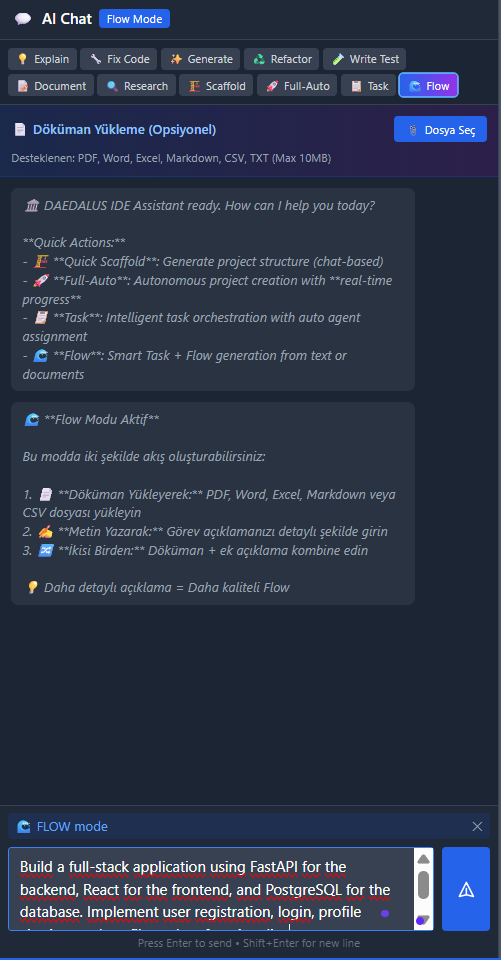
Chat Panel in Flow Mode

Context-aware chat docked alongside the live flow graph — query, control, and guide your flow through natural conversation.

Zoom AI Chat 1
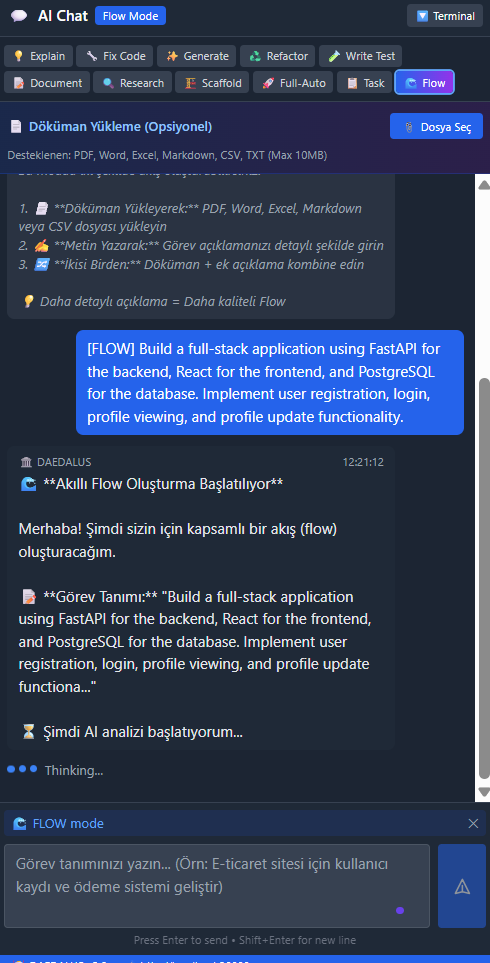
Task Clarification Dialog

The AI proactively asks clarifying questions when task requirements are ambiguous — reducing rework.

Zoom AI Chat 2
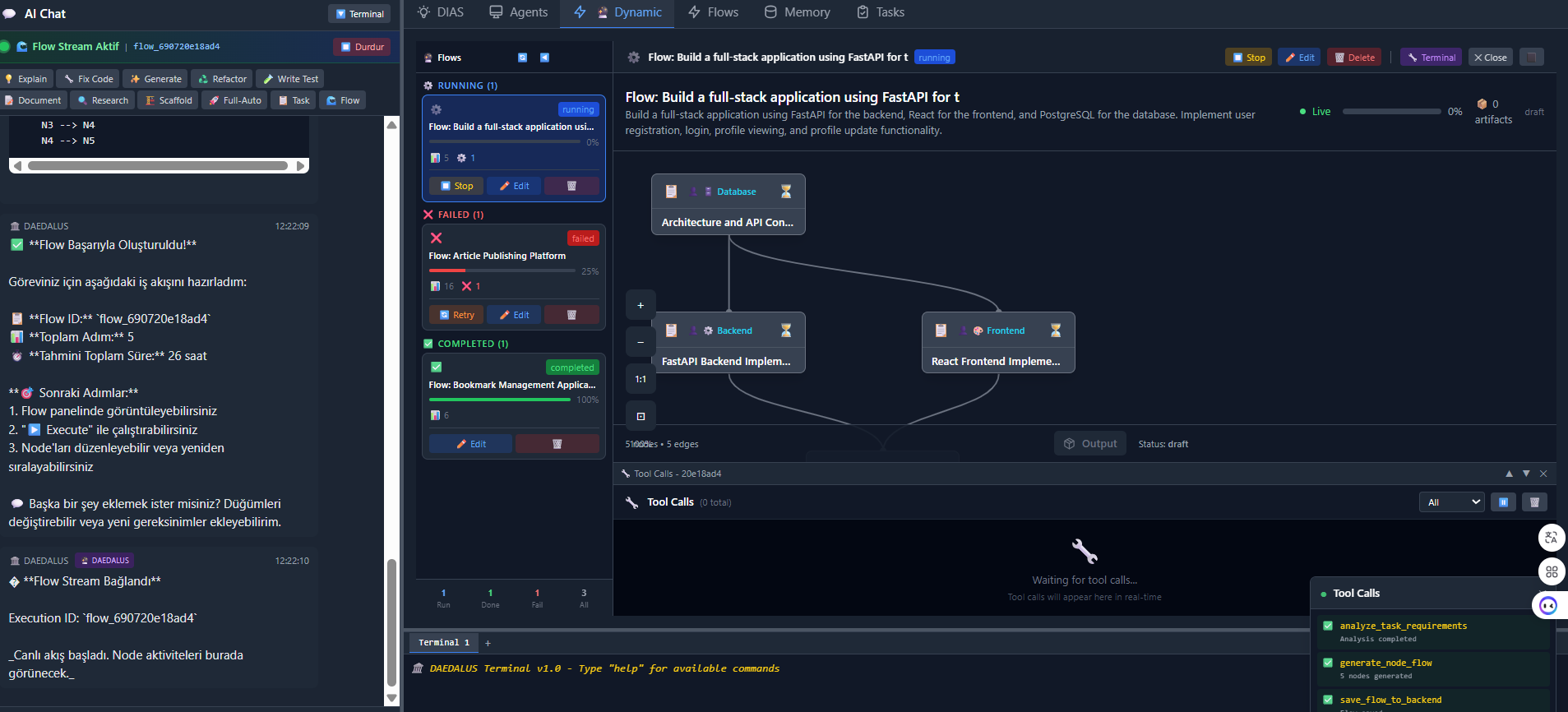
Code Explanation & Review

Ask the AI to explain any artifact in the flow — it reads the code and explains it in full context.

Zoom AI Chat 3
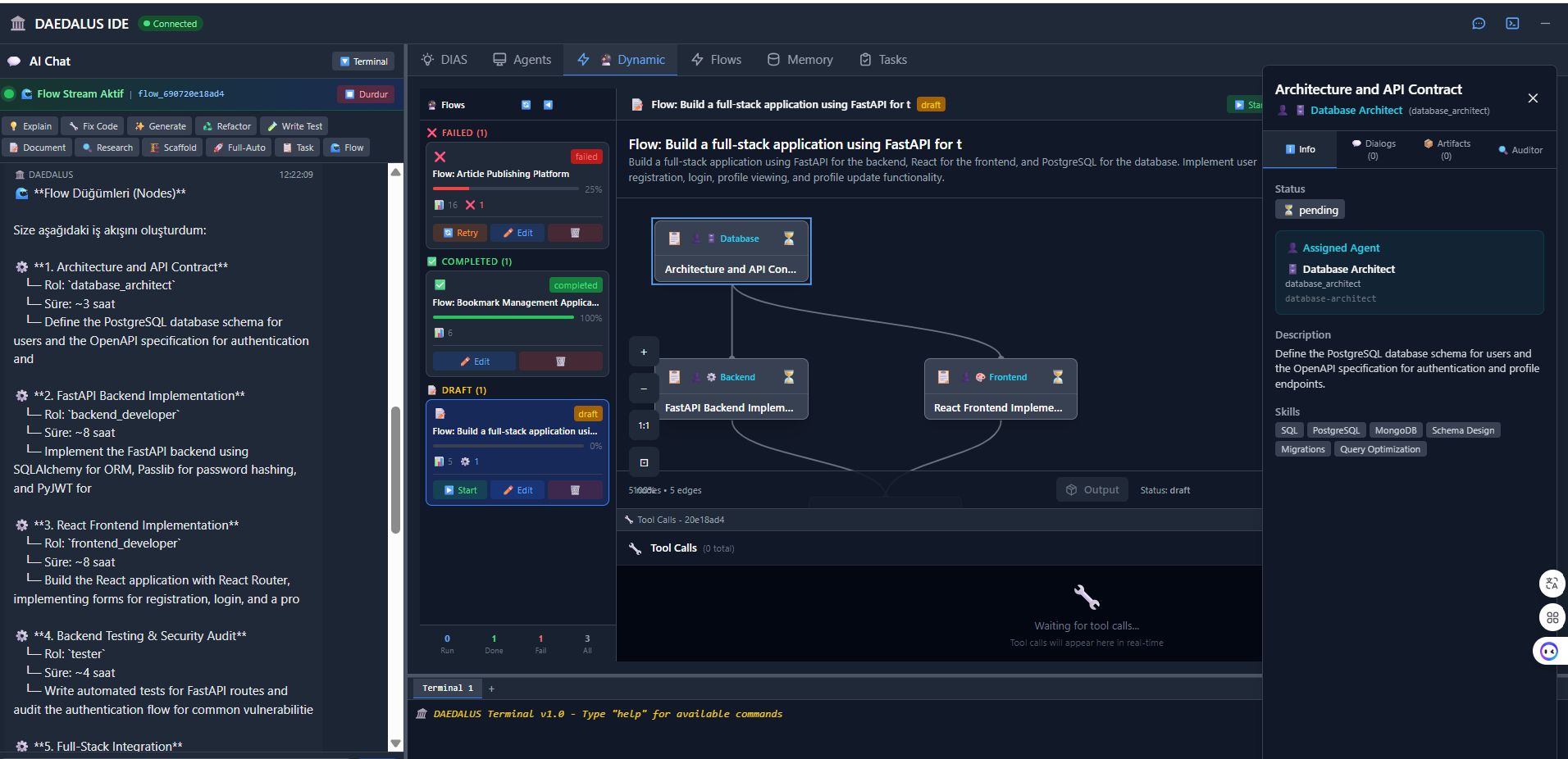
Flow Status Query

Natural language status queries: "What's left to do?" returns a structured live summary instantly.

Zoom AI Chat 4
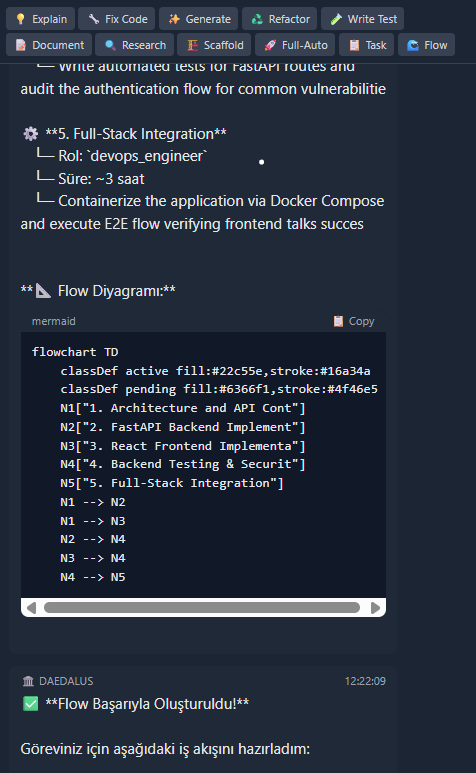
Mid-Flight Modification

Inject new requirements mid-execution — the AI propagates changes through the dependency graph safely.

Zoom Memory Selection
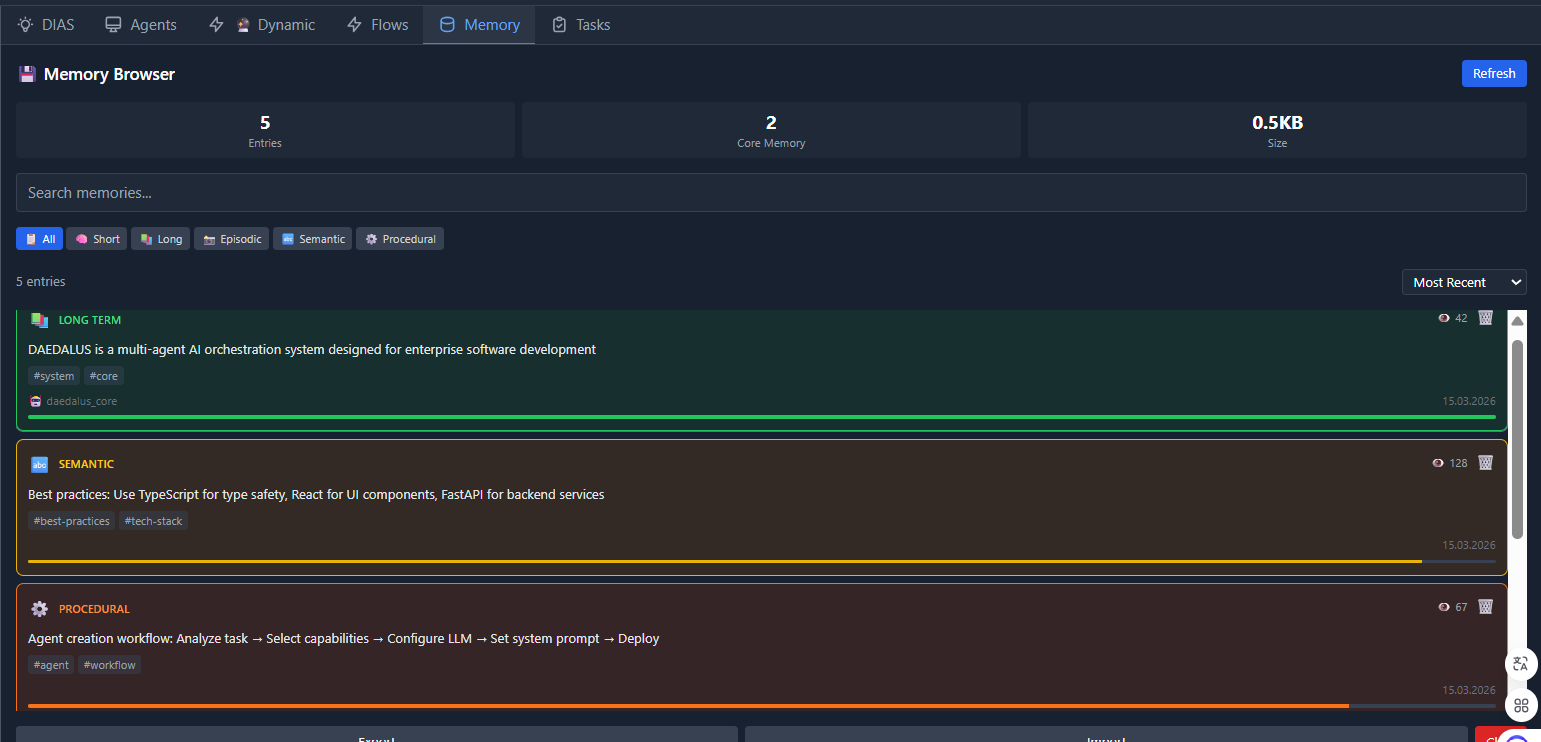
Memory & Context Selection

Choose which memory layers the AI uses: project KB, conversation history, artifact context, or external docs.

9. Function Tool Call Execution

Agents in TaskFlow are not confined to text generation. They autonomously invoke tools — file operations, API calls, terminal commands, database queries, browser automation — with full visibility into every tool invocation and its result.

Every tool call is transparent and inspectable. The Function Tool Call panel shows: the function name, input parameters, execution duration, return value, and whether the result was used successfully. Tool calls are rate-limited, sandboxed, and logged — giving you confidence that agents are doing exactly what they're supposed to do.
  • Full tool registry: file, terminal, API, DB, browser, git, test runner
  • Transparent call log with input/output inspection
  • Sandboxed execution — agents cannot exceed granted permissions
  • Tool retry logic with exponential backoff
  • MCP (Model Context Protocol) server integrations
Zoom Function Tool Call
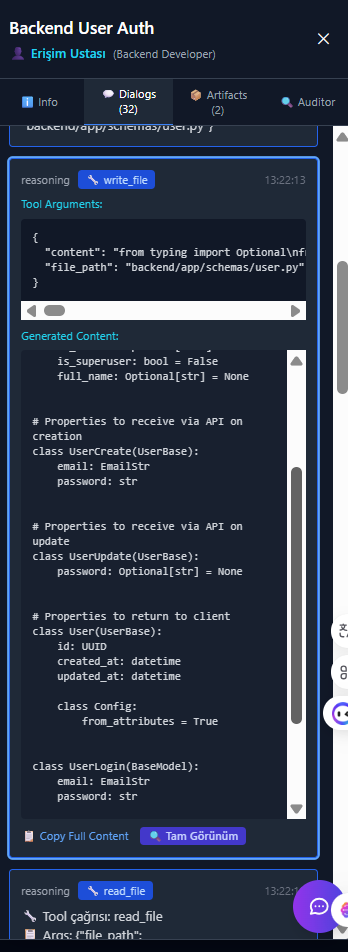
Tool Call Log Panel

Every function invocation by every agent — tool name, params, duration, result status — in a scannable real-time feed.

Zoom Function Tool Call Full Screen
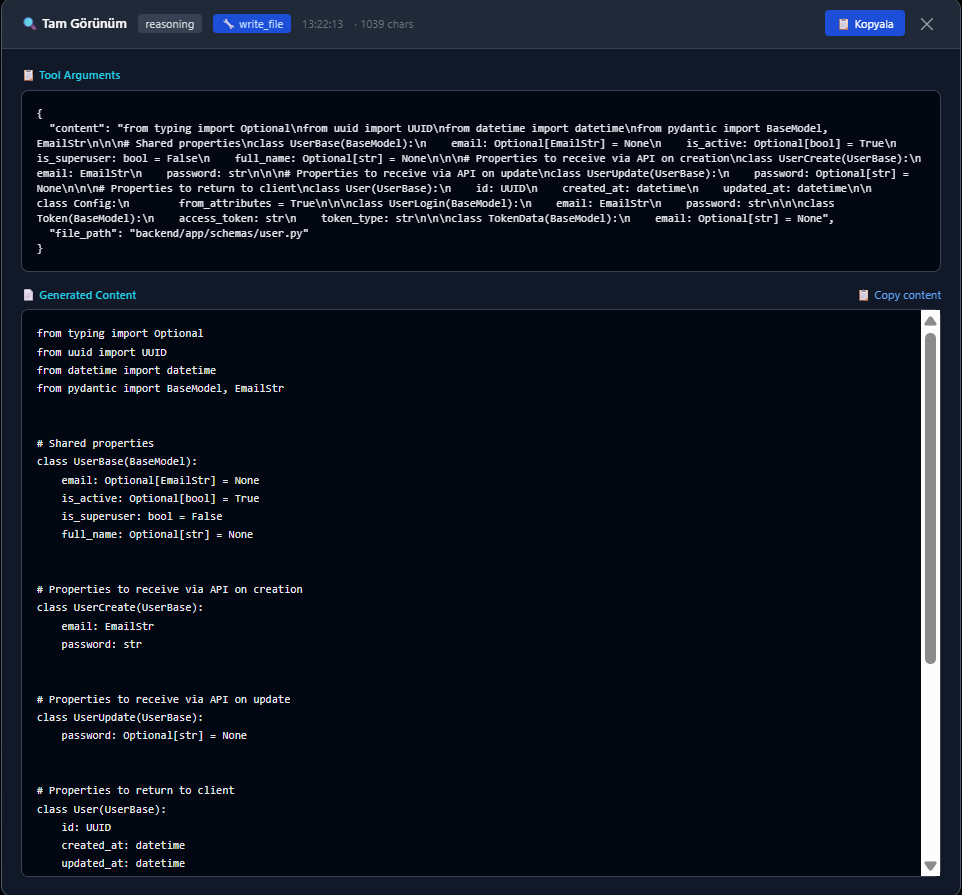
Full-Screen Tool Inspection

Expand any tool call to inspect the complete JSON payload, response body, and agent's interpretation of the result.

10. Artifact Management & Output Traceability

Every file, code snippet, document, dataset, or structured output produced by an agent is captured as an Artifact. Artifacts are versioned, audited, and linked to the task node that produced them — giving you full traceability from requirement to deliverable.

The Artifact System is the production output layer of TaskFlow. Artifacts can be: viewed inline (with syntax highlighting), downloaded, compared (diff view), promoted to the project repository, or rejected (triggering an agent revision cycle). Every artifact carries its audit score, creator agent ID, creation timestamp, and revision history.
  • All agent outputs captured as versioned artifacts
  • Inline viewer with syntax highlighting for 30+ languages
  • Diff view between artifact versions
  • One-click promotion to project repository
  • Audit score & quality badge on every artifact
  • Reject → revision loop with targeted agent feedback
Zoom Artifacts Establish
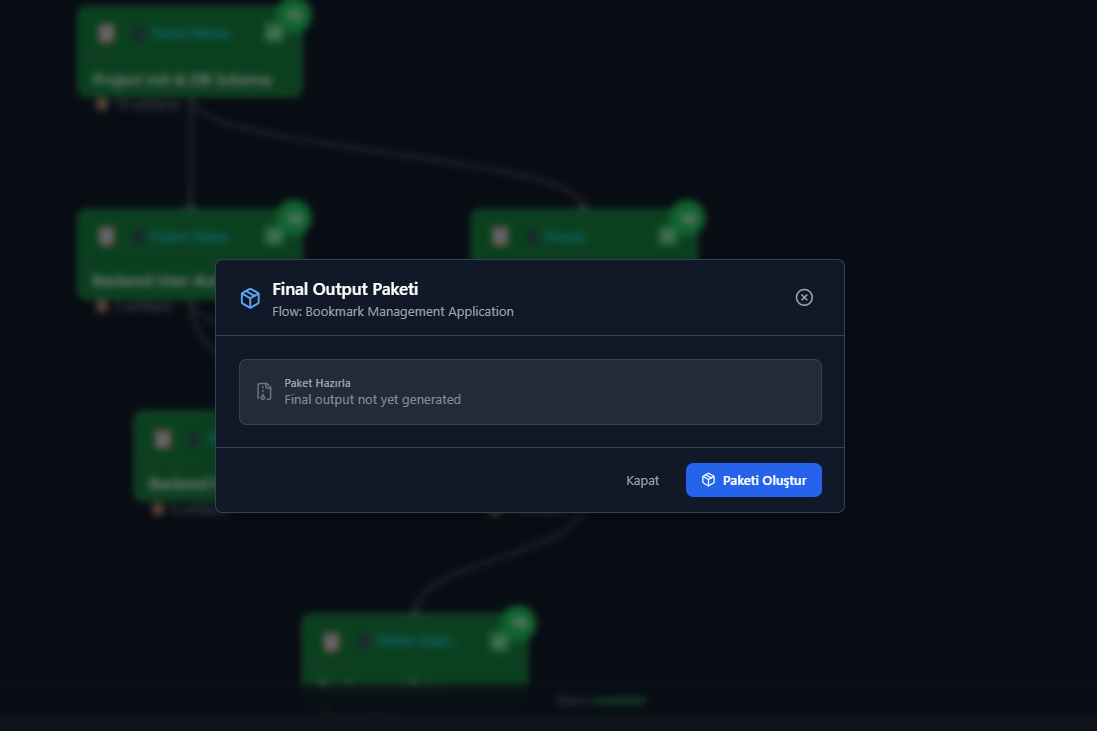
Artifact Establishment

The moment an agent produces output, it's immediately registered as an artifact — linked to its parent task node, versioned, and queued for audit.

Zoom Artifacts Gallery
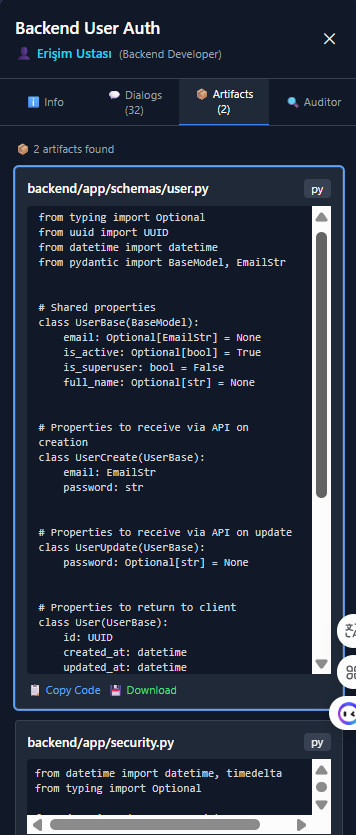
Artifact Gallery & Management

Browse all artifacts from a flow in one gallery view. Filter by type, agent, audit score, or status. Promote, compare, or reject in one click.

Ready to See It Live?

TaskFlow IDE is available now in DAEDALUS

Request a live demo or trial access to experience every feature shown above in your own environment — with your own tasks and your own agents.

Request Live Demo

IDE-Agentic Mode — Unified IDE Deep Dive

DAEDALUS Unified IDE: Beyond Code Assistance

Where competitors offer code completion, DAEDALUS delivers end-to-end autonomous software creation. Unified IDE orchestrates multi-agent teams, scaffolds entire projects from a single prompt, self-heals in real-time, and continuously evolves its own knowledge base — all within one seamless environment.
6
Interaction Modes
12+
Specialist Agents
100%
Full Autonomy
0
Manual Interventions
Self-Healing Cycles

How DAEDALUS Stacks Up Against the Competition

Capability Cursor Windsurf GitHub Copilot DAEDALUS Unified IDE
Tab / Ghost-text Completions
Inline Edit (Cmd/Ctrl+K)
Multi-file Context Editing
Full Autonomous Project Scaffolding
Multi-Agent Orchestration
Real-time Self-Healing
Deep Web Search Integration
Persistent Knowledge Base & Learning
DevOps / DB / Security Specialist Agents
Watchdog System Health Monitor
MCP Server Integration
Memory Persistence Across Sessions

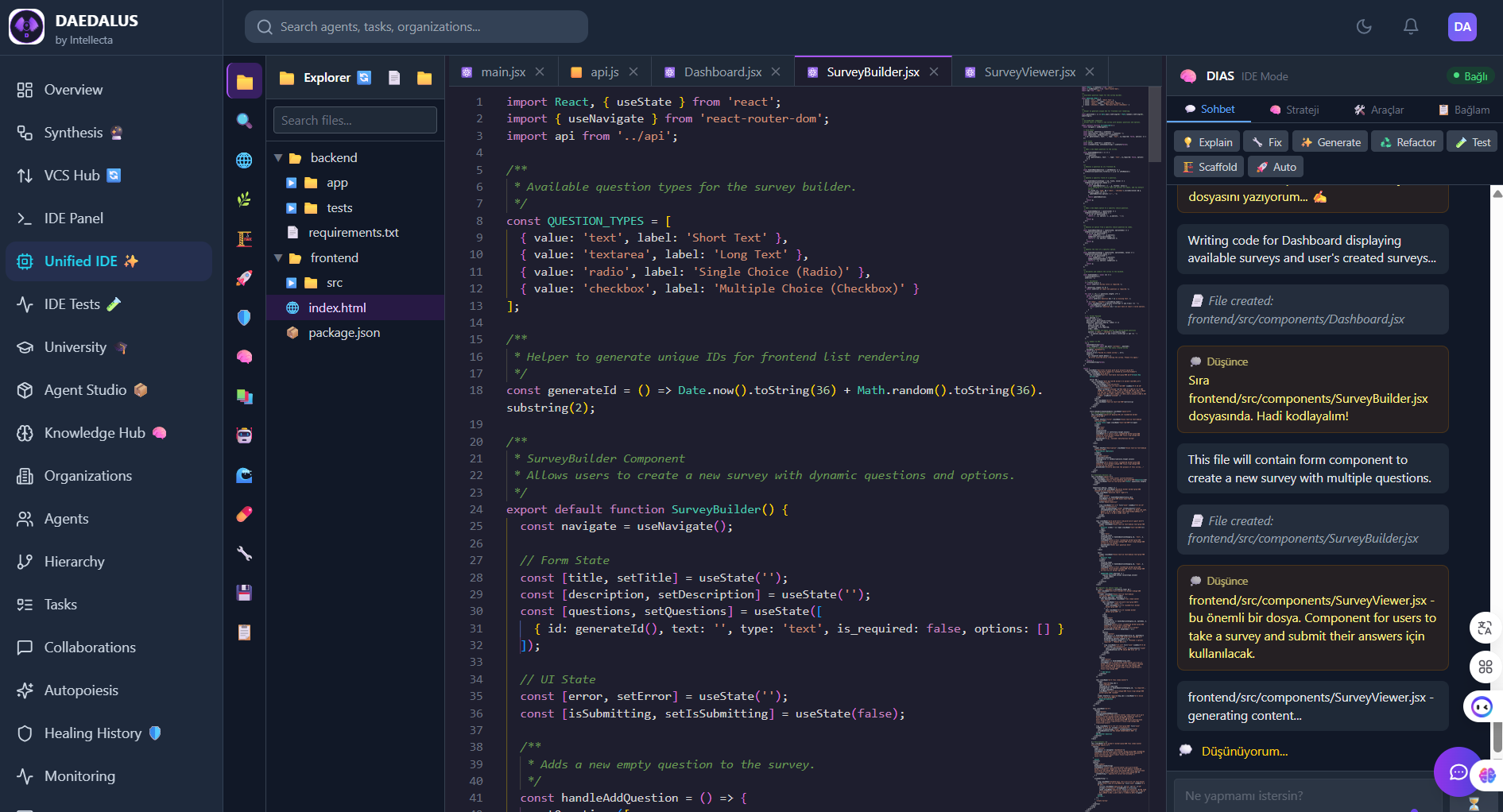
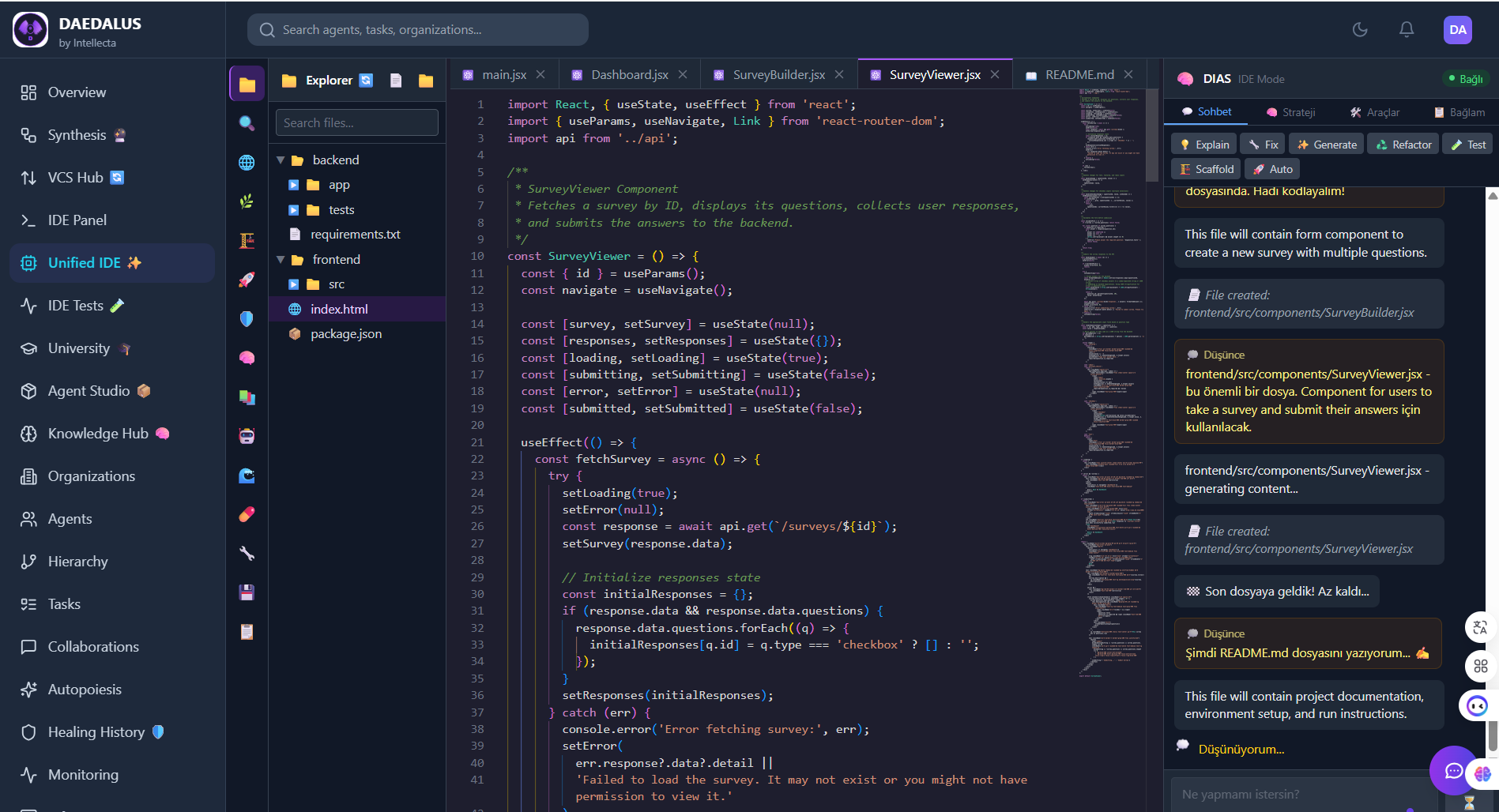
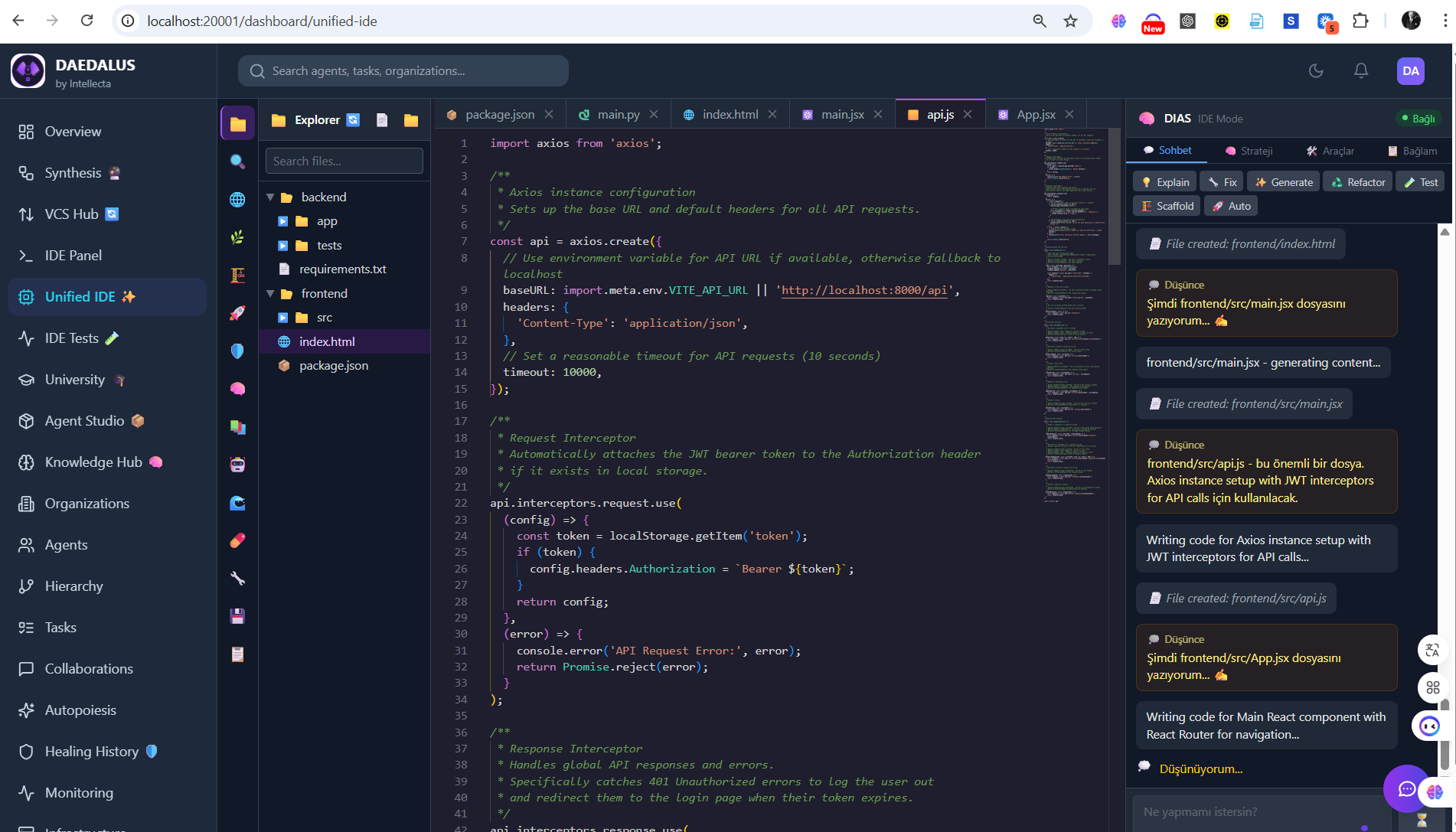
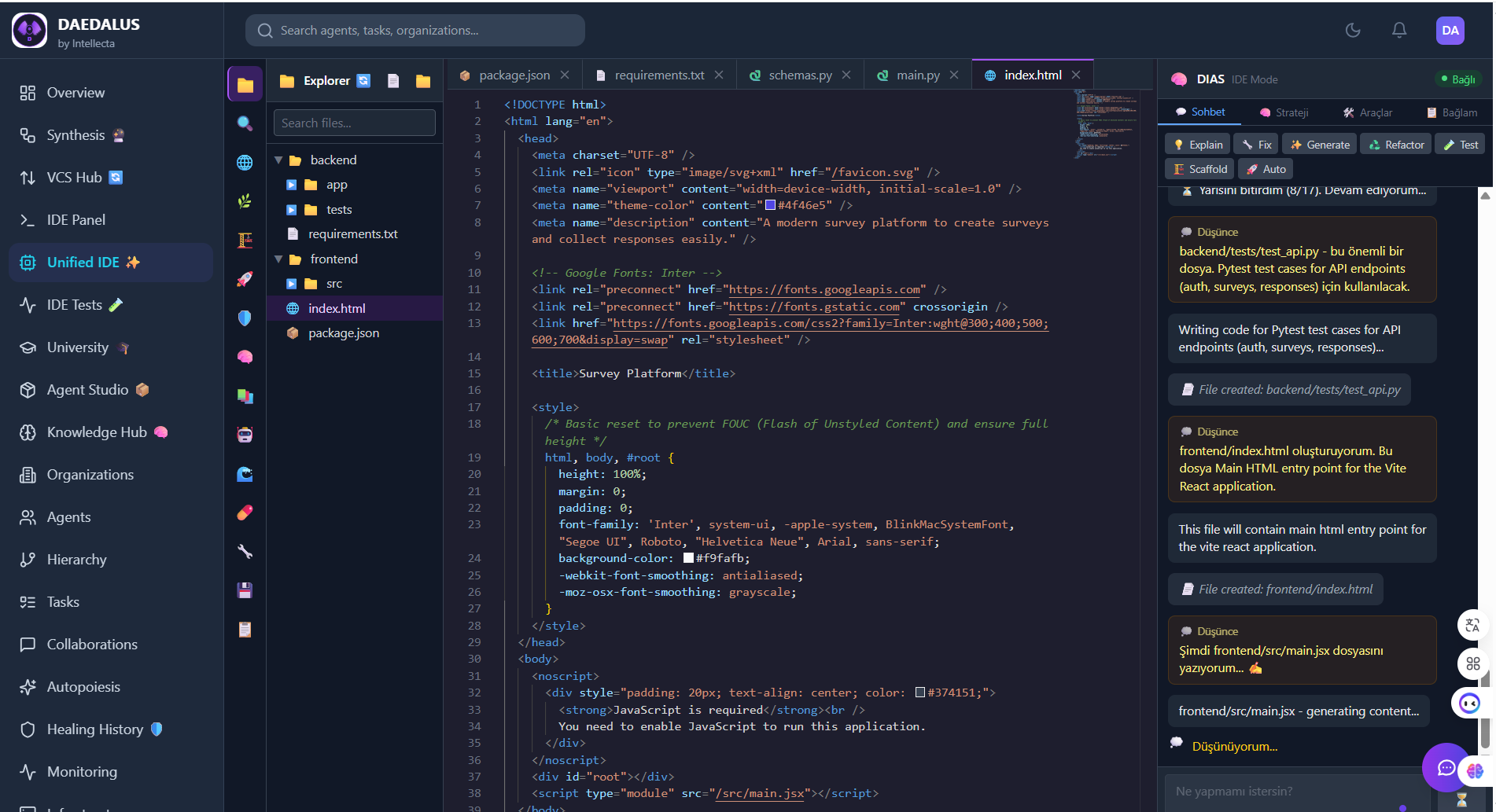
1. Full Autonomous Project Creation

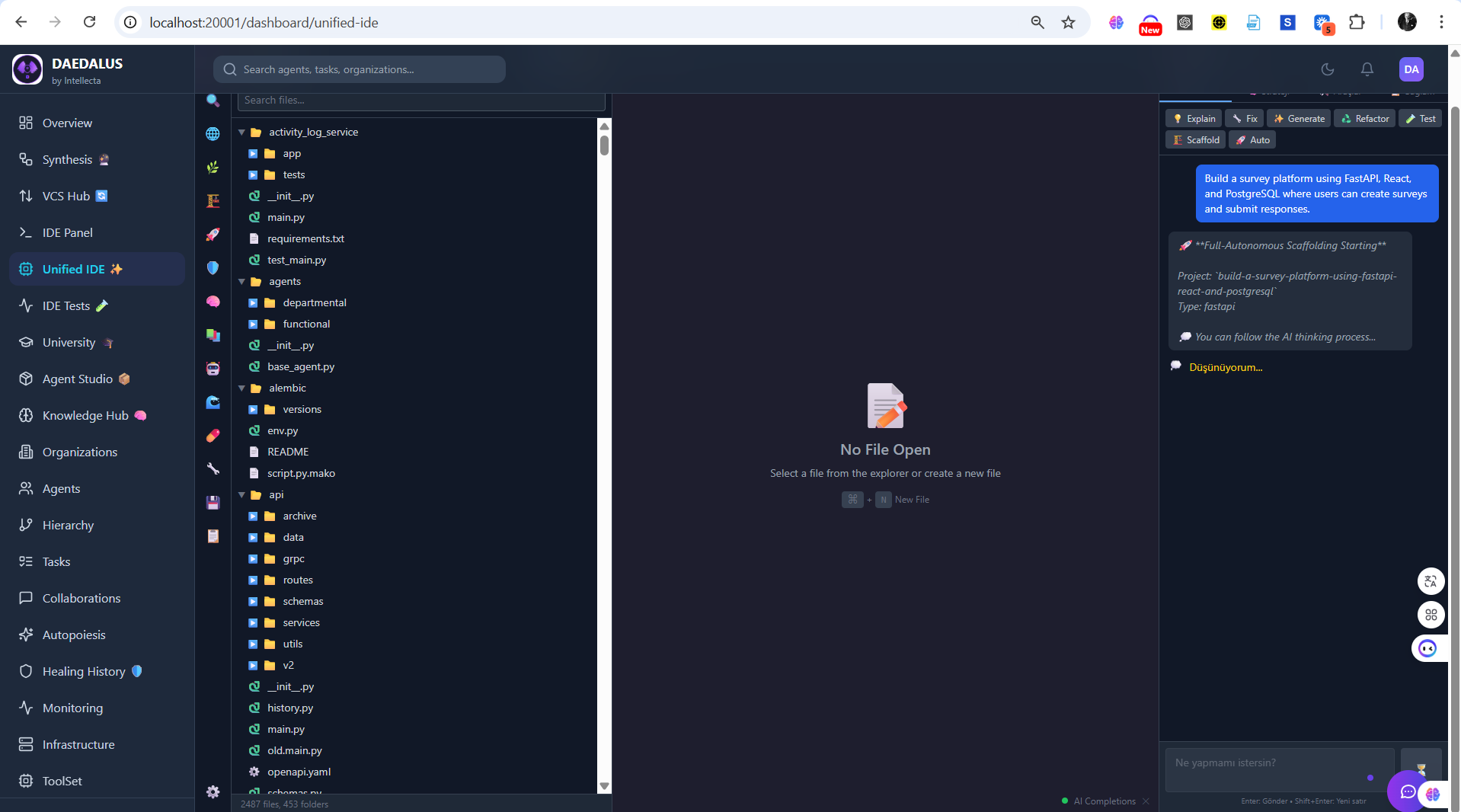
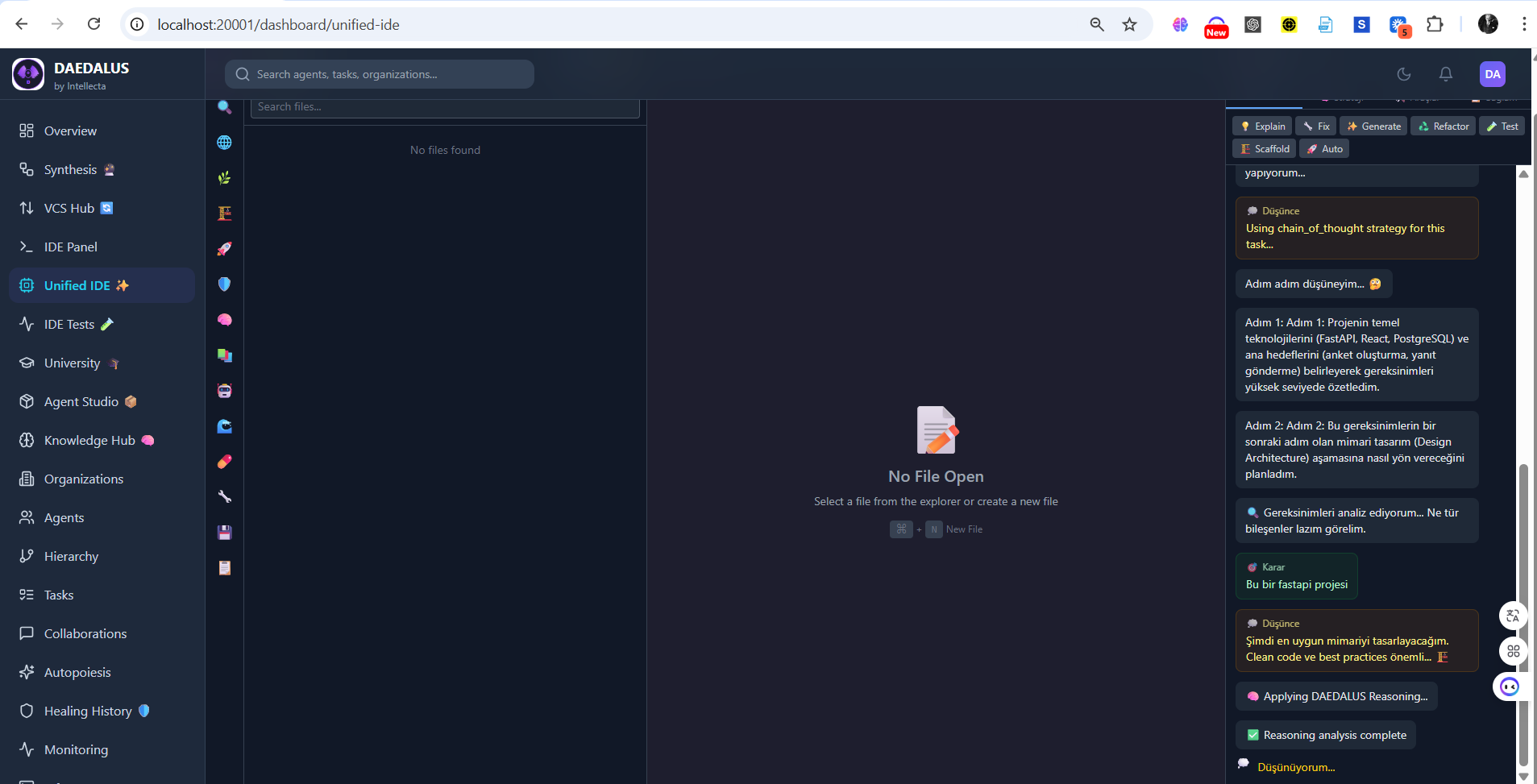
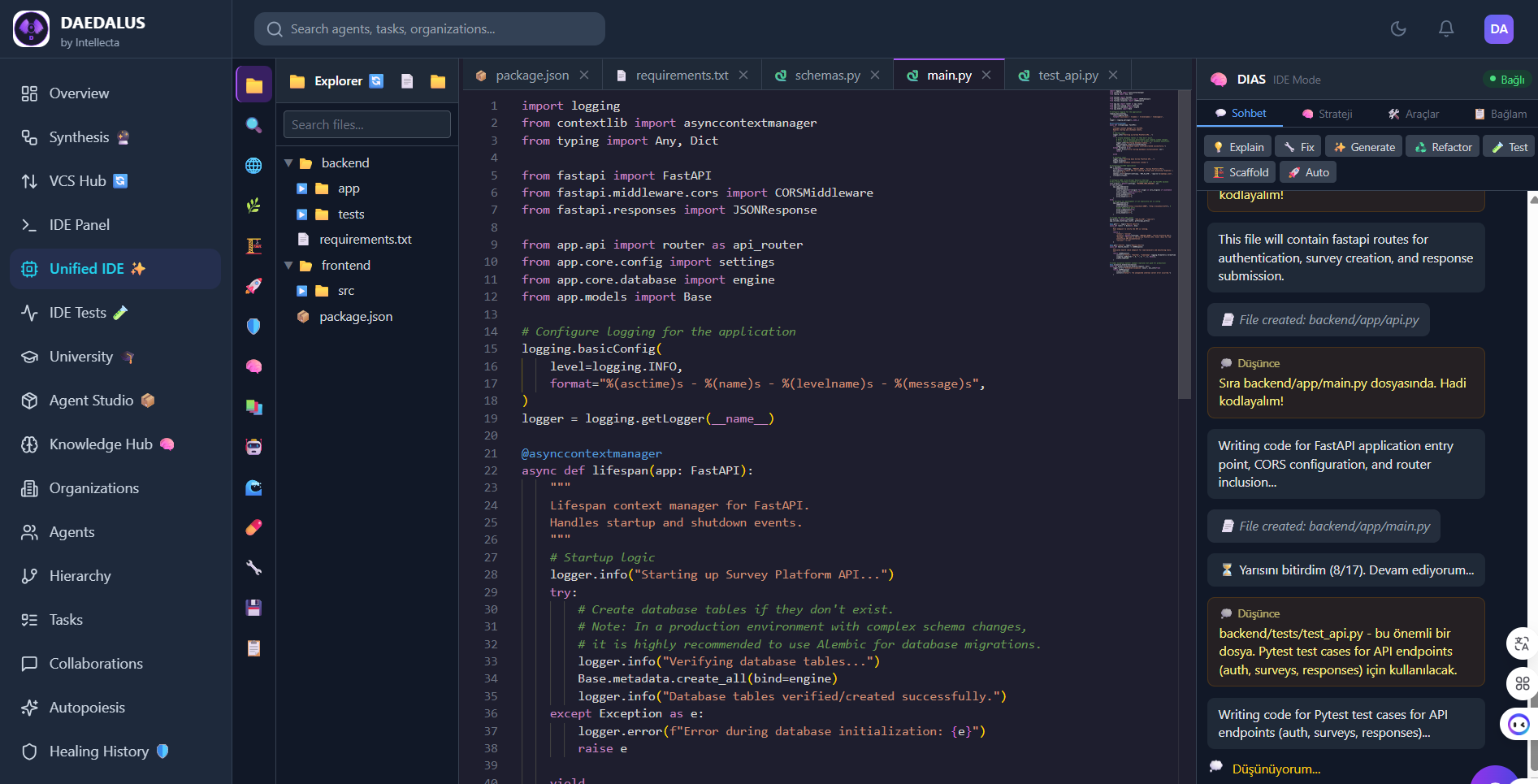
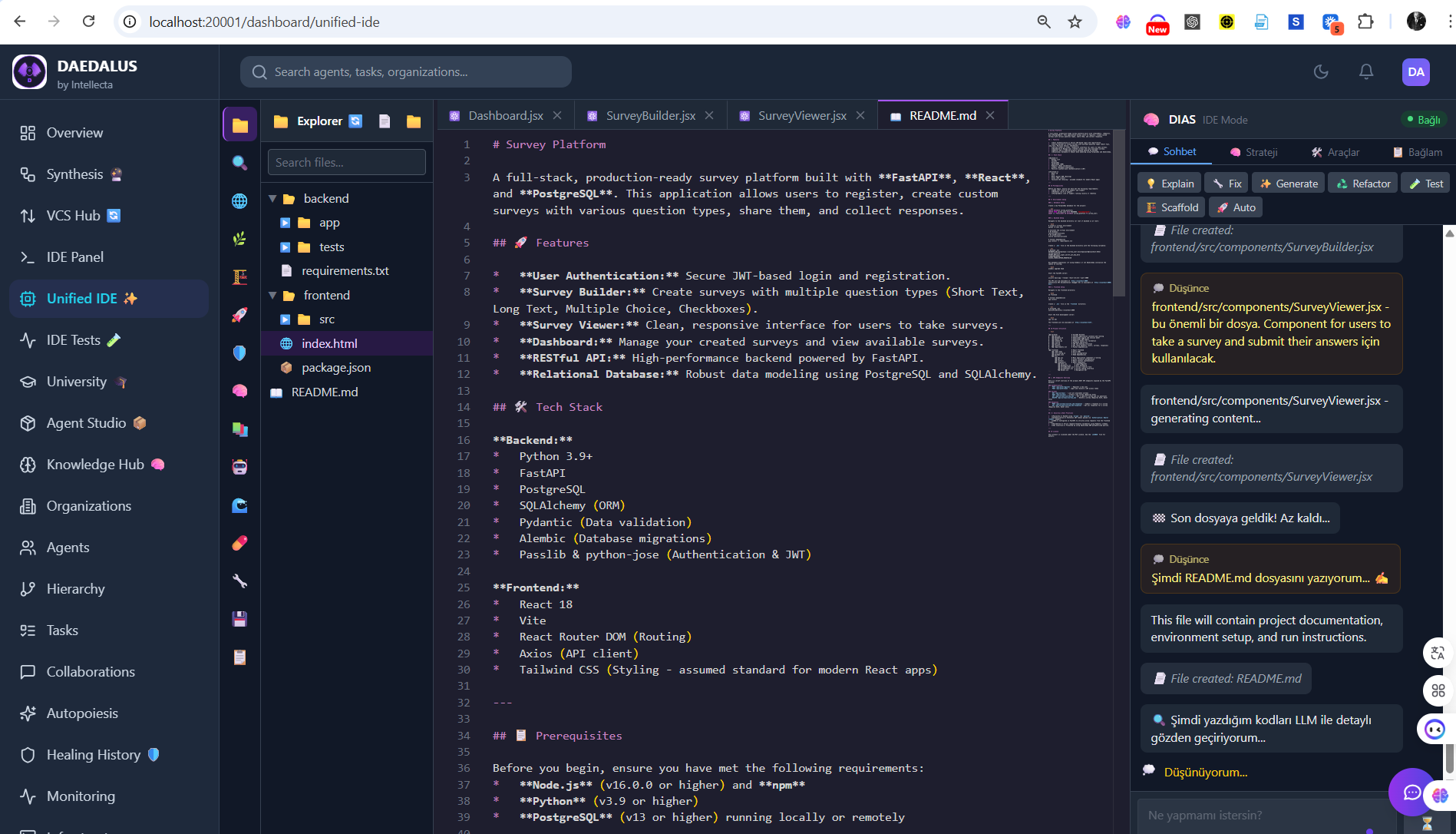
From a single natural-language prompt, DAEDALUS Unified IDE spawns a complete multi-agent team, decomposes the project into components, and autonomously generates every file — frontend, backend, database schemas, configuration, and documentation — without a single manual step.

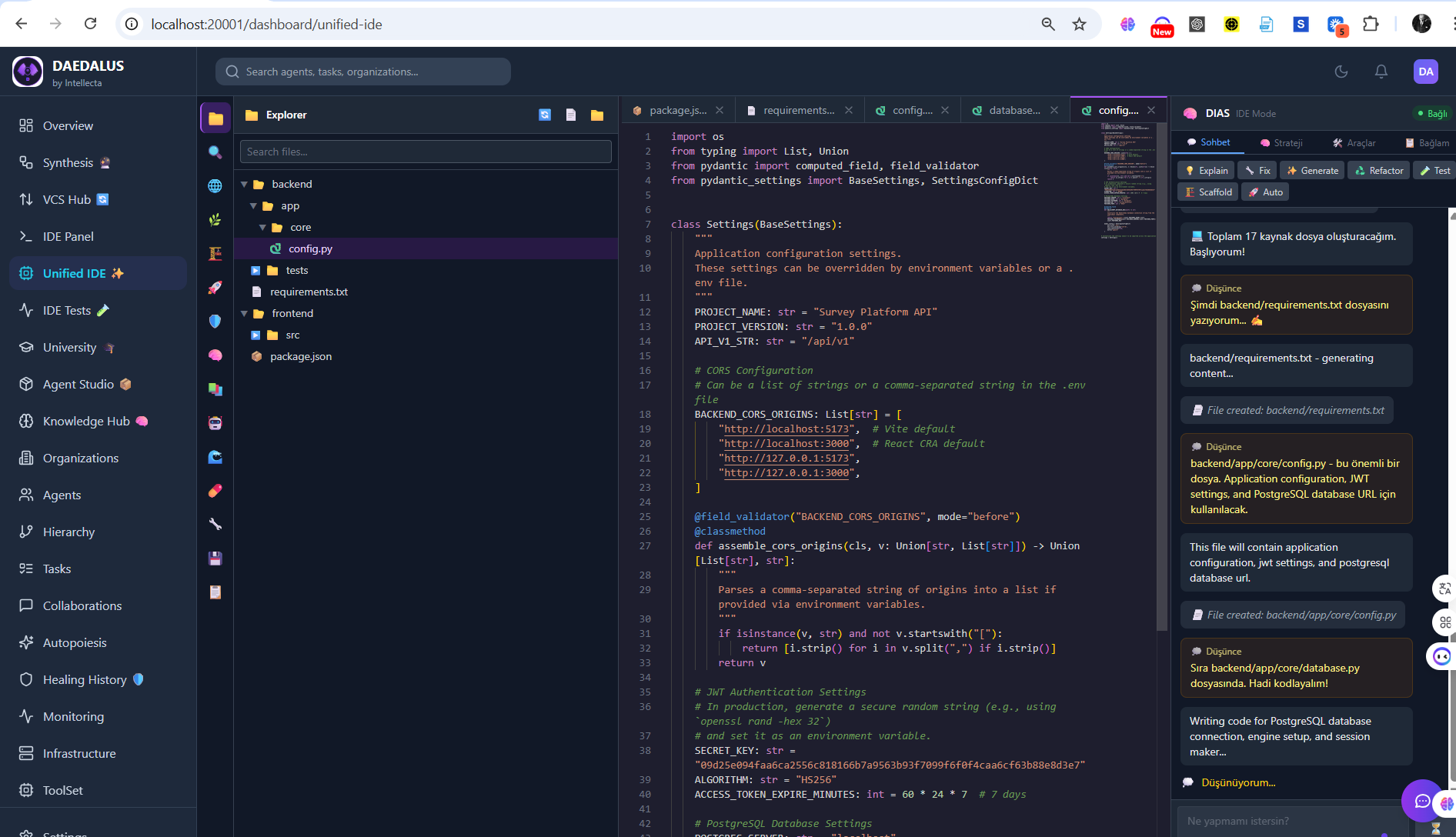
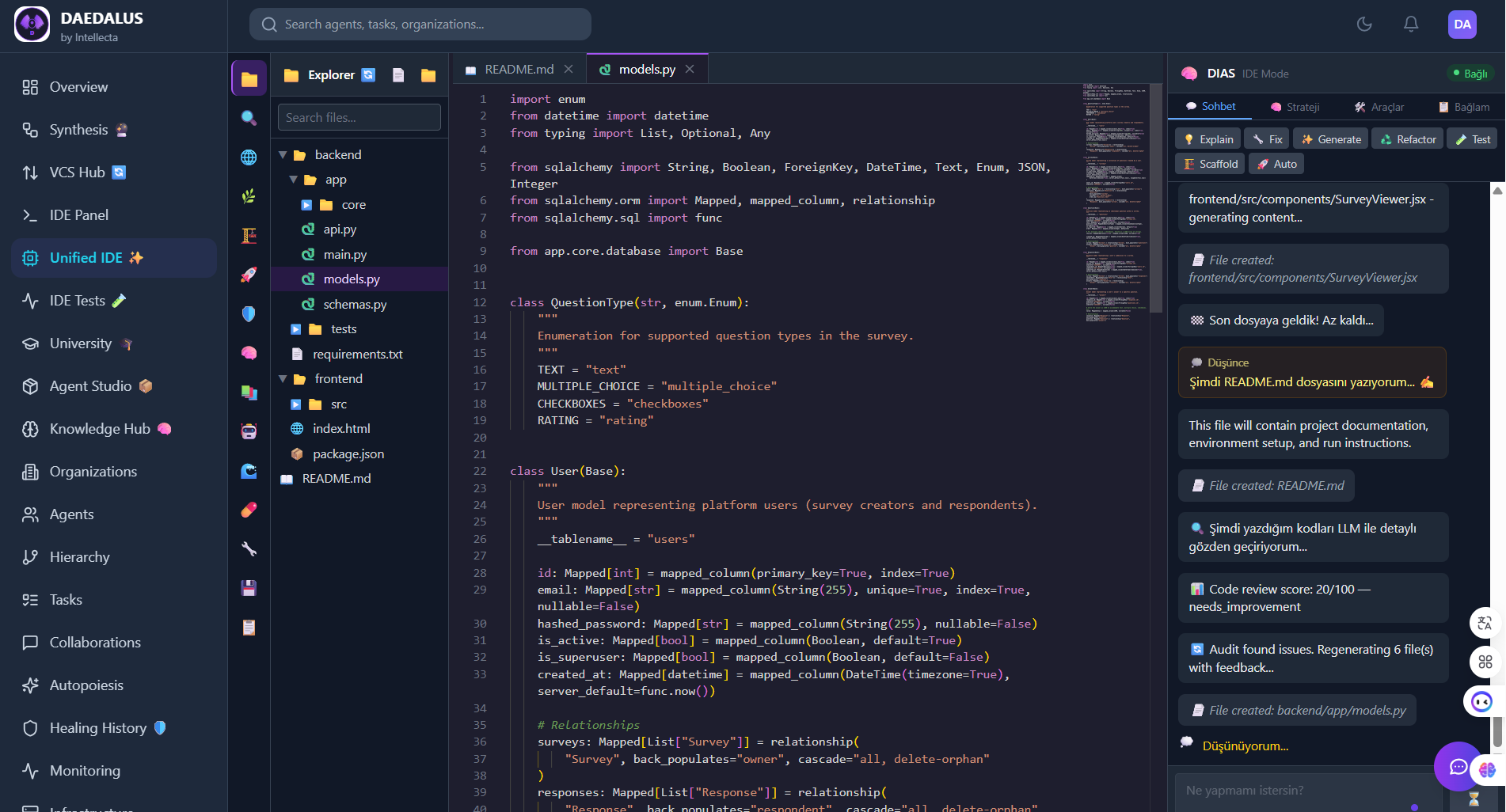
2. Intelligent Backend Code Generation

DAEDALUS does not just write boilerplate — it understands your full data model, creates relational schemas, FastAPI routes, service layers, and configuration files with perfect consistency across all files. Each backend file is generated by a specialized agent that cross-validates with other agents.

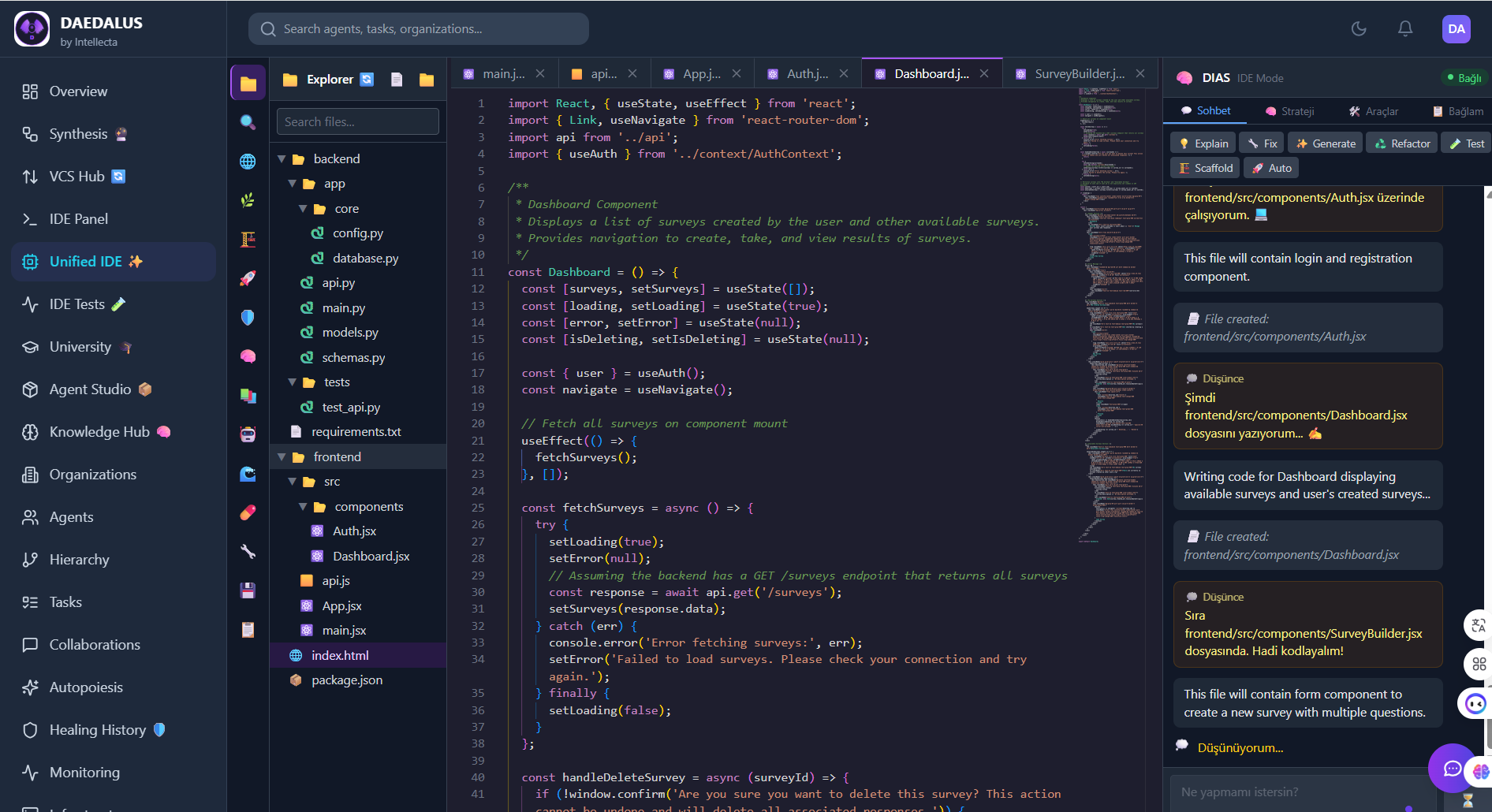
3. Autonomous Frontend Development

The Frontend Agent generates complete React/JSX components, routing setups, API integrations, and static HTML — fully consistent with the backend schemas generated by the Backend Agent. No manual copy-pasting of types, no mismatched API contracts.

4. Real-time Self-Healing Capabilities

Unlike any competitor, DAEDALUS actively monitors its own outputs. When a generated file contains a logical inconsistency, type mismatch, or API contract violation, the Watchdog Agent detects it and dispatches the appropriate specialist agent to auto-fix it — without any human intervention.

5. AI Chat, Web Search & Knowledge Intelligence

DAEDALUS goes far beyond in-IDE chat. The Unified IDE includes deep web search integration, code explanation with contextual reasoning, and a self-evolving knowledge visualization layer that maps what the system knows about your entire codebase and domain.

6. Agent Creation, Summary & Documentation

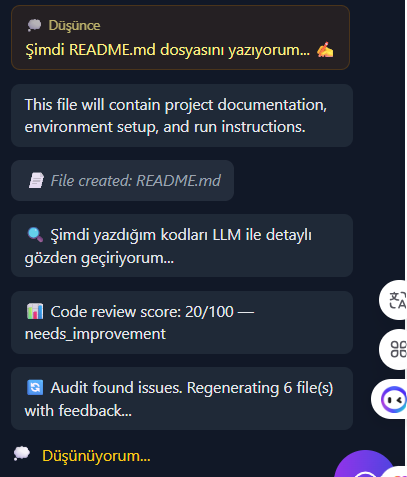
Once a project is built, DAEDALUS auto-generates comprehensive documentation, creates README files, and produces a complete project summary with file inventory, architecture diagrams, and dependency maps. Agents can even create and configure other agents within the IDE — true meta-agentic capability.

EXPERIENCE THE FUTURE OF DEVELOPMENT

Ready to Eliminate Manual Coding Forever?

Request a live demo of DAEDALUS Unified IDE and watch it build your next production-ready application — fully autonomous, from prompt to deployment.

Request Live Demo

Enterprise IDE Intelligence

DIAS — Dynamic Intelligent Analysis System

DIAS is the enterprise intelligence layer of the DAEDALUS Unified IDE. It extends the existing chat-based assistant with 5 specialized analysis engines — Compliance & Security Audit, Symbol Trace & Impact Analysis, Root Cause Analysis, Spec-to-Code Synchronization, and Team-Aware Collaboration. Each engine works independently or enriched by LLM, delivering real-time results via WebSocket.

1

DIAS IDE Panel — Unified Intelligence Interface

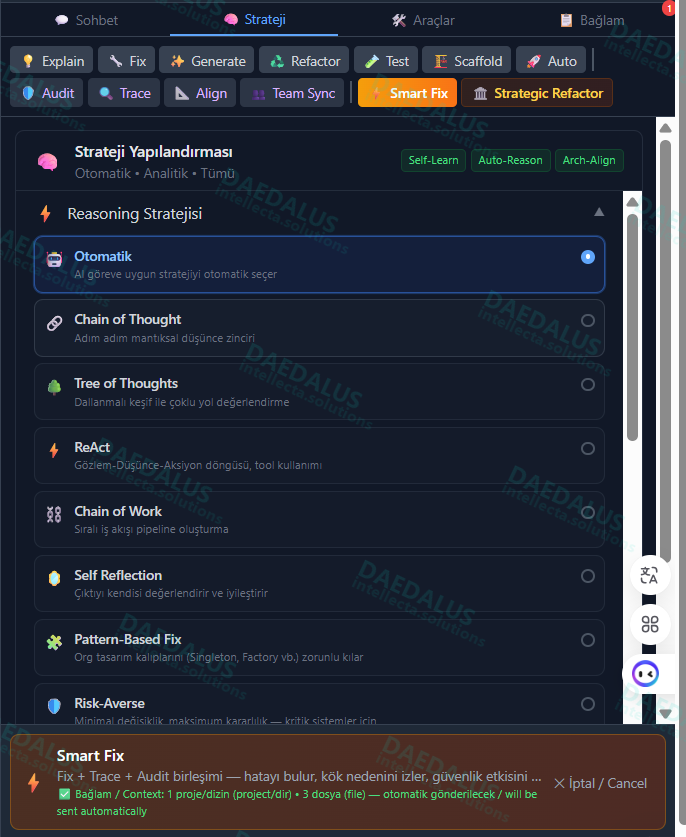
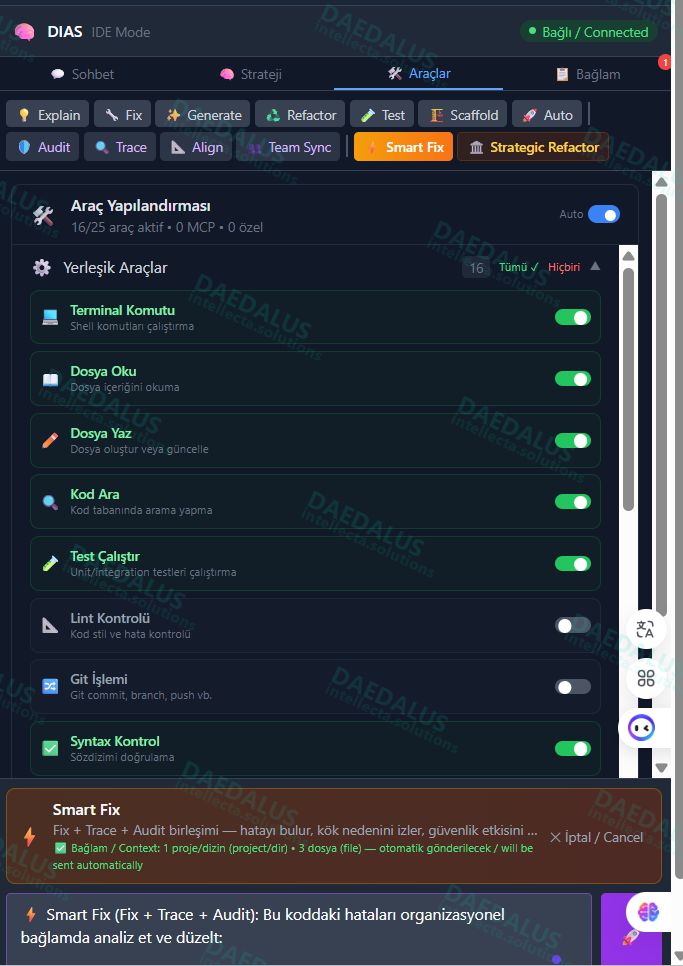
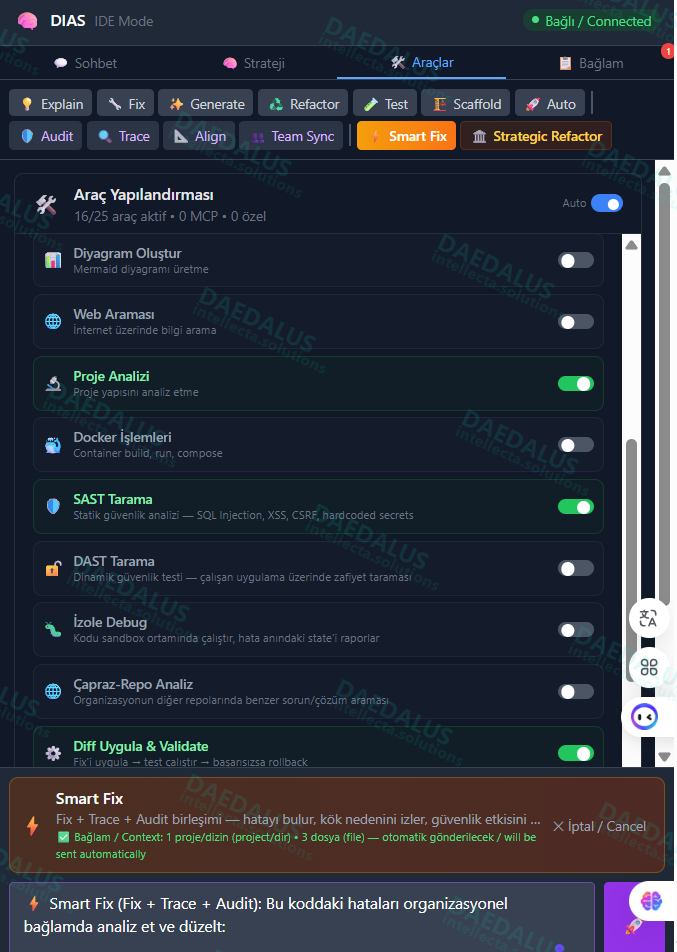
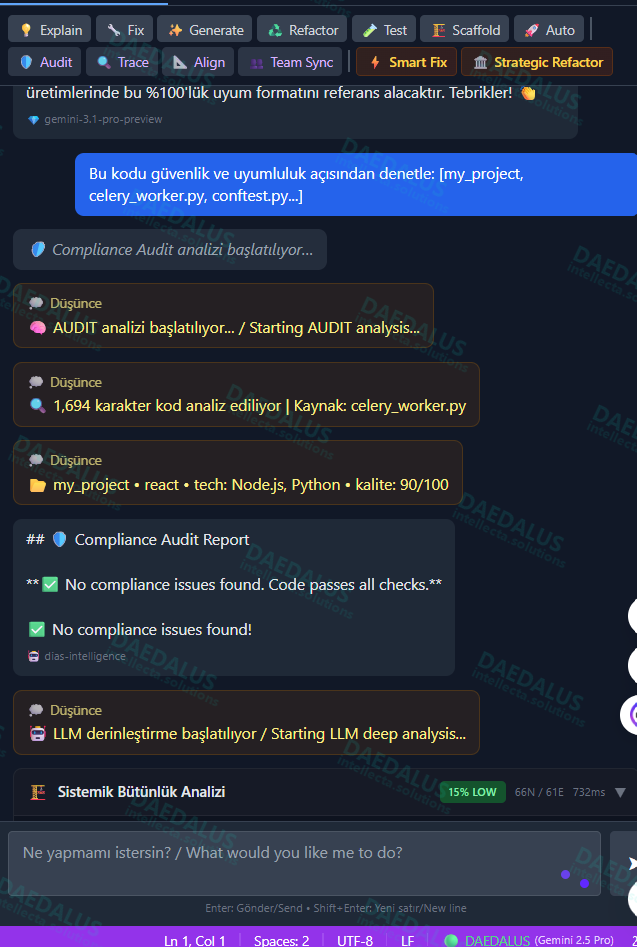
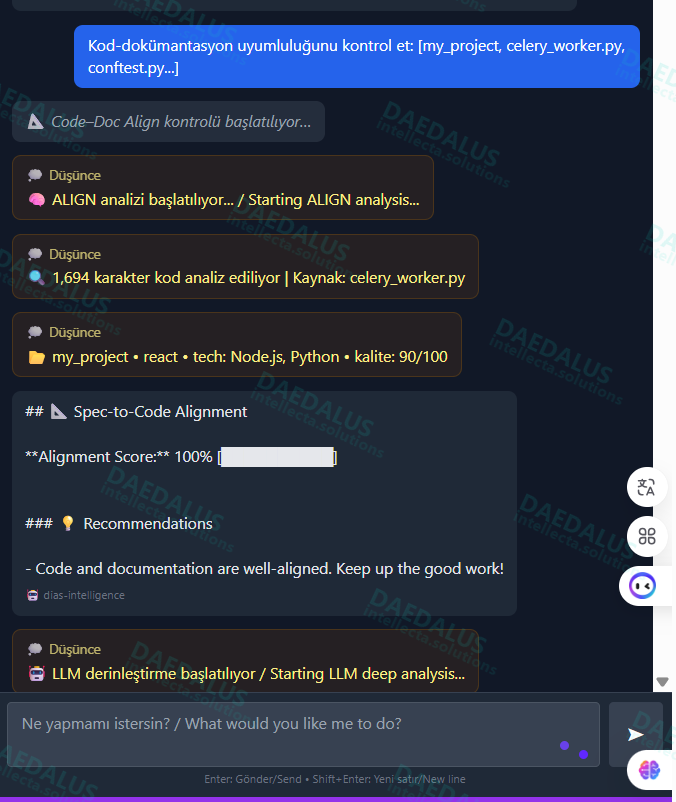
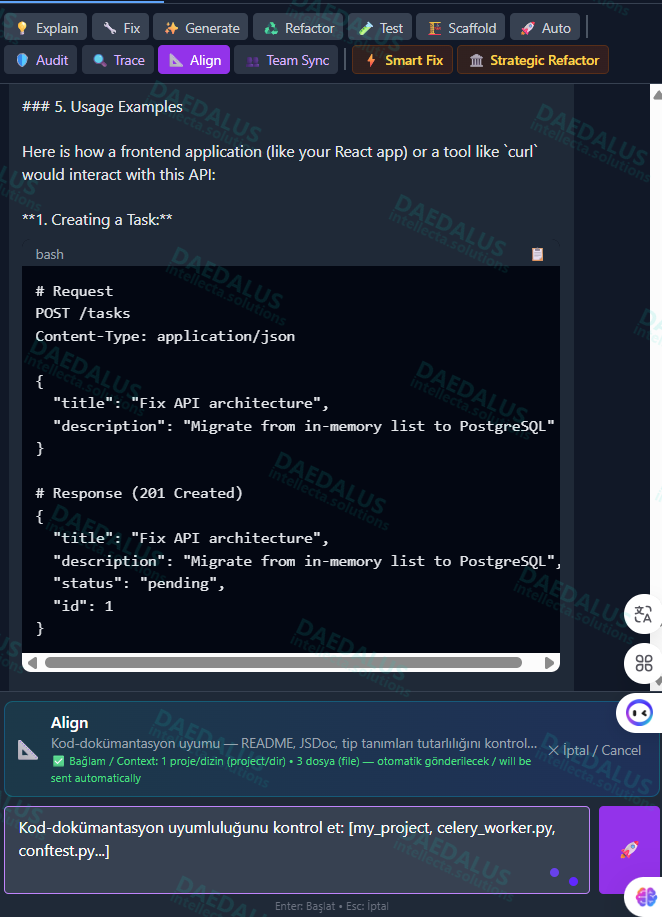
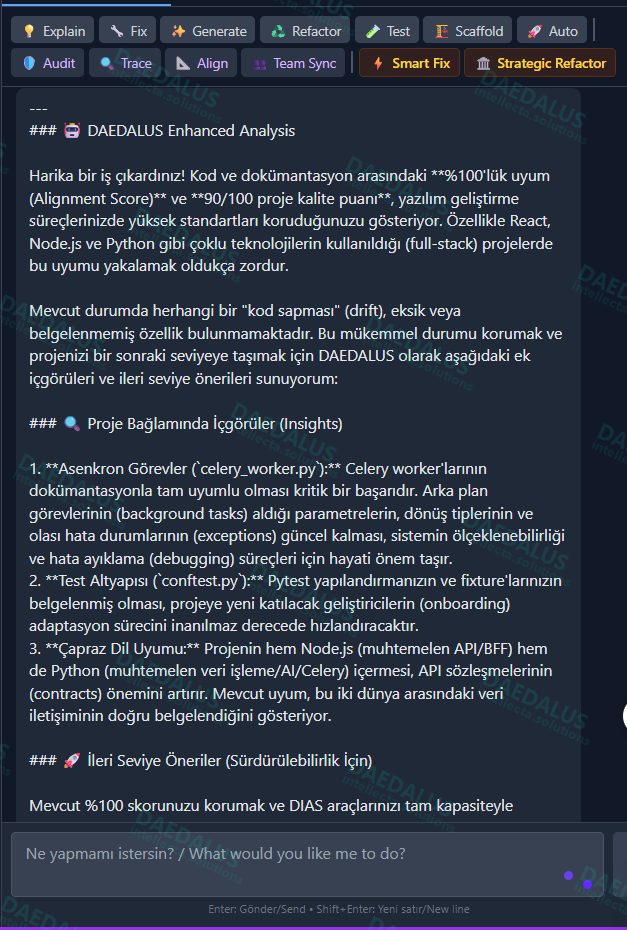
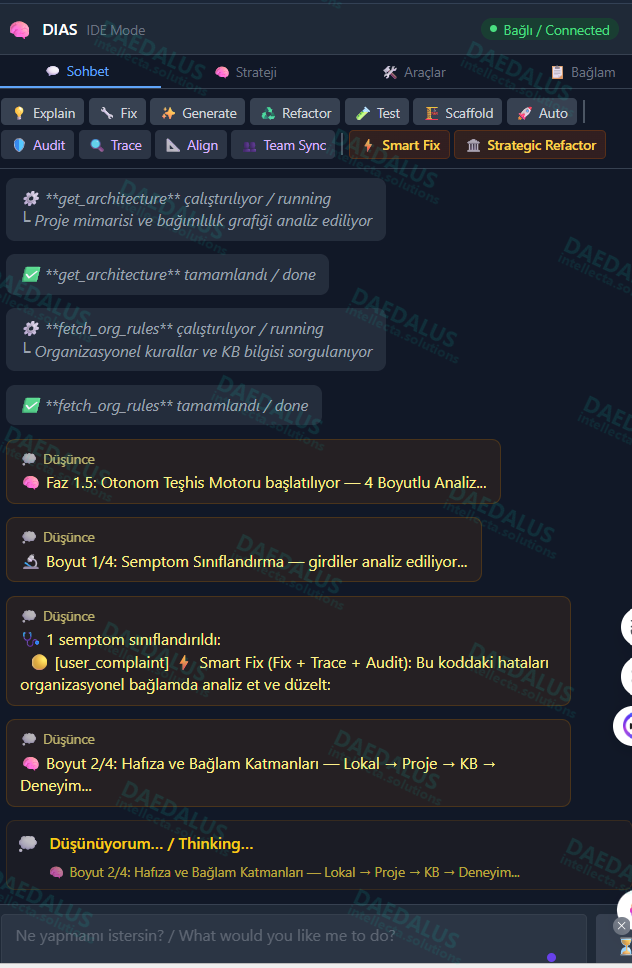
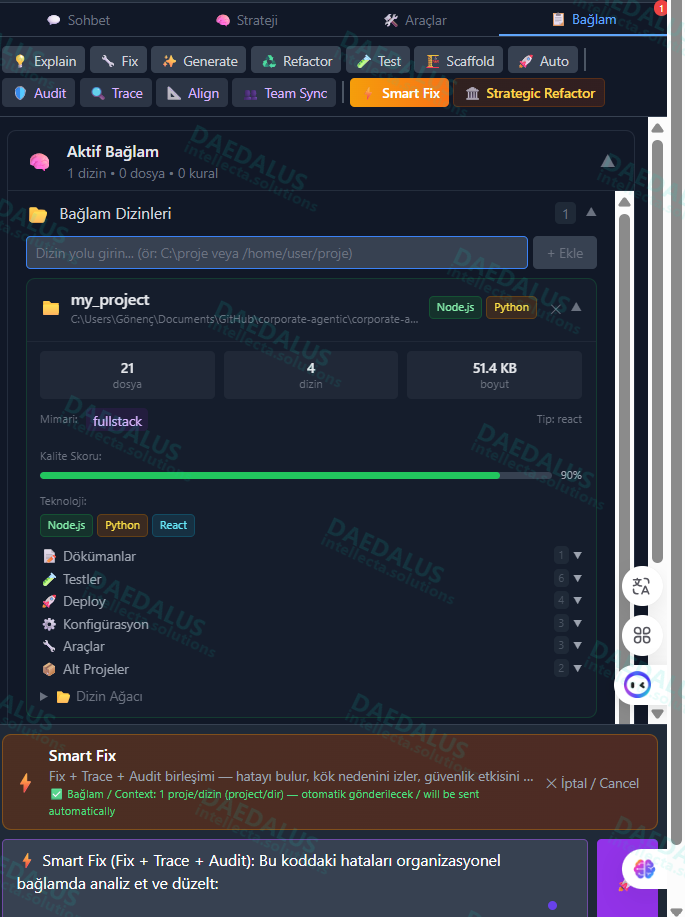
The DIAS panel integrates directly into the DAEDALUS IDE as a chat-side intelligence layer. Four dedicated buttons — Audit, Trace, Align, and Team Sync — provide instant access to enterprise-grade analysis without leaving your development environment. Every action flows through a structured pipeline: from user click to engine execution to formatted chat response.

Audit Trace Align Team Sync Root Cause
2

Context-Aware Analysis — Deep Project Understanding

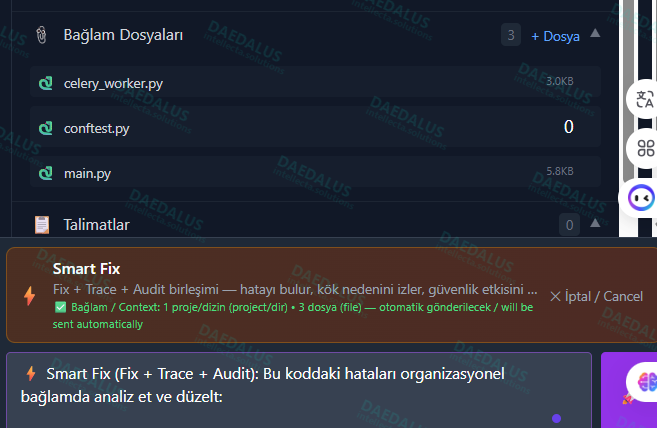
DIAS analyzes your project at multiple levels: file selection for targeted scoping, project directory structure analysis, advanced context binding with constraints, and function/tool call options for fine-grained control. This multi-layered context system ensures every analysis is grounded in your actual project reality — not generic assumptions.

3

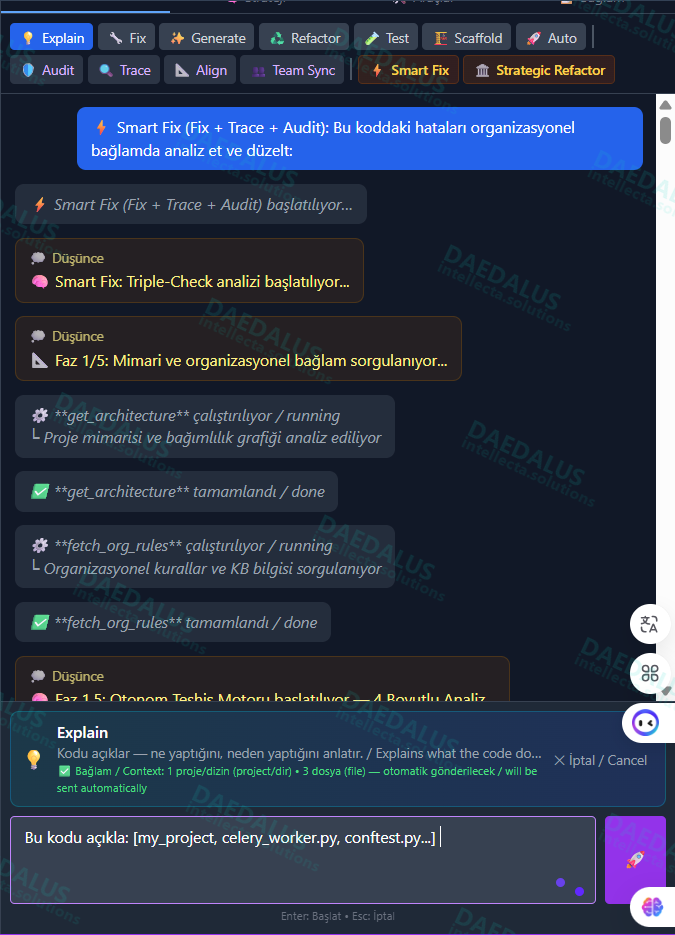
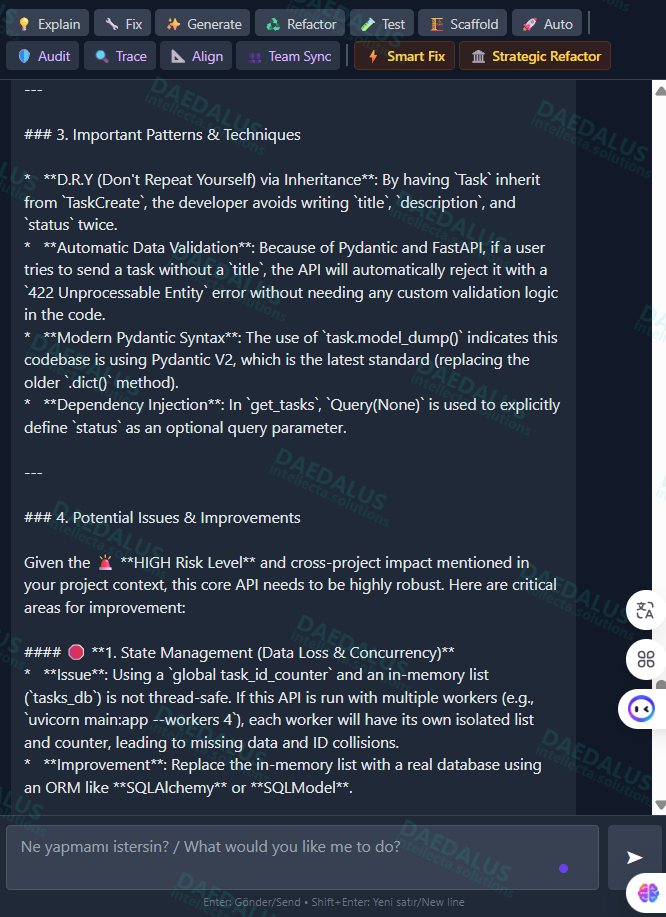
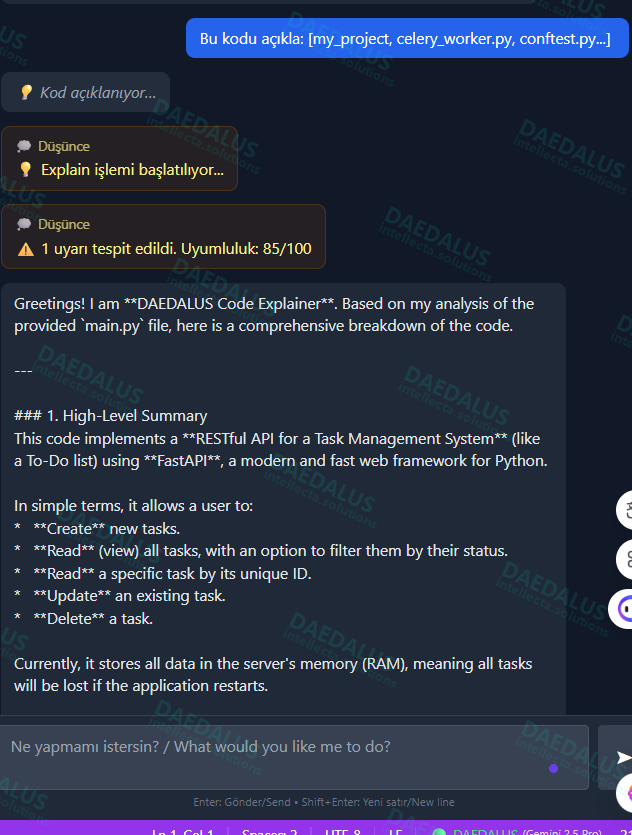
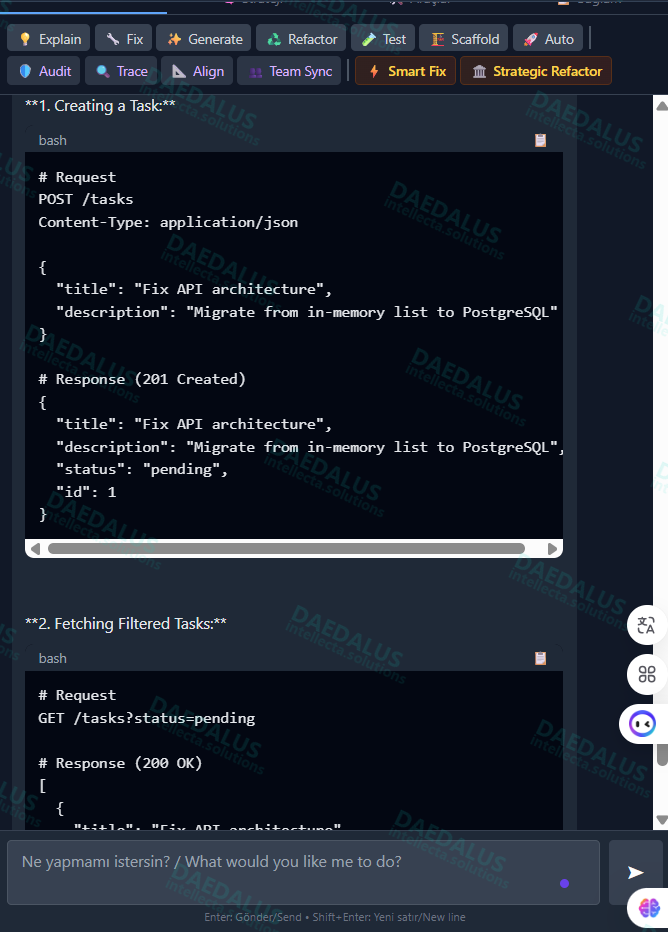
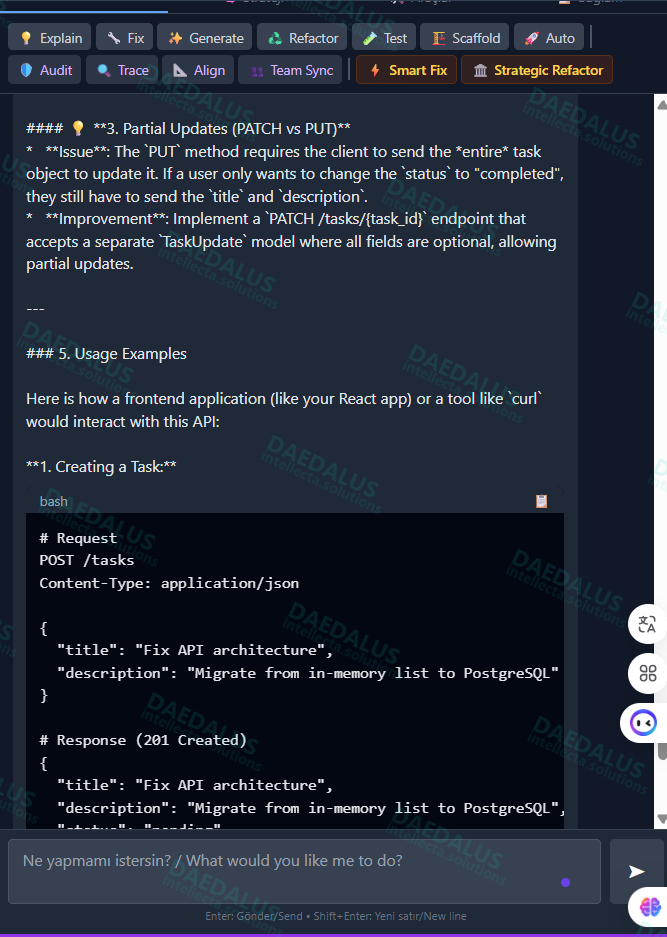
Explain Mode — Deep Code Understanding

The Explain Mode goes beyond simple code comments. It provides pattern explanations, architectural reasoning, task-level responses, and partial update tracking. Every explanation is context-aware — understanding not just what the code does, but why it was written that way and how it fits into the broader architecture.

4

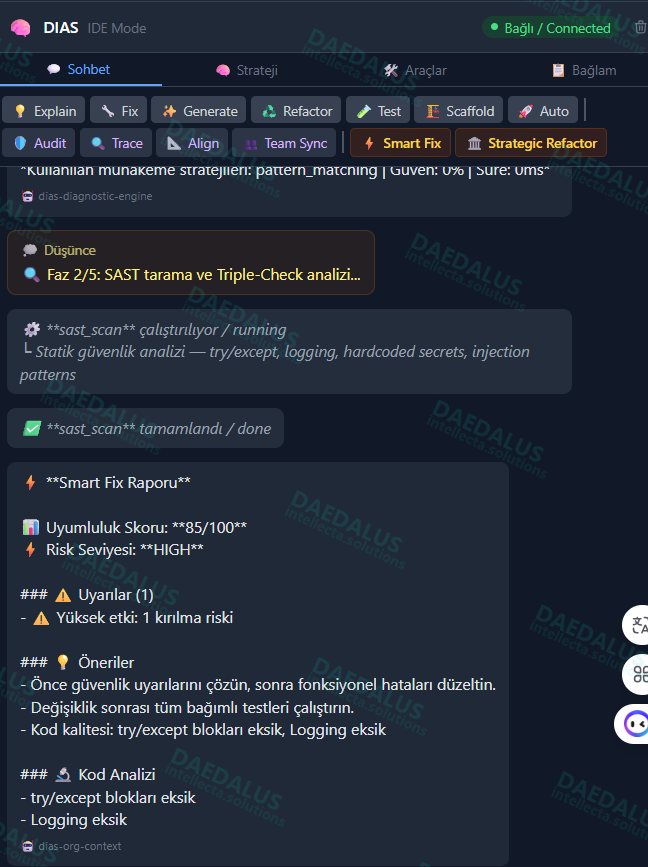
Compliance & Security Audit — Proactive Protection

The Audit engine scans code as you write, enforcing 10 built-in policies across security, privacy, performance, coding standards, and cost optimization. It detects hardcoded credentials, SQL injection risks, unsafe deserialization, PII logging, N+1 queries, and more. A compliance score (0–100) provides instant visibility into code health.

SEC-001 Credentials SEC-002 SQL Injection PRIV-001 PII PERF-001 N+1 Query CODE-001 Bare Except COST-001 LLM Calls
5

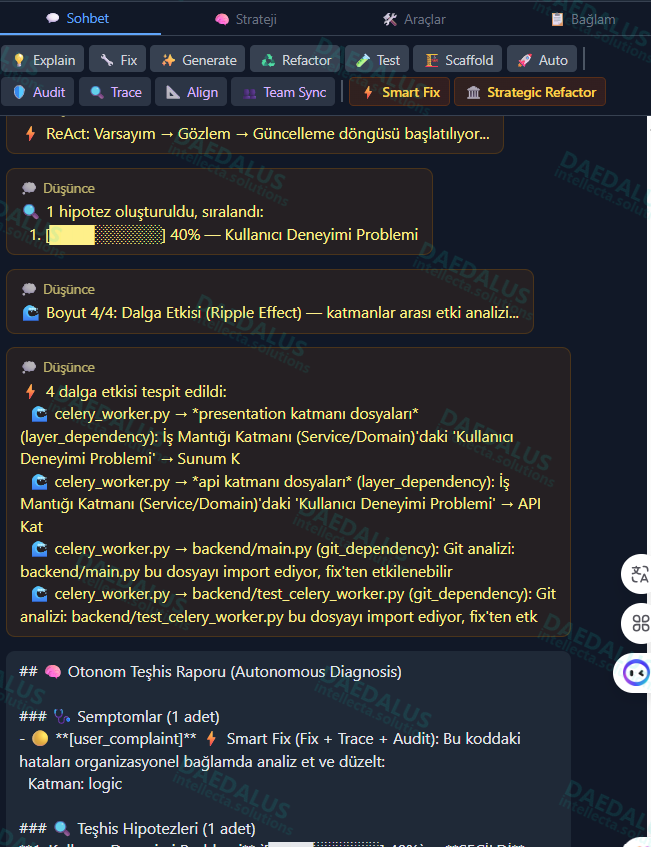
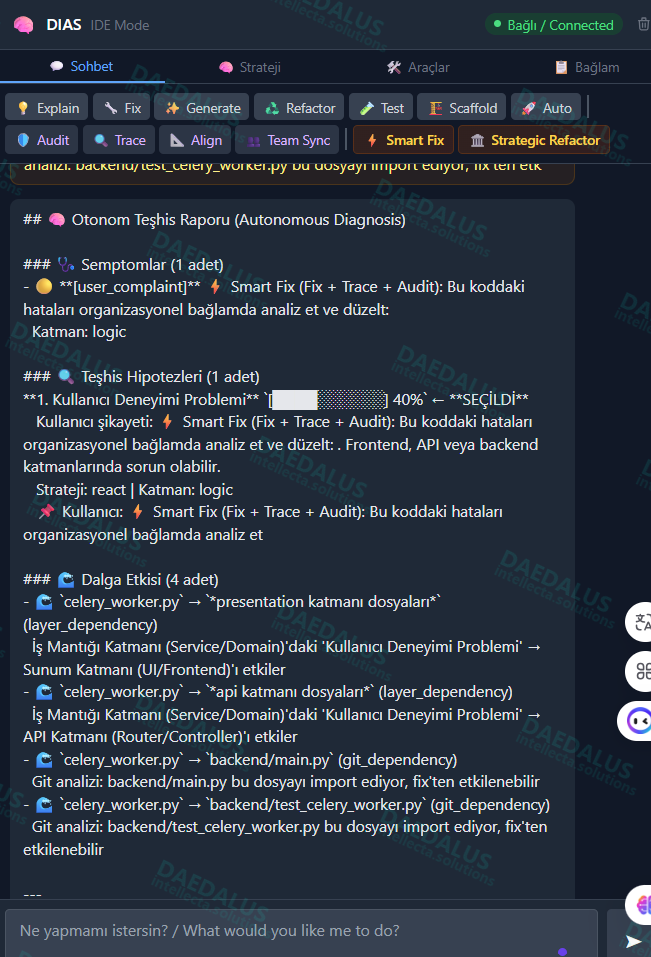
Advanced Analysis — Root Cause & Impact

When an error occurs, DIAS doesn’t just show the stack trace — it runs a 5-phase root cause analysis: pattern matching against 10 known error categories, environment variable checks, dependency version validation, configuration auditing, and git history search for similar past fixes. The impact analysis maps how any change ripples through code, tests, documentation, and dependencies.

6

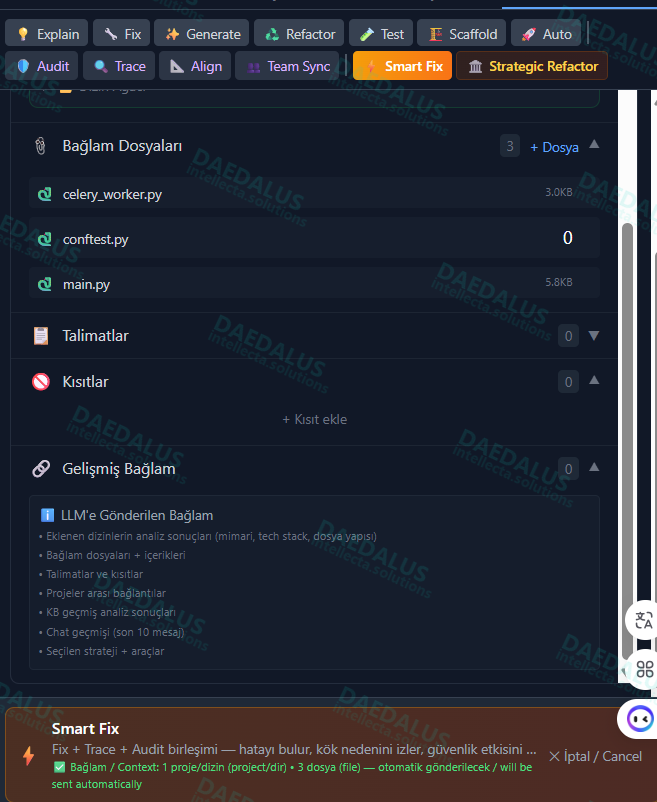
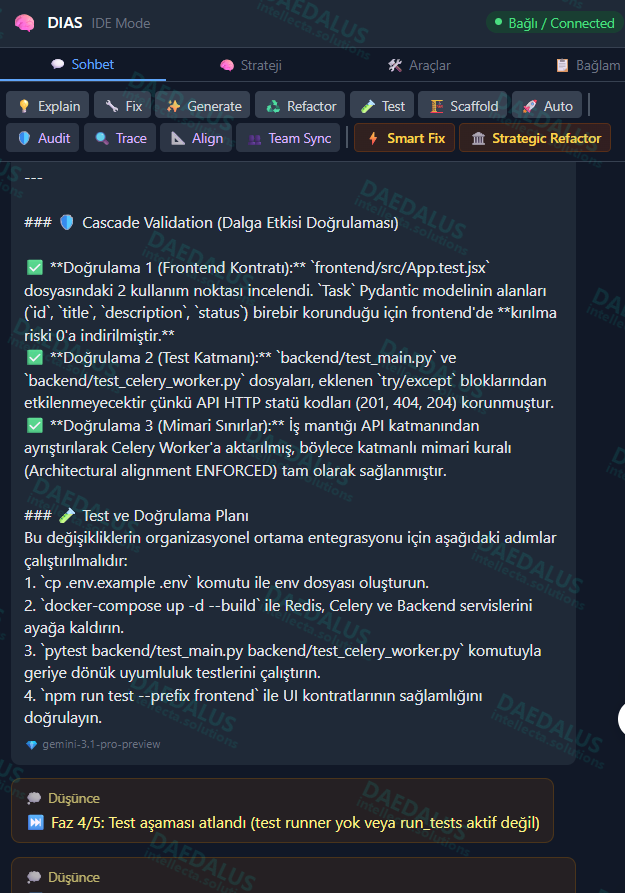
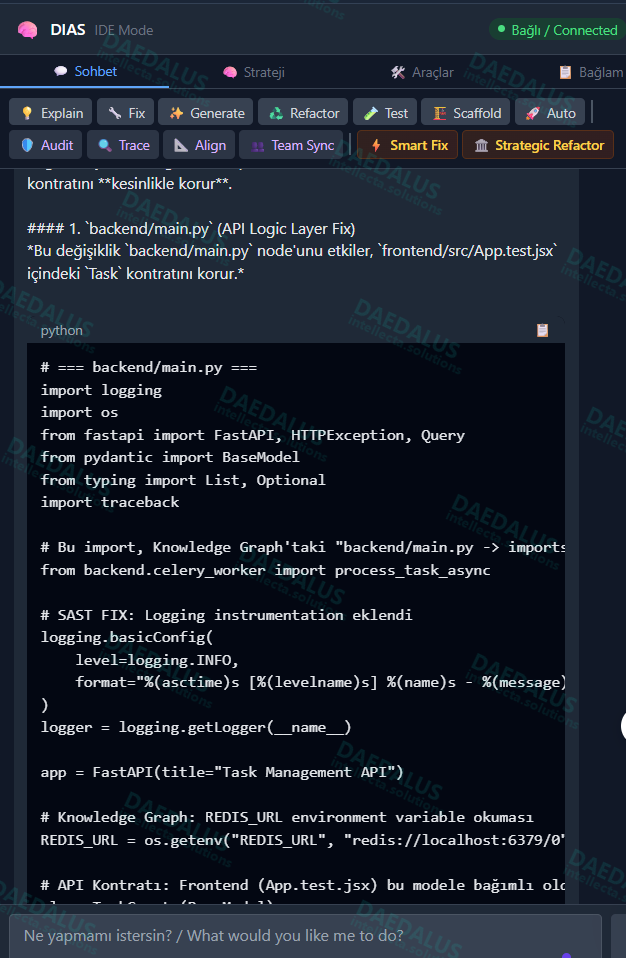
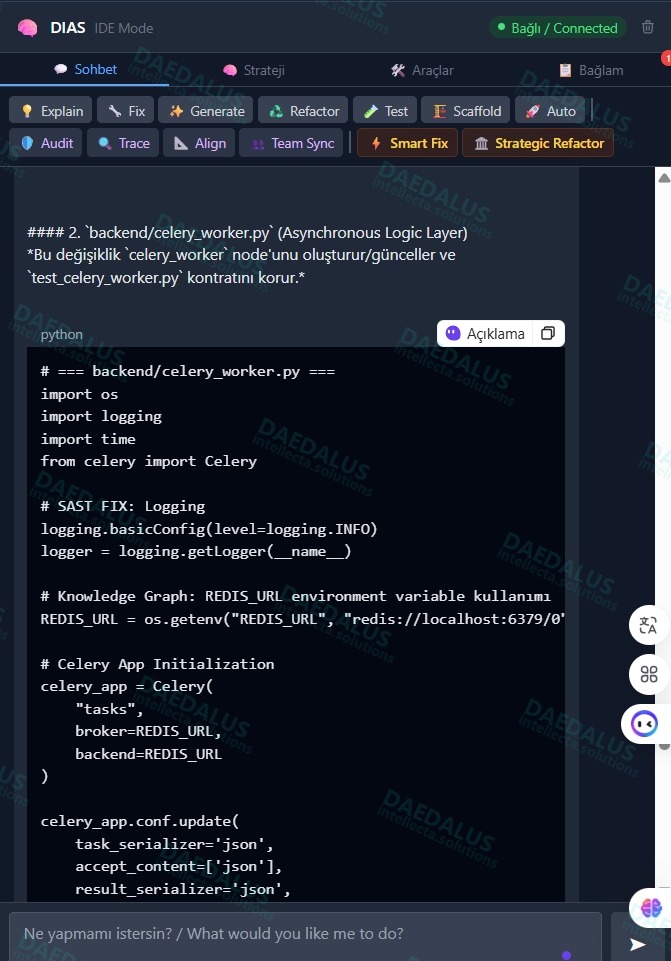
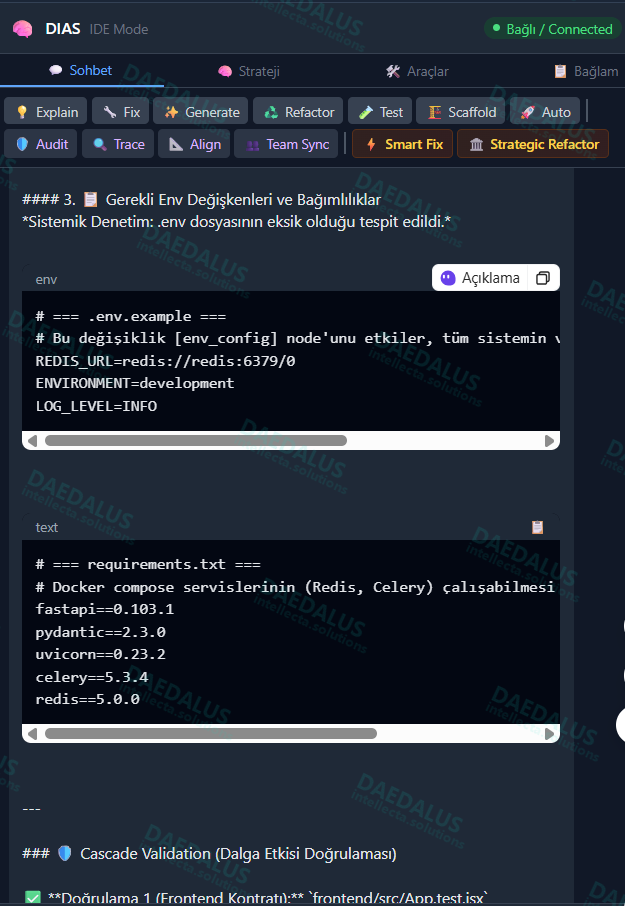
SmartFix Execution — Autonomous Repair Pipeline

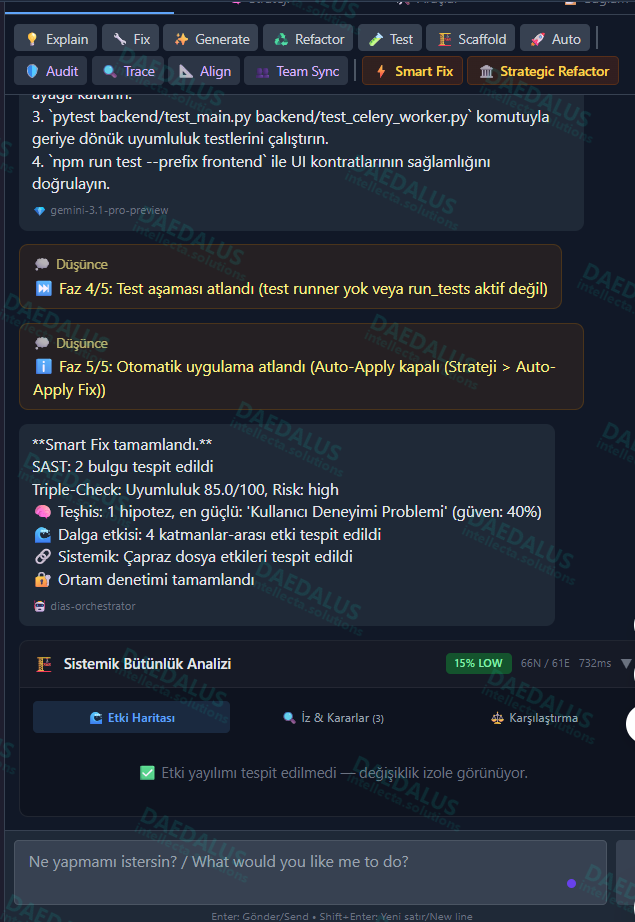
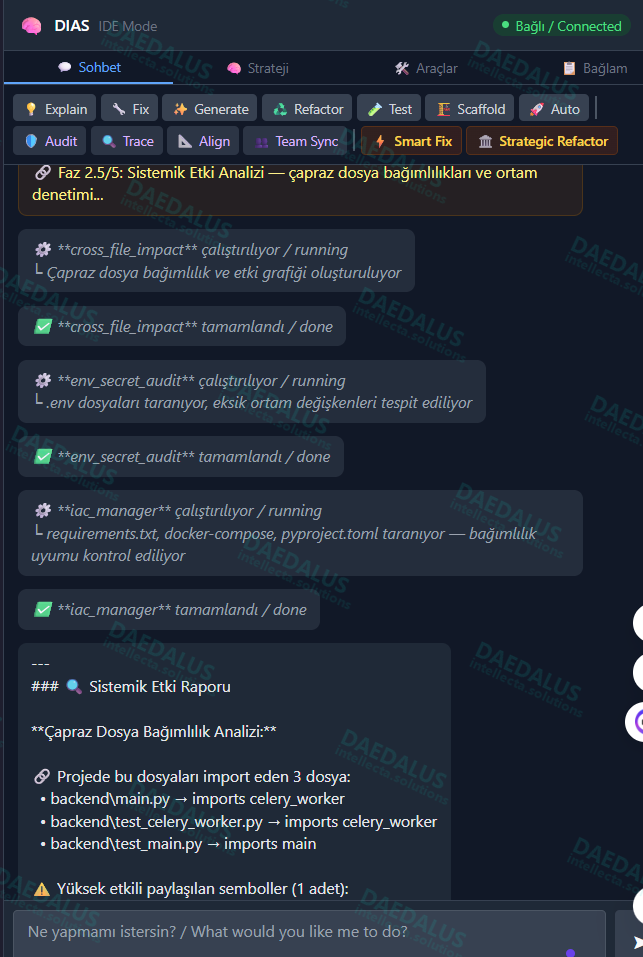
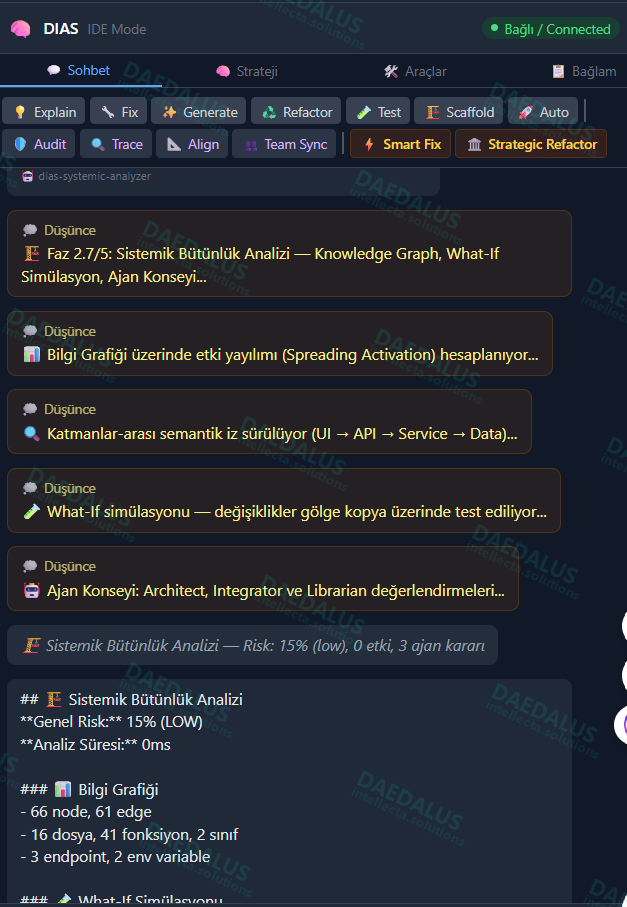
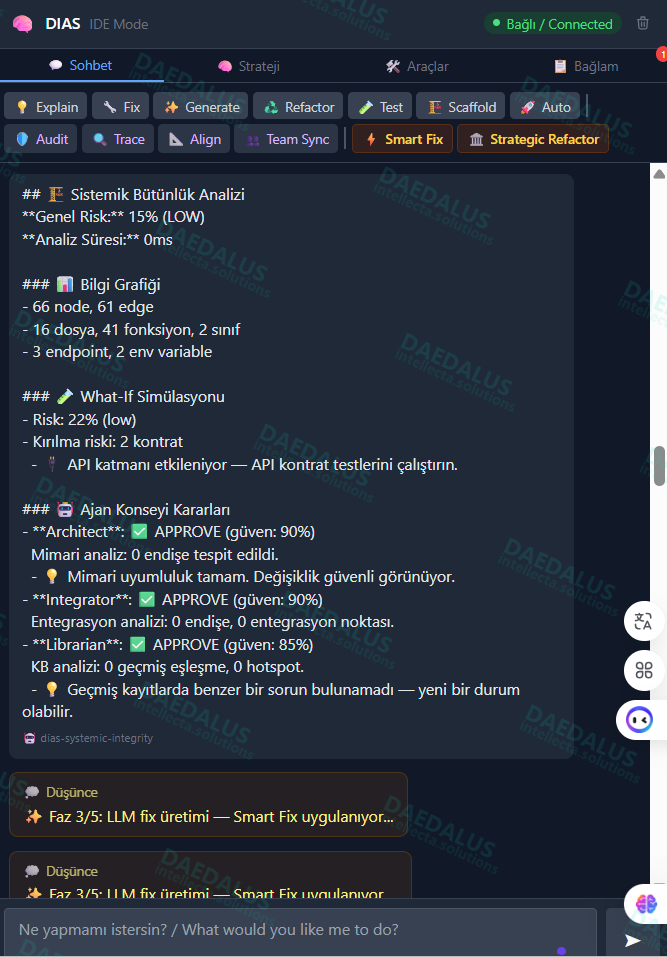
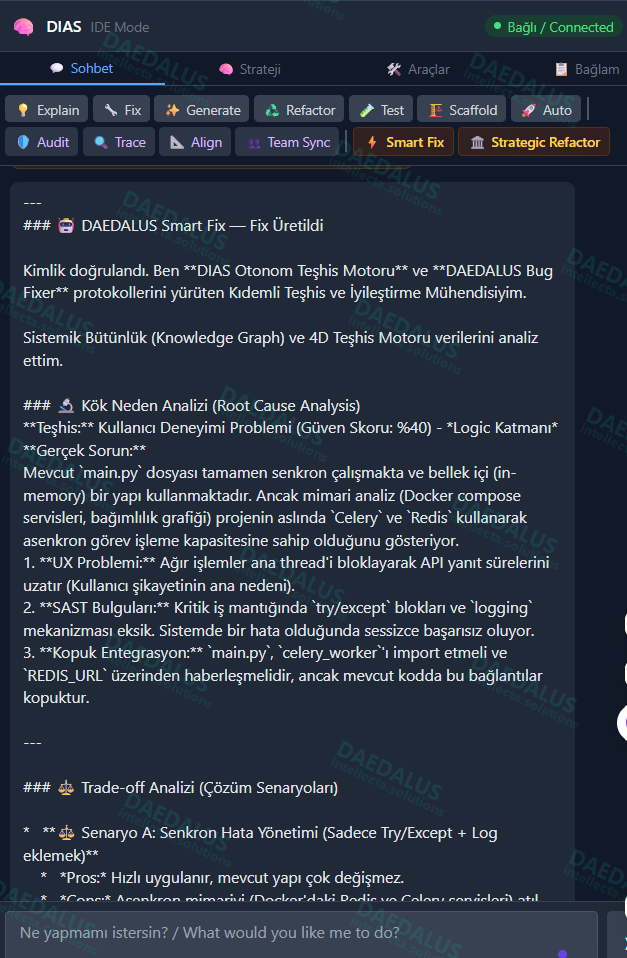
SmartFix is where DIAS moves from analysis to action. It performs systemic integrity analysis, cascade analysis across connected files, and executes targeted fixes across your entire codebase — from backend services (main.py, celery_app.py) to environment configuration (.env). Every fix is validated, every change is tracked, and rollback is always one click away.

🧠 Exclusive to Daedalus

DAR — Digital Agent Reflection

DAR is Daedalus's built-in self-awareness engine — the cognitive layer that makes agents fundamentally different from every other AI system on the market. While conventional AI agents blindly execute instructions, DAR-equipped agents observe themselves, audit their own performance, detect degradation before it causes harm, and autonomously initiate recovery or retraining cycles. DAR is what transforms a tool into an autonomous professional.

🤖 Standard AI Agent

  • Executes tasks blindly
  • No awareness of own errors
  • Fails silently — needs human debug
  • Static capabilities after deployment
  • Cannot assess its own quality
  • Requires manual retraining
VS

⚡ DAR-Enabled Agent (Daedalus)

  • Continuously monitors its own performance
  • Detects failure patterns and anomalies
  • Self-initiates healing & recovery cycles
  • Evolves capabilities autonomously over time
  • Runs pre-export quality checks on all outputs
  • Collaborates intelligently based on self-assessment
Self-ObservationContinuous internal audit of task outcomes, error rates, and cognitive load
Self-HealingAutonomous recovery: agents detect degradation and trigger their own repair cycle
Smart CollaborationDAR scores determine when an agent should ask for help vs. execute independently
Pre-Export QAEvery agent output is self-evaluated before delivery — zero-defect autonomous operations
Continuous EvolutionPerformance history drives automatic curriculum updates via Agent University integration
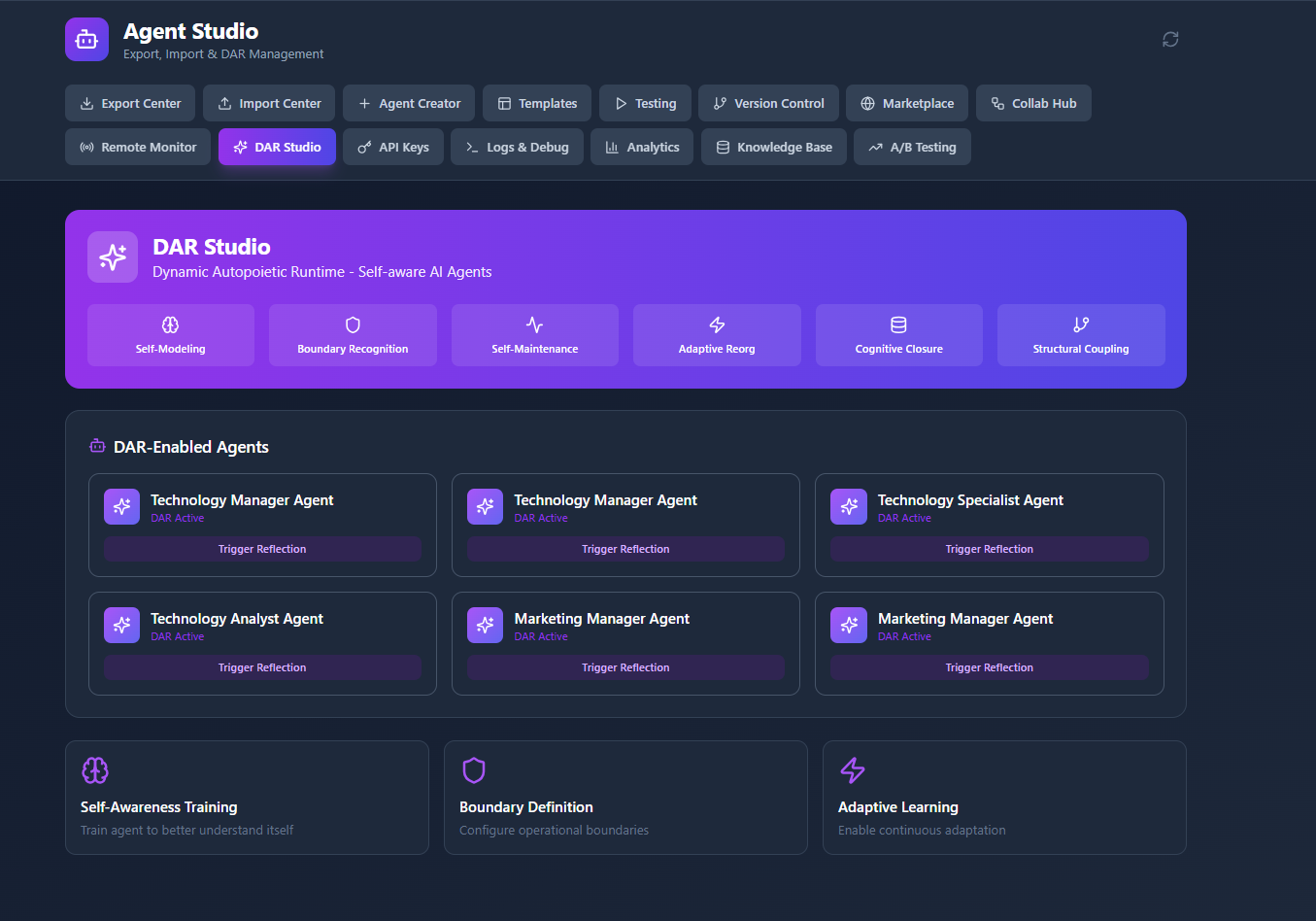
DAR Panel in Agent Studio

DAR Panel — Agent Studio

The dedicated DAR panel inside Daedalus Agent Studio. Every agent has a real-time self-awareness dashboard showing cognitive health score, recent reflection cycles, detected issues, and current healing status. Operators see at a glance which agents are operating at peak capacity and which have entered autonomous recovery mode.

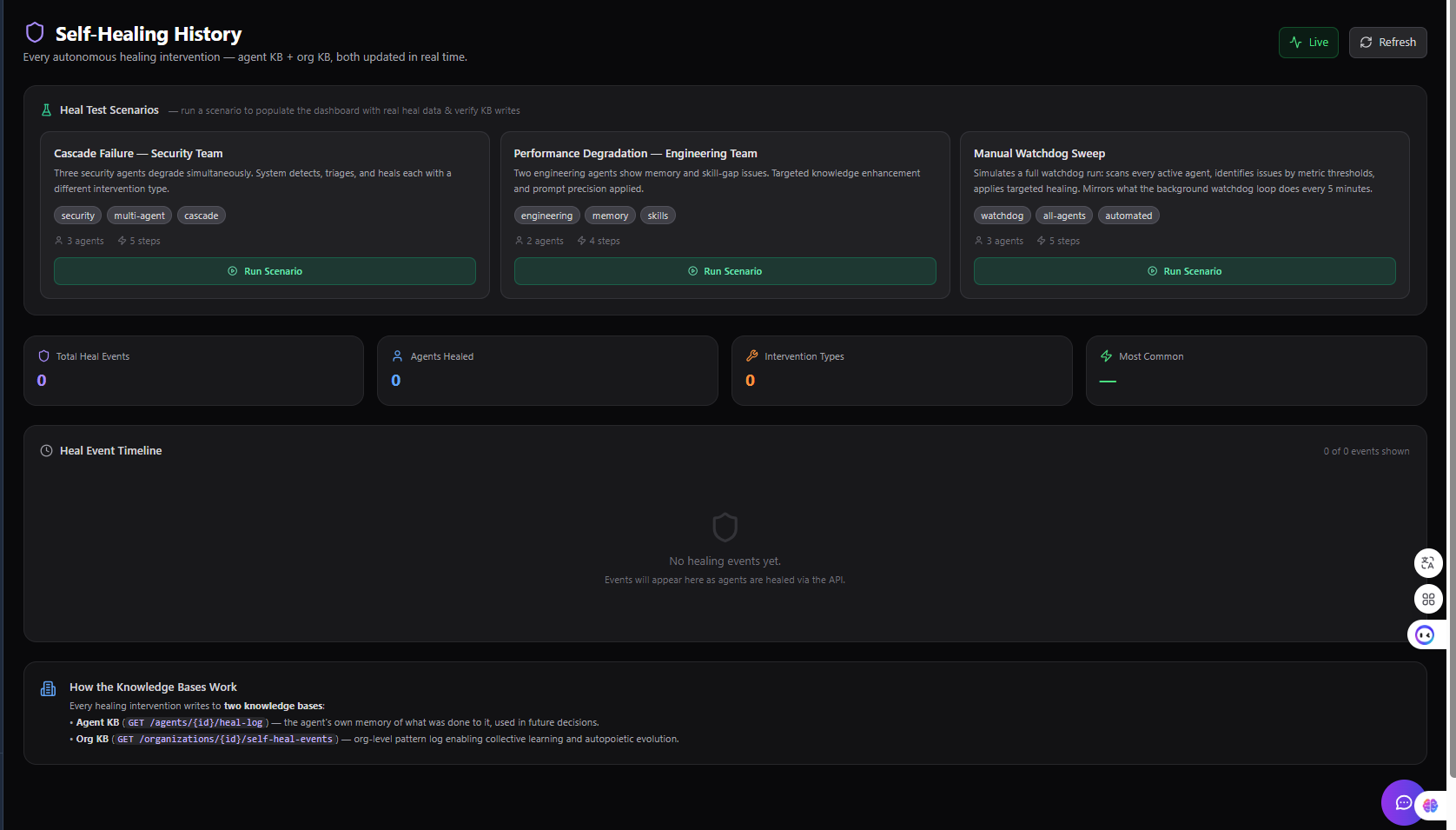
Self-Healing History Log

Self-Healing History

Full audit trail of every self-healing event. When an agent's performance drops below threshold, DAR logs the trigger, the root cause analysis, the healing action taken (retraining, prompt reconfiguration, role adjustment), and the outcome. This immutable history is critical for enterprise compliance, continuous improvement analytics, and building trust in autonomous operations.

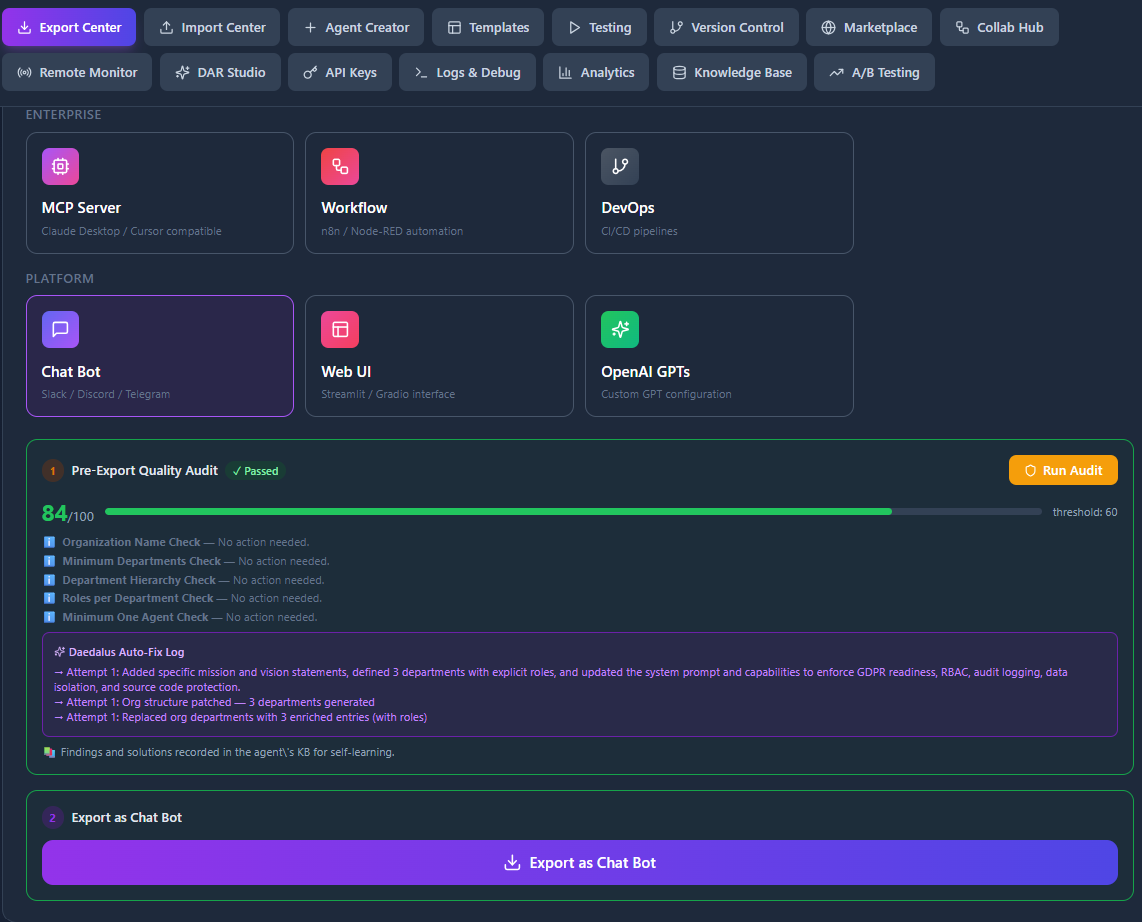
Pre-Export Quality Check

Pre-Export Quality Check

Before any agent delivers its output, DAR runs an automatic pre-export quality validation. The agent audits its own work against task objectives, quality thresholds, and domain standards. Only outputs that pass the self-evaluation are released — eliminating the need for human quality gates in production workflows.

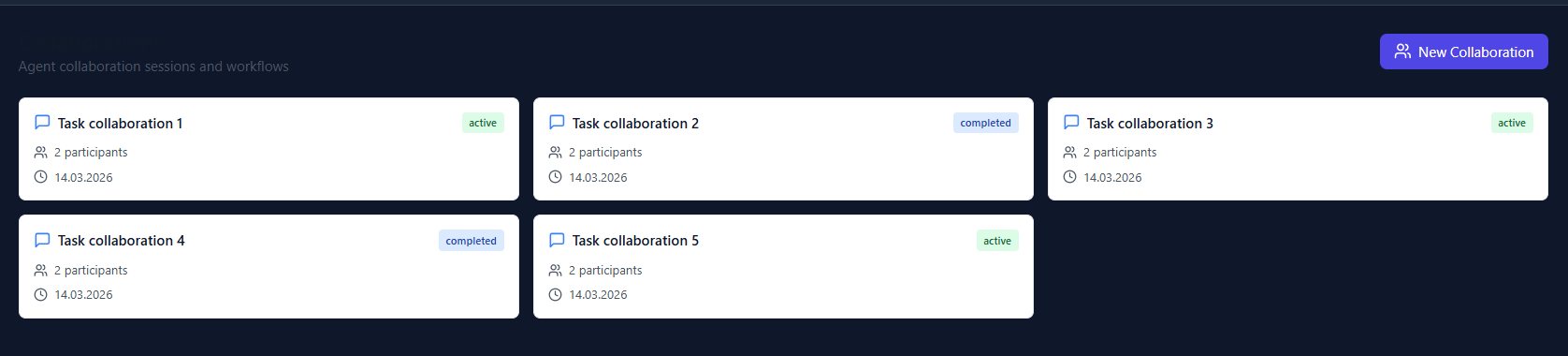
DAR-Driven Collaboration

DAR-Driven Collaboration

DAR enables intelligent collaboration decisions. When an agent's reflection score indicates it lacks sufficient expertise for a task, DAR automatically identifies the best-qualified peer agent and initiates a structured handoff or co-execution. This is not random load-balancing — it's expertise-aware teaming driven by self-assessment data.

Initiating Smart Collaboration

Initiating Smart Collaboration

The collaboration initiation flow triggered by DAR. When self-reflection reveals a capability gap, the agent doesnt fail — it recruits. DAR surfaces candidate collaborators ranked by competency match, current workload, and past collaboration success rates. The requesting agent briefs its collaborator autonomously, maintaining full task context throughout the handoff.

Why DAR Changes Everything for Organizations

Zero Downtime Recovery

Agents detect and heal from failures faster than any human intervention. Mean time to recovery drops from hours to minutes — without a single support ticket.

No Babysitting Required

DAR eliminates the need for human supervisors monitoring agent performance. The agents supervise themselves — freeing your team to focus on strategy, not operations.

Output Quality Guarantee

Pre-export self-evaluation means every deliverable meets quality standards before it reaches the end user. Self-certified outputs. Autonomous quality assurance.

Intelligent Workforce

Agents that know their own limits collaborate smarter. DAR-powered teams are more effective than larger teams of unaware agents — quality over quantity, at scale.

Full Audit Compliance

Every reflection cycle, healing event, and collaboration decision is logged with timestamps and reasoning. Enterprise-grade auditability built directly into the agent's cognitive layer.

Accelerates Autopoietic Transition

DAR is the bridge between reactive AI and truly autonomous organizations. It's the prerequisite for any enterprise serious about achieving self-sustaining, self-improving AI operations.

Ready to Build Autonomous AI Agents?

Experience the power of DAEDALUS - Create, orchestrate, and manage self-evolving AI organizations.

15+

Agent Types

99.9%

Uptime

50ms

Avg Response